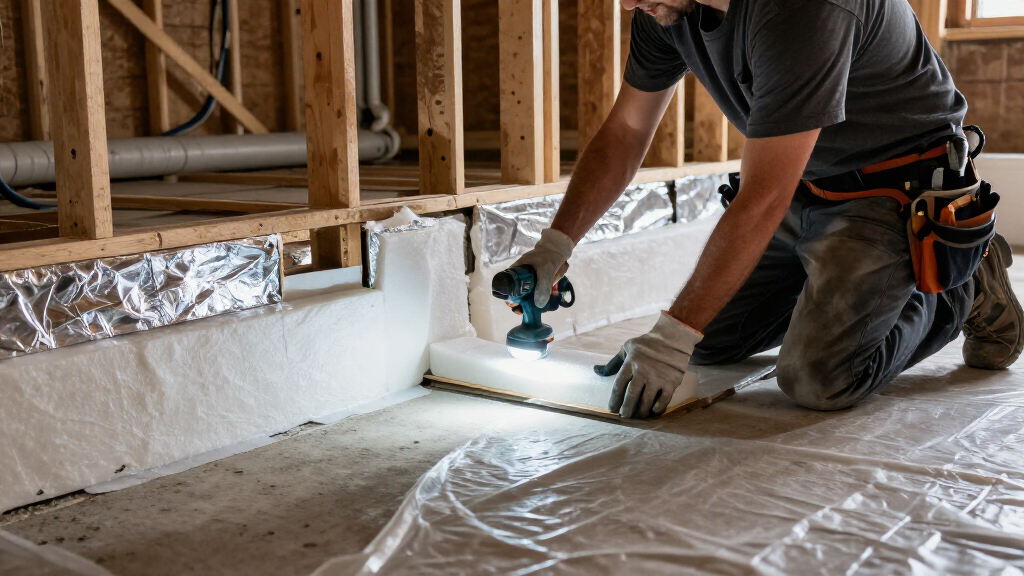

A conditioned crawlspace depends on more than one kind of upgrade: a continuous ground vapor barrier reduces moisture rising from soil, while sealed vents help limit outside air entering through the foundation. For a large encapsulation job, I put the Whitecap 20 Mil Encapsulation Kit first because it bundles the barrier, tapes, and fasteners. The Crawldryer 20 Mil Panda Film suits buyers who want a substantial barrier roll without a full kit, while the Large Outward Mounted Vent Cover is the better fit when the immediate task is closing an exterior vent opening.

Get business pricing on tools and workshop supplies
- Business-only prices and quantity discounts
- Tax-exempt purchasing
- Multiple users, one account, clear invoices
These products do different jobs, so they are not substitutes for one another. The main tradeoff is between coverage and installation completeness on the barrier side and opening fit and sealing method on the vent-cover side. I rank them by how directly they support a conditioned crawlspace upgrade, how much installation work they leave to the buyer, and how clearly their stated dimensions suit a common project. A vent cover cannot replace a ground liner, and a vapor barrier alone does not seal foundation vents.
Complete the kit



Key Takeaways
Whitecap is the most complete barrier purchase in this lineup: its 1,200-square-foot kit includes tape, butyl tape, and fasteners, though installation still takes substantial labor.
Crawldryer offers a barrier roll without accessory bundling; its 20 mil thickness and 10-by-100-foot format suit larger or custom layouts, but buyers need to source fastening and seam materials separately.
The large vent cover has more overlap than the Kensal Home cover, making it the stronger candidate for uneven edges around a standard opening, but its solid design blocks airflow rather than providing ventilation.
Kensal Home is the smaller, simpler vent-cover option for a measured 8-by-16-inch opening; it does not include mounting hardware or insulation.
Match the upgrade to the moisture pathway: use a ground barrier for soil vapor and a sealed vent cover for openings, while confirming local requirements and the rest of the crawlspace design.
| Whitecap Crawl Space Vapor Barrier Encapsulation Kit – 20 Mil Woven Barrier for 1,200 Sq Ft, Vapor Barrier Tape, Butyl Tape & Installation Fasteners Included |  | Best Overall Barrier Kit | Brand: Crawl Space DIY | Model: 20MILKIT | Coverage: 1,200 sq ft | VIEW LATEST PRICE | See Our Full Breakdown |
| Crawl Space Vapor Barrier 20 Mil (10′ x 100′) Black and White Panda Film |  | Best Standalone Heavy-Duty Roll | Brand: Crawldryer | Thickness: 20 mil | Dimensions: 10 ft x 100 ft | VIEW LATEST PRICE | See Our Full Breakdown |
| Large Outward Mounted Crawl Space Vent Cover, 13″ H x 21″ W, Black |  | Best Vent Cover for Added Overlap | Dimensions: 13 in H x 21 in W x 4 in D | Material: ABS plastic | Color: Black | VIEW LATEST PRICE | See Our Full Breakdown |
| Outward Mounted Crawl Space Vent Cover – 10″ H × 18″ W, Solid ABS Plastic, Black |  | Best Compact Vent Cover | Manufacturer: Kensal Home | Model number: FOMVC-B | Product dimensions: 17.5 x 10 x 0.75 in | VIEW LATEST PRICE | See Our Full Breakdown |
| conditioned crawlspace upgrade | Material | Brand | Included accessories | Dimensions |
|---|---|---|---|---|
| Whitecap Crawl Space Vapor Bar | Woven vapor barrier | Crawl Space DIY | Two rolls of vapor-barrier tape, one roll of butyl tape, and 100 fasteners | — |
| Crawl Space Vapor Barrier 20 M | Low-density polyethylene | Crawldryer | No tape or fasteners listed | 10 ft x 100 ft |
| Large Outward Mounted Crawl Sp | ABS plastic | — | — | 13 in H x 21 in W x 4 in D |
| Outward Mounted Crawl Space Ve | ABS plastic | — | — | — |
More Details on Our Top Picks
Whitecap Crawl Space Vapor Barrier Encapsulation Kit – 20 Mil Woven Barrier for 1,200 Sq Ft, Vapor Barrier Tape, Butyl Tape & Installation Fasteners Included
I rank the Whitecap kit first because it addresses a common frustration with crawlspace liners: buying the sheet material is only part of the job. This package includes a 20 mil woven barrier, vapor-barrier tape, butyl tape, and 100 fasteners, giving a DIY installer a more coherent starting set for covering the ground and joining sections. Compared with the Crawldryer roll, it asks less of the buyer in sourcing basic seam and fastening supplies.
The stated 1,200-square-foot coverage gives a useful project boundary, but buyers should measure the crawlspace and account for overlaps, wall coverage, obstructions, and cuts rather than treating the area figure as a guaranteed finished footprint. Larger or irregular spaces may need more than one kit. Its woven construction and 20 mil thickness are positioned for tear and puncture resistance, though careful handling and a well-prepared surface still matter.
This is the strongest pick for someone trying to assemble a barrier installation from one purchase, not a shortcut around the labor. Encapsulation work can involve moving around confined spaces, trimming around supports, fastening edges, and sealing seams. The Crawldryer roll may be preferable if a contractor already has compatible tapes and fasteners or wants to choose each component independently. I would skip Whitecap if the project is very small, if the included coverage does not match the layout, or if the installer expects a fast, low-effort task. The listed lifetime warranty is a useful product detail, but it does not remove the need to check installation conditions and warranty terms.
Pros:- Includes barrier, vapor-barrier tape, butyl tape, and 100 fasteners.
- 20 mil woven material is specified for stronger tear and puncture resistance.
- Stated coverage is 1,200 square feet, which helps with project planning.
- Lifetime warranty is listed for buyers seeking long-term product coverage.
Cons:- Larger crawlspaces may require multiple kits, especially after overlap and wall coverage are included.
- Installation is still labor-intensive and may be difficult for an inexperienced installer.
- The package does not remove the need to prepare surfaces and seal edges and penetrations carefully.
Best for: DIY homeowners or contractors who want a 20 mil ground barrier plus common seam and fastening materials in one package for a crawlspace up to the stated coverage area.
Not ideal for: Buyers with a small patch job, a crawlspace larger than the kit coverage, or little time for labor-intensive measuring, trimming, and sealing.
- Brand:Crawl Space DIY
- Model:20MILKIT
- Coverage:1,200 sq ft
- Barrier thickness:20 mil
- Material:Woven vapor barrier
- Barrier roll:12 x 100 ft
- Included accessories:Two rolls of vapor-barrier tape, one roll of butyl tape, and 100 fasteners
- Warranty:Lifetime warranty listed
Our verdict“I would choose Whitecap when I want the most complete barrier package here and can match its coverage to a labor-intensive installation.”
Crawl Space Vapor Barrier 20 Mil (10′ x 100′) Black and White Panda Film
The Crawldryer roll is my choice for buyers who want a substantial sheet of barrier material but do not need the bundled accessories in Whitecap’s kit. Its 20 mil LDPE film and 10-by-100-foot format provide a long run of material that can suit larger layouts or a contractor’s planned cut pattern. Against Whitecap, its main strength is flexibility: you are not paying for a preset kit structure in the product description, and you can source tape, fasteners, and other materials to match the site.
That flexibility also creates extra work. The listing describes a barrier roll, not a complete seam-sealing package, so the buyer must plan how to join sheets, secure edges, and manage penetrations. Whitecap is easier to spec as a single barrier set because its tapes and fasteners are included. The Crawldryer film may be the better fit when those supplies are already on hand, but it is less convenient for a first-time installer trying to assemble an entire encapsulation system from scratch.
The roll’s 10-foot width and 100-foot length are useful for broad coverage, yet they can be awkward to maneuver in a tight crawlspace or for a small repair. A buyer should check access, layout, and required overlap before ordering. The supplied product details describe a black-and-white panda film in the title while listing white as the color, so I would verify the actual surface appearance if color orientation matters to the installation. This is a material-first option, not a replacement for drainage work or vent sealing. Choose it for the ground barrier component; pair it with the appropriate sealing and moisture-control measures for the site.
Pros:- 20 mil LDPE film is specified for heavy-duty moisture protection.
- 10-by-100-foot roll provides substantial continuous material for larger layouts.
- Waterproof and odor-free properties are stated in the product description.
- Roll packaging provides a straightforward format for transport and cutting to fit.
Cons:- Tape, butyl tape, and installation fasteners are not listed as included.
- The large roll can be cumbersome in small or restricted crawlspaces.
- Title and color specification differ on the black-and-white surface description, so buyers may want to confirm appearance.
Best for: A contractor or experienced DIY installer who wants a thick, wide barrier roll and prefers to select tape and fastening materials separately.
Not ideal for: First-time installers seeking an all-in-one kit, buyers working in a confined crawlspace with limited room to handle a 100-foot roll, or those needing only a small patch.
- Brand:Crawldryer
- Thickness:20 mil
- Dimensions:10 ft x 100 ft
- Material:Low-density polyethylene
- Listed color:White
- Pack count:1 roll
- Intended use:Crawlspace encapsulation and moisture barrier
- Included accessories:No tape or fasteners listed
Our verdict“I would pick Crawldryer over Whitecap when I want a heavy-duty barrier roll and already have a plan for seams, edges, and fastening.”
Large Outward Mounted Crawl Space Vent Cover, 13″ H x 21″ W, Black
When the job is closing a foundation vent as part of a conditioned-crawlspace plan, this larger cover is the more forgiving of the two vent options. It measures 13 by 21 inches and mounts outside a stated 8-by-16-inch opening, giving more perimeter overlap than the Kensal Home cover. That added size can help cover uneven edges around a standard opening, though it does not make every off-size opening a guaranteed fit.
The solid, UV-stabilized ABS construction is designed for exterior exposure and is described as blocking airflow, moisture, and humidity. That makes the product more aligned with a vent-sealing task than a vent that is meant to remain open. Its outward mounting also means installation can be done from outside, avoiding entry into the crawlspace for this particular task. Compared with Kensal Home, I favor this option where overlap is the priority; Kensal is the more compact choice for a measured opening and a cleaner, less oversized appearance.
There are two important limits. First, a solid cover does not provide ventilation; closing vents should fit the overall crawlspace design and local requirements, not be treated as an isolated fix. Second, no mounting hardware is included, so the buyer needs to choose suitable construction adhesive or Tapcon screws for the foundation and conditions. The product may help block outside air at the vent, but it does not add insulation or replace a ground vapor barrier. I would select it as one component of an intentional air-sealing plan and skip it if the opening is not compatible or the project requires an operable vent.
Pros:- Larger 13-by-21-inch face provides more overlap than the Kensal Home cover.
- Exterior surface mounting avoids the need to enter the crawlspace for installation.
- ABS plastic is described as rust-free and UV-stabilized for outdoor exposure.
- Solid design is intended to block airflow, moisture, and humidity at the vent.
Cons:- Solid construction provides no ventilation capability.
- Adhesive or Tapcon screws are required and are not included.
- No built-in insulation is specified.
Best for: A buyer sealing a standard 8-by-16-inch foundation vent who wants a larger exterior cover with extra overlap around the opening.
Not ideal for: Anyone who needs airflow through the opening, a built-in insulated cover, included mounting hardware, or a cover sized to an unusual vent without field verification.
- Dimensions:13 in H x 21 in W x 4 in D
- Material:ABS plastic
- Color:Black
- Weight:12.8 ounces
- Installation:Exterior surface-mount
- Fits opening:8 in H x 16 in W
- Weather feature:UV-stabilized, rust-free construction described
- Mounting materials:Construction adhesive or Tapcon screws required; not included
Our verdict“I would choose this cover over Kensal Home when a standard opening needs more exterior overlap and the crawlspace plan calls for a solid seal.”
Outward Mounted Crawl Space Vent Cover – 10″ H × 18″ W, Solid ABS Plastic, Black
The Kensal Home cover is the more compact vent option in this roundup, sized at 17.5 by 10 inches to surface-mount over a standard 8-by-16-inch crawlspace opening. It earns a distinct place because a buyer with a correctly measured opening may not need the larger 13-by-21-inch cover from Crawl Space Door Systems. The smaller profile can suit a straightforward replacement or encapsulation project where modest overlap is enough and the surrounding finish matters.
Its solid ABS plastic body resists rust and rot, and the paintable finish gives buyers some flexibility to match nearby surfaces. The outward installation method can keep the work on the exterior side of the foundation. Those qualities put it in the same general role as the larger cover, but not the same fit preference: the larger model offers more coverage around uneven edges, while Kensal is better aligned with a standard opening and a less oversized cover.
The product description is clear about what it does not provide: there is no built-in insulation, and mounting screws or adhesive are not included. A cover that blocks the vent is not the same as insulating the foundation wall, so buyers should plan those upgrades separately if their design calls for them. It is also only specified for standard 8-by-16-inch openings; measure the opening and the available mounting surface rather than relying on nominal dimensions alone. I would skip this model when edges are rough or irregular enough to need more overlap, or when the crawlspace design requires ventilation through the opening.
Pros:- Compact outward-mounted format is specified for standard 8-by-16-inch openings.
- ABS plastic resists rust and rot.
- Paintable finish can be matched to the surrounding exterior.
- Surface mounting can be completed without entering the crawlspace.
Cons:- Screws or adhesive are not included.
- No built-in insulation is specified.
- Fits only the stated standard opening, with less overlap than the larger cover.
Best for: A homeowner with a verified standard 8-by-16-inch opening who wants a paintable, outward-mounted cover without the larger footprint of the other vent option.
Not ideal for: Buyers with rough or oversized openings needing extra overlap, those who need ventilation or insulation in the cover, or anyone expecting mounting hardware in the package.
- Manufacturer:Kensal Home
- Model number:FOMVC-B
- Product dimensions:17.5 x 10 x 0.75 in
- Material:ABS plastic
- Color:Black
- Weight:14 ounces
- Mounting:Outward surface mount using screws or adhesive
- Opening fit:Standard 8 x 16 in crawlspace opening
Our verdict“I would choose Kensal Home for a measured standard opening where a compact, paintable cover is enough, and choose the larger model when extra overlap matters.”

How We Picked
I ranked these four options around the practical needs of a conditioned crawlspace, rather than treating them as interchangeable accessories. A ground vapor barrier and an exterior vent cover address different routes for moisture and air. I gave the highest placement to the product that offers the clearest path to a continuous ground-cover installation, then distinguished the remaining products by included materials, stated dimensions, and how much project planning they leave to the buyer.
For the barriers, I compared the stated 20 mil thickness, material description, roll or kit coverage, and installation components. A thick barrier can be useful where durability matters, but thickness alone does not establish that seams, edges, penetrations, and wall connections will be sealed. I therefore favored the Whitecap kit for its included tapes and fasteners, while noting its stated coverage limit and hands-on installation demands. The Crawldryer roll ranks as a flexible material choice, not a complete encapsulation package.
For vent covers, I looked at opening compatibility, overlap, material, and mounting needs. Both covers are outward-mounted over standard 8-by-16-inch openings and use solid ABS plastic. The larger cover gets the edge for overlap and weather exposure; the Kensal Home option earns its place as a more compact fit for buyers whose opening matches its stated size. Neither product includes built-in insulation, and both require the buyer to plan for mounting materials.
I used the supplied product details and did not assume performance claims beyond them. Actual conditioned-crawlspace results depend on site conditions, drainage, air sealing, insulation, and installation quality. I also treated local building requirements as a project-specific check, particularly before blocking vents. These rankings are intended to help identify the right component and tradeoff, not to replace a complete moisture-control plan.
| conditioned crawlspace upgrade | Brand | Material | Included accessories |
|---|---|---|---|
| Whitecap Crawl Space Vapor Bar | Crawl Space DIY | Woven vapor barrier | Two rolls of vapor-barrier tape, one roll of butyl tape, and 100 fasteners |
| Crawl Space Vapor Barrier 20 M | Crawldryer | Low-density polyethylene | No tape or fasteners listed |
| Large Outward Mounted Crawl Sp | — | ABS plastic | — |
| Outward Mounted Crawl Space Ve | — | ABS plastic | — |
Factors to Consider When Choosing Best Conditioned Crawlspace Upgrades
I would start by identifying which part of the crawlspace needs attention. A ground liner manages moisture moving from the soil; a vent cover closes a foundation opening. Choosing the right product category comes before comparing thickness, footprint, or mounting style.
Choose the upgrade that matches the moisture path
A vapor barrier is intended to cover exposed soil, with seams and edges handled as part of the installation. It is not the same thing as a vent cover, and neither product by itself solves every moisture problem. If the concern is damp soil or ground vapor, the barrier products are the relevant choices. If the concern is outside air entering through an open foundation vent, compare the two vent covers. A conditioned crawlspace plan may use both categories, but that does not make them interchangeable.
I would also look beyond the product being purchased. Persistent water, poor drainage, plumbing leaks, or standing water need their own attention. Covering soil or closing an opening does not correct those sources. The products in this roundup are components for a moisture-control and air-sealing approach, not a diagnosis or complete system.
Decide between a bundled kit and a standalone roll
The Whitecap kit is easier to plan as a single barrier purchase because it includes the woven liner, vapor-barrier tape, butyl tape, and fasteners. That reduces the number of separate materials a first-time buyer has to source. Its stated 1,200-square-foot coverage gives a starting point for project planning, but I would measure the actual floor area and include overlaps, upturned edges, supports, and cuts before deciding how many kits are needed.
Crawldryer provides a 10-by-100-foot roll of 20 mil film without the listed accessory bundle. That is a sensible fit when an installer already has suitable tape and fasteners, wants to tailor materials to the site, or needs a particular sheet format. For a buyer assembling an installation from scratch, Whitecap is more convenient; for a buyer who values component choice, Crawldryer leaves more room to customize. Neither package should be judged on thickness alone: seams and perimeter details affect how continuous the barrier is.
Measure vent openings and mounting surface
Both vent covers are intended for standard 8-by-16-inch openings, but their exterior dimensions differ. Kensal Home measures about 17.5 by 10 inches, while the larger cover measures 13 by 21 inches. The larger face offers more overlap around the stated opening and may be more forgiving where the edge is uneven. The Kensal cover is more compact for an opening with a clean, compatible mounting area. I would measure both the opening and the flat surface around it before ordering.
Check the mounting method against the foundation material and the exterior conditions. Neither cover includes the adhesive or screws described for installation. The buyer must choose suitable hardware, prepare the surface, and follow the product directions. A loose or poorly seated cover can undermine the goal of limiting air and moisture at the opening.
Treat vent sealing as part of a broader design
Both covers are solid, so they block airflow rather than provide ventilation. That feature may fit a conditioned crawlspace design, but it should not be chosen without checking the intended building approach and local requirements. If a project calls for an operable or ventilating opening, neither cover fits that need. A solid cover also does not add insulation: Kensal explicitly has no built-in insulation, and none is specified for the larger cover.
I would plan insulation and air sealing as separate decisions. Closing a vent is not the same as insulating the foundation wall, and a ground barrier is not the same as sealing every air leak. Buyers may need additional materials or professional guidance based on the house, climate, and crawlspace condition.
Plan for handling, coverage, and installation labor
Large barrier rolls reduce the need for many small pieces but can be awkward in a confined area. The Crawldryer 10-by-100-foot roll is especially worth checking against crawlspace access and the available room to unroll and cut the film. Whitecap includes more installation materials, yet laying a barrier, working around supports, fastening edges, and sealing seams still takes time and attention. A kit is not a labor-free installation.
For vent covers, the work is smaller in scale but still depends on measurements and a secure mount. Outward mounting can avoid entry into the crawlspace for the vent-cover task, although it does not make the rest of an encapsulation project unnecessary. I would select products that fit the actual access conditions and the installer’s experience, and bring in a qualified contractor when the site or the full design is beyond a straightforward DIY job.
Frequently Asked Questions
Which product is the best starting point for a conditioned crawlspace upgrade?
For a ground vapor barrier, I would start with the Whitecap kit if its stated 1,200-square-foot coverage suits the measured project, because it includes barrier tape, butyl tape, and fasteners along with the 20 mil woven barrier. It is not a complete crawlspace system, and it still requires careful installation. If the project is specifically about sealing a foundation vent, choose between the two outward-mounted covers instead; neither vent cover replaces a ground liner.
Are the Whitecap kit and Crawldryer roll interchangeable?
They share a 20 mil thickness specification and are both intended for crawlspace moisture-barrier use, but they are not equally complete purchases. Whitecap includes a woven barrier, two rolls of vapor-barrier tape, butyl tape, and fasteners, with stated coverage of 1,200 square feet. Crawldryer is a 10-by-100-foot LDPE roll with no tape or fasteners listed. I would choose based on the material format, project measurements, and whether installation accessories are already available.
Which vent cover should I choose for an 8-by-16-inch opening?
Both vent covers are described for standard 8-by-16-inch openings. I would favor the larger 13-by-21-inch cover when extra overlap around uneven edges is useful, while the Kensal Home cover is a more compact choice for a measured opening with a suitable mounting surface. Confirm the opening and surrounding flat area before ordering. Both designs are solid, so neither is appropriate when the opening needs to remain ventilated.
Do these vent covers insulate the foundation?
No built-in insulation is specified for either cover, and the Kensal Home listing explicitly says it requires a separate insulation upgrade. Their primary role is to cover a vent opening. Buyers who need foundation insulation should plan it separately and treat it as part of the overall crawlspace design rather than assuming a solid plastic cover provides an insulated assembly.
Can I install these products without professional help?
The listings describe the barrier products as suitable for DIY installation, but a full liner job can be labor-intensive, especially when the crawlspace has tight access, many supports, or a complex perimeter. The vent covers use exterior surface mounting, but suitable screws or adhesive are not included and must be selected for the site. I would check local requirements, product directions, and crawlspace conditions before deciding whether to handle the work independently or bring in a professional.
Conclusion
My recommendation depends on the job. For a barrier installation where included materials matter, I would choose the Whitecap kit, provided its stated coverage fits after allowing for overlaps and wall edges. For an experienced installer who wants a substantial roll and already has a seam-sealing plan, Crawldryer is the more flexible material-only option. Neither is the right choice if the immediate issue is a foundation vent opening.
For vent sealing, I would pick the Large Outward Mounted Cover when added overlap is useful around a standard opening, and Kensal Home when a more compact cover fits a clean, measured opening. Both block airflow, neither includes built-in insulation, and neither comes with mounting hardware. Before buying, I would confirm the measurements and check that a solid vent cover fits the full crawlspace plan and local requirements. A good conditioned-crawlspace upgrade starts with matching each product to its specific job.