
The best roof ventilation products depend on the airflow problem you need to solve: my best overall pick is the Quarrix 58785 Shingle Ridge Vent for adding continuous exhaust along a compatible roof ridge. For powered ventilation, the Master Flow ERV6BL offers higher listed airflow, while the Remington Solar 30-Watt fan suits buyers who want a solar-powered option. The main tradeoffs are passive versus powered airflow, roof compatibility, installation complexity, and the need to balance exhaust with adequate intake. A fan or vent alone cannot fix an attic with poor intake or an unsuitable vent layout. Read on for the full breakdown, selection criteria, and guidance on matching a product to your roof.

Get business pricing on tools and workshop supplies
- Business-only prices and quantity discounts
- Tax-exempt purchasing
- Multiple users, one account, clear invoices
Complete the kit



Key Takeaways
- Continuous ridge ventilation and powered fans solve different problems: Quarrix’s ridge vent provides passive exhaust along a roof ridge, while the Master Flow ERV6BL is a powered option with a listed 1500 CFM capacity.
- Listed airflow is not a complete performance comparison: Fan capacity, roof layout, intake vents, and installation conditions all affect how well a ventilation system works in practice.
- Small 4-inch vent caps are not substitutes for whole-attic exhaust: The steel, Hon&Guan, and JYINCPED options are better matched to compatible ducts or localized venting needs.
- Turbine options vary in size and intended fit: The 110 mm and 7.9-inch models are compact choices, while the 14-inch L.L. Building Products turbine has a larger form factor; the roof opening and roof covering still need to match.
- Intake and installation details can decide the result: ADO Durovent rafter vents help preserve airflow at the eaves, and products such as ridge vents or powered fans still need a sound intake-and-exhaust plan.
| 4-Inch Steel Roof Vent Cap with Backdraft Damper |  | Best for Cleanable Duct Exhaust | Duct diameter: 4 inches | Material: Steel | Finish: Black powder-coated | VIEW LATEST PRICE | See Our Full Breakdown |
| Roof Ridge Vent Mesh Roll with Activated Carbon Filter, 19.7 ft x 9.8 in |  | Best for Custom Ridge-Vent Filtering | Length: 19.7 feet | Width: 9.8 inches | Weight: 1.7 pounds | VIEW LATEST PRICE | See Our Full Breakdown |
| Hon&Guan 4-Inch Galvanized Steel Roof Vent Cap with Backdraft Damper, Black |  | Best for 4-Inch Duct Versatility | Duct size: 4 inches | Material: Galvanized steel | Color: Black | VIEW LATEST PRICE | See Our Full Breakdown |
| Quarrix 58785 Shingle Ridge Vent, 9 in x 20 ft, Black |  | Best for Continuous Ridge Ventilation | Size: 9 inches x 20 feet | Material: High-density polyethylene | Color: Black | VIEW LATEST PRICE | See Our Full Breakdown |
| Master Flow ERV6BL 1500 CFM Powered Roof Mount Attic Fan with Thermostat |  | Best Powered Option for Larger Attics | Airflow capacity: Up to 1,500 CFM | Recommended attic coverage: Up to 2,800 sq ft | Power source: Electric | VIEW LATEST PRICE | See Our Full Breakdown |
| 201 Stainless Steel Non-Powered Roof Turbine Ventilator, 110 mm |  | Best for Small, Wind-Driven Openings | Material: 201 stainless steel; alloy steel | Bottom vent diameter: 110 mm | Blade length: 11 cm | VIEW LATEST PRICE | See Our Full Breakdown |
| Remington Solar 30-Watt Roof-Mount Attic Fan |  | Best Solar-Powered Attic Fan | Power source: Solar | Wattage: 30 watts | Airflow capacity: 1,550 CFM | VIEW LATEST PRICE | See Our Full Breakdown |
| GAF Master Flow 1000 CFM Black Roof-Mount Attic Vent |  | Best for Hard-Wired High-Volume Ventilation | Airflow capacity: 1,000 CFM | Recommended attic area: Up to 1,600 sq ft | Power source: Electric | VIEW LATEST PRICE | See Our Full Breakdown |
| DioOnes Stainless Steel Turbine Roof Ventilator, 7.9-Inch |  | Best Passive Stainless Steel Turbine | Material: 304-grade stainless steel | Diameter: 7.9 in (20 cm) | Product dimensions: 11.8 × 11.5 × 11.5 in | VIEW LATEST PRICE | See Our Full Breakdown |
| ADO Products UDV2248 Durovent Attic Rafter Vent, Pack of 70 |  | Best for Rafter-Bay Airflow | Material: ABS | Pack quantity: 70 | Available sizes: 14 inch and 22 inch | VIEW LATEST PRICE | See Our Full Breakdown |
| JYINCPED 4-Inch Galvanized Steel Roof Vent Kit with Backdraft Damper |  | Best All-in-One 4-Inch Vent Kit | Duct diameter: 4 inches | Material: Galvanized steel | Raised edge: 1.58 inches | VIEW LATEST PRICE | See Our Full Breakdown |
| L.L. Building Products AIC14WW 14-Inch Internally Braced Turbine Ventilator, Weathered Wood |  | Best for Adjustable Roof Pitches | Size: 14 inches | Material: Aluminum | Weight: 8.1 pounds | VIEW LATEST PRICE | See Our Full Breakdown |
| 4-Inch Stainless Steel Turbine Roof Ventilator |  | Best Compact Wind-Powered Vent | Material: Stainless steel 201 | Bearing material: Galvanized steel | Bottom vent diameter: 4.33 inches (110 mm) | VIEW LATEST PRICE | See Our Full Breakdown |
| ROOFIVENT IVENT ROTO 6-Inch Roof Turbine Vent – Graphite, Oblong Head, for Shingle/Slate/Shake Roofs |  | Best Feature-Rich Turbine for Shingle Roofs | Vent size: 6 inches | Material: UV-stable polypropylene | Head shape: Oblong | VIEW LATEST PRICE | See Our Full Breakdown |
| roof ventilation product | Material | Weight | Color |
|---|---|---|---|
| 4-Inch Steel Roof Vent Cap wit | Steel | 2.9 pounds | — |
| Roof Ridge Vent Mesh Roll with | — | 1.7 pounds | Black |
| Hon&Guan 4-Inch Galvanized Ste | Galvanized steel | — | Black |
| Quarrix 58785 Shingle Ridge Ve | High-density polyethylene | 5 pounds | Black |
| Master Flow ERV6BL 1500 CFM Po | — | — | — |
| 201 Stainless Steel Non-Powere | 201 stainless steel; alloy steel | — | — |
| Remington Solar 30-Watt Roof-M | — | 30 lb | — |
| GAF Master Flow 1000 CFM Black | Galvanized steel | — | — |
| DioOnes Stainless Steel Turbin | 304-grade stainless steel | — | — |
| ADO Products UDV2248 Durovent | ABS | — | — |
| JYINCPED 4-Inch Galvanized Ste | Galvanized steel | — | Black |
| L.L. Building Products AIC14WW | Aluminum | 8.1 pounds | Weathered wood |
| 4-Inch Stainless Steel Turbine | Stainless steel 201 | 0.75 kg (1.65 lb) | Silver |
| ROOFIVENT IVENT ROTO 6-Inch Ro | UV-stable polypropylene | 4.2 pounds | Graphite |
More Details on Our Top Picks
4-Inch Steel Roof Vent Cap with Backdraft Damper
For a roof opening serving a small duct, I’d favor this cap when access for upkeep matters. Its removable top makes cleaning easier than on the Hon&Guan 4-Inch Galvanized Steel Roof Vent Cap, whose listed details emphasize its mesh cover and duct connection instead. The backdraft damper is intended to limit reverse airflow when ventilation stops, while the curved cap and screen help keep out water and unwanted entry. Steel construction with a black powder-coated finish gives it a more protective surface than an unspecified basic finish. The main compromise is the screen: for dryer exhaust, the listing advises removing it or switching to wider mesh to reduce lint buildup. I’d also verify the real dimensions before ordering, since the supplied 1 x 1 x 1-inch listing appears unreliable.
Pros:- Removable top provides access for cleaning.
- Backdraft damper is designed to limit reverse airflow.
- Powder-coated steel offers a protective finish.
- Curved top and screen help limit water and unwanted entry.
Cons:- The screen may clog with dryer lint unless removed or replaced with wider mesh.
- Listed dimensions of 1 x 1 x 1 inches do not provide dependable fit information.
- The package includes only four screws, so the installer may need other mounting materials.
Best for: Homeowners replacing a 4-inch roof duct cap who want a removable top for periodic cleaning and a backdraft damper.
Not ideal for: Buyers needing a dryer cap they can install without modifying the screen, or anyone who cannot confirm the cap’s actual dimensions and duct fit.
- Duct diameter:4 inches
- Material:Steel
- Finish:Black powder-coated
- Weight:2.9 pounds
- Damper:Backdraft damper
- Included components:Roof vent cap and 4 screws
Our verdict“Choose this cap for a cleanable 4-inch roof duct outlet, but confirm its dimensions and plan for screen changes if it will vent a dryer.”
Roof Ridge Vent Mesh Roll with Activated Carbon Filter, 19.7 ft x 9.8 in
This roll is a different kind of roof-ventilation product from the Quarrix 58785 Shingle Ridge Vent: it is a filter layer for an existing ridge opening, not a complete ridge vent. Its flexible, trimmable format lets a roofer adapt coverage to a specific layout, while the activated carbon layer is intended to capture airborne particles and reduce musty odors. The mesh also helps block insects and debris, giving buyers a filtering option that the Quarrix vent’s weather-blocking design does not specifically provide. That extra layer brings a tradeoff: the buyer has to measure, cut, and secure it, and an improvised fit may leave gaps or affect airflow. I’d choose it only when the ridge vent’s construction and ventilation needs are clear; it cannot replace a properly sized ridge vent or solve poor attic ventilation on its own.
Pros:- Long flexible roll can be trimmed for different ridge layouts.
- Activated carbon layer is designed to capture particles and reduce musty odors.
- Mesh helps block insects, leaves, and dirt.
- Designed to withstand sun, rain, wind, and seasonal temperature changes.
Cons:- Requires measuring, cutting, and securing during installation.
- Custom fit may be needed for different ridge vent designs.
- It is a filter material, not a standalone ventilation outlet.
Best for: Roofers or experienced DIYers adapting a ridge-vent opening who want a cut-to-fit mesh layer aimed at reducing debris and musty odors.
Not ideal for: Homeowners looking for a ready-to-install, complete ridge vent, or anyone unable to measure and secure filter material without obstructing the vent.
- Length:19.7 feet
- Width:9.8 inches
- Weight:1.7 pounds
- Material/features:Vent mesh with activated carbon filter layer
- Color:Black
- Model:rf001
- Included components:1 roll of roof ridge vent mesh filter
Our verdict“Pick this roll to customize filtering over a compatible ridge opening, not as a substitute for a complete ridge vent like the Quarrix 58785.”
Hon&Guan 4-Inch Galvanized Steel Roof Vent Cap with Backdraft Damper, Black
The Hon&Guan cap makes the most sense when a project needs a 4-inch duct connection that can mount on a roof or a vertical wall. Its powder-coated galvanized steel body, backdraft damper, and mesh cover combine basic weather and pest barriers in one fitting. Compared with the 4-Inch Steel Roof Vent Cap with Backdraft Damper, this model is lighter at 1.8 pounds and gives clearer installation details, including a pipe extension and mounting holes. The other cap, however, has a removable top specifically described as easier to clean, which may suit maintenance-focused buyers better. Hon&Guan’s mesh gap is about 3 mm, so it can help keep birds and small animals out, but the product is still limited to 4-inch ducting. I would not rely on its stated airflow figure as a precise performance measure because no measurement method is given.
Pros:- Supports roof or vertical-wall mounting.
- Powder-coated galvanized steel is intended to resist corrosion.
- Backdraft damper helps limit reverse airflow.
- Mesh cover helps deter birds and small animals.
Cons:- Designed for 4-inch ducting only.
- The listed airflow figure of up to 75% has no stated measurement method.
- The product details do not describe a removable top for cleaning.
Best for: Homeowners and installers connecting a 4-inch duct who want one vent cap option for roof or vertical-wall mounting.
Not ideal for: Buyers with ductwork other than 4 inches, or those choosing primarily for verified airflow data or a removable cleaning top.
- Duct size:4 inches
- Material:Galvanized steel
- Color:Black
- Item weight:1.8 pounds
- Damper:Backdraft damper
- Mesh cover dimensions:120 x 90 mm
- Mesh grid gap:About 3 mm
- Installation:Roof or vertical wall mounting
Our verdict“Choose Hon&Guan for a clearly specified 4-inch duct cap that can mount on a roof or wall, but look elsewhere if cleanout access or measured airflow is your priority.”
Quarrix 58785 Shingle Ridge Vent, 9 in x 20 ft, Black
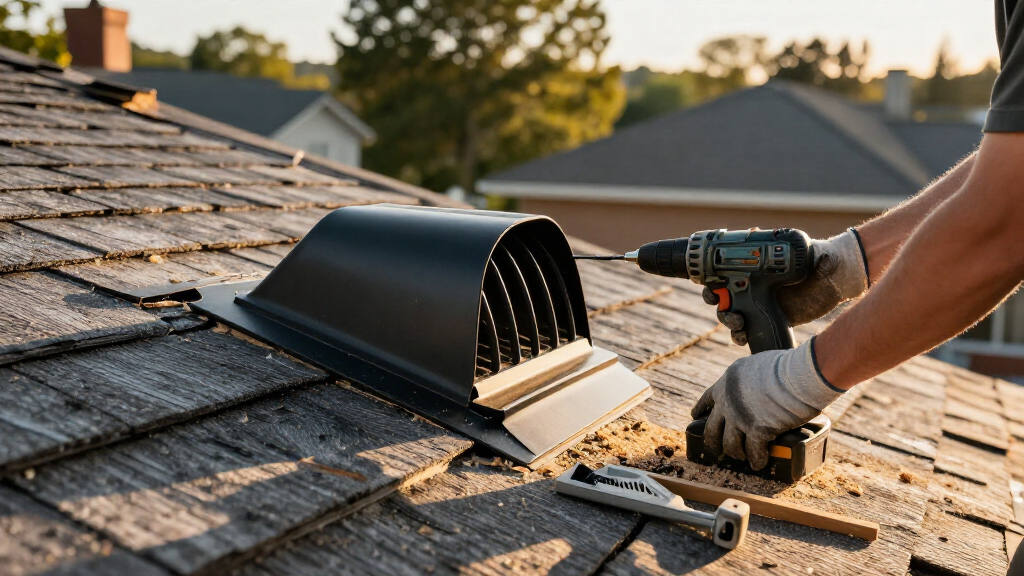
For a shingle roof with suitable soffit intake, this is the lineup’s clearest choice for continuous passive exhaust along the ridge. Unlike the Master Flow ERV6BL powered attic fan, the Quarrix vent does not use electricity or a thermostat; it relies on the roof’s ventilation layout to move hot, moist air out. Its Storm Stop technology is designed to resist wind-driven rain, snow, and dust, while the one-pass installation secures the vent with the cap shingles. High-density polyethylene is specified to resist cracking, curling, and expansion, and the pitch range covers many common roof designs. The tradeoff is its narrow purpose: it only serves the ridge and cannot make up for inadequate soffit intake. Buyers should also check roof pitch compatibility before choosing it over a powered fan or a localized duct cap.
Pros:- Provides continuous passive exhaust along the roof ridge.
- Storm Stop technology is designed to limit wind-driven rain, snow, and dust entry.
- High-density polyethylene is designed to resist cracking, curling, and expansion.
- One-pass installation secures the vent and cap shingles together.
Cons:- Only suits ridge installation and is not a general-purpose roof vent.
- Requires a balanced ventilation system, including suitable soffit intake.
- Compatible roof pitch is limited to 2-1/2/12 through 20/12.
Best for: Roofers and homeowners installing or replacing a shingle ridge vent on a roof with compatible pitch and working soffit intake.
Not ideal for: Buyers who need a powered, thermostat-controlled attic fan, a vent for a non-ridge location, or a solution for roofs outside the listed pitch range.
- Size:9 inches x 20 feet
- Material:High-density polyethylene
- Color:Black
- Weight:5 pounds
- Compatible roof pitch:2-1/2/12 to 20/12
- Installation:One-pass installation; gun nailable
- Included components:Foam end caps and shingle hammers
- Warranty:Lifetime manufacturer warranty
Our verdict“Choose the Quarrix for passive, continuous ridge exhaust on a compatible shingle roof; choose the Master Flow ERV6BL instead when powered airflow is needed.”
Master Flow ERV6BL 1500 CFM Powered Roof Mount Attic Fan with Thermostat
When passive ridge ventilation is not the type of system a buyer needs, the Master Flow ERV6BL offers a more direct route: an electric roof-mounted fan rated up to 1,500 CFM, with coverage listed for attics up to 2,800 square feet. Its hard-wired thermostat controller can run the fan based on temperature, unlike the passive Quarrix 58785 Shingle Ridge Vent, which depends on the roof’s intake and exhaust design. Galvanized steel construction and a built-in screen are practical inclusions, but installation is more involved because the unit needs a 120 V hard-wired connection. It is also incompatible with tile roofing, a firm limitation rather than a minor fit issue. I’d compare its capacity and installation needs with the GAF Master Flow 1000 CFM Black Roof-Mount Attic Vent before selecting a powered fan, while checking that the attic and roof are suitable.
Pros:- Rated to move up to 1,500 CFM of air.
- Designed for attic spaces up to 2,800 square feet.
- Built-in hard-wired thermostat controller.
- Galvanized steel construction and built-in screen.
Cons:- Not compatible with tile roofing.
- Requires a hard-wired 120 V electrical connection.
- Powered operation differs from passive ridge vents and adds electrical installation requirements.
Best for: Homeowners with a larger, non-tile roof and attic who need thermostat-controlled powered exhaust and can arrange a hard-wired electrical connection.
Not ideal for: Owners of tile roofs, buyers seeking passive ventilation without electrical work, or anyone whose attic coverage and ventilation needs have not been checked.
- Airflow capacity:Up to 1,500 CFM
- Recommended attic coverage:Up to 2,800 sq ft
- Power source:Electric
- Voltage:120 V
- Mounting type:Roof mount
- Controller:Hard-wired thermostat
- Dimensions:25 x 25 x 9 inches
- Roof compatibility:Not compatible with tile roofing
Our verdict“Choose this fan for thermostat-controlled exhaust in a compatible larger attic when powered ventilation and hard-wired installation suit the project.”
201 Stainless Steel Non-Powered Roof Turbine Ventilator, 110 mm
This compact turbine is a better fit for a small, existing 110 mm roof opening than for ventilating a large attic. Its non-powered design avoids electrical wiring, while the 201 stainless steel body is intended to resist rust outdoors. Compared with the much larger DioOnes 7.9-inch turbine, this model suits a smaller opening but offers less scale for moving attic air. Its light 1.28-pound weight may make handling easier during installation, though the listing’s power-source field says “corded electric,” which conflicts with its non-powered description. I would verify that detail and confirm opening compatibility before buying. Like other wind-driven vents, its airflow depends on wind, so it is a poor choice when steady, controlled ventilation is the priority.
Pros:- Compact 110 mm bottom diameter fits small compatible roof openings.
- Non-powered design avoids routine electrical operation.
- 201 stainless steel construction is described as rust resistant.
- Lightweight 1.28-pound unit is easier to handle than larger powered fans.
Cons:- Airflow varies with wind conditions rather than running on demand.
- Requires an exact compatible 110 mm roof opening.
- The listed corded-electric power source conflicts with the non-powered description and should be clarified.
Best for: Owners of a shed, garage, or small roofed space with a compatible 110 mm opening who want a compact turbine without planned electrical wiring.
Not ideal for: Homeowners ventilating a large attic or needing reliable airflow in still weather; its small diameter and wind dependence limit that use.
- Material:201 stainless steel; alloy steel
- Bottom vent diameter:110 mm
- Blade length:11 cm
- Item weight:1.28 lb
- Product dimensions:7.8 × 7.9 × 7.8 in
- Package quantity:1
- Manufacturer:Municiap
Our verdict“Choose this compact turbine for a small, compatible opening where wind-driven airflow is acceptable, but not as a primary vent for a large attic.”
Remington Solar 30-Watt Roof-Mount Attic Fan
The Remington Solar is the lineup’s solar-powered option for active attic exhaust, pairing a 30-watt panel with a brushless motor rated for up to 1,550 CFM. Its built-in thermostat and humidistat respond to attic conditions, so buyers get more automatic control than with the wind-dependent DioOnes turbine. The 22.5-inch steel flashing and Texas Windstorm certification also make it a more substantial roof installation than the compact 110 mm turbine. The tradeoff is dependence on sunlight: night operation needs a separately sold hybrid adapter, and the single speed offers no manual airflow range. At 30 pounds, it is also a larger installation than a passive vent. I’d favor it where daytime solar ventilation and automatic controls matter more than uninterrupted operation.
Pros:- Solar power runs the fan without routine grid electricity.
- Built-in thermostat and humidistat adjust operation to attic conditions.
- Brushless motor is designed for quiet, long-life operation.
- Steel flashing and Texas Windstorm certification support a weather-conscious roof installation.
Cons:- Nighttime operation requires a separately sold hybrid adapter.
- Single-speed operation provides no adjustable airflow range.
- At 30 pounds, installation and roof handling are more involved than with a passive turbine.
Best for: Homeowners seeking powered attic exhaust without standard grid operation, especially those who value automatic temperature and humidity response.
Not ideal for: Buyers who need ventilation after dark without buying an added adapter, or who want multiple speed settings and a lightweight installation.
- Power source:Solar
- Wattage:30 watts
- Airflow capacity:1,550 CFM
- Motor type:Brushless
- Controls:Built-in thermostat and humidistat; button control
- Dimensions:22.5 × 22.5 × 11 in
- Weight:30 lb
- Certification:Texas Windstorm certified
Our verdict“Pick the Remington when solar-powered, condition-responsive attic exhaust is the priority and you can accept limited nighttime operation without an added adapter.”
GAF Master Flow 1000 CFM Black Roof-Mount Attic Vent
For buyers who want powered airflow on demand, the GAF Master Flow offers a clear step up from the wind-driven turbines in this group: its electric motor moves up to 1,000 CFM and is sized for attics up to 1,600 square feet. A hard-wired thermostat controls operation, while a heavy-duty internal screen helps keep animals out. Compared with the solar Remington, this unit avoids dependence on sunlight but requires a permanent electrical connection. Its galvanized steel body and listed windstorm approvals suit buyers who prioritize a fixed, code-conscious installation. The main fit restriction is significant: it is not compatible with tile roofing, and the roof slope must fall between 3:12 and 12:12. I’d choose it for a compatible roof and attic, not for a flexible retrofit.
Pros:- Up to 1,000 CFM supports active ventilation for attics up to 1,600 square feet.
- Hard-wired thermostat control automates operation based on attic conditions.
- Galvanized steel housing and internal screen provide durable construction and animal exclusion.
- UL Listed and carries the stated Miami-Dade, Florida, and Texas approvals.
Cons:- Not compatible with tile roofing.
- Hard-wired electrical installation is required.
- Roof slope must be within the specified 3:12 to 12:12 range.
Best for: Homeowners with a shingle-compatible roof, a hard-wired electrical connection, and an attic up to 1,600 square feet seeking thermostat-controlled powered ventilation.
Not ideal for: Tile-roof owners, buyers without access to hard-wired power, or anyone whose roof slope falls outside the stated 3:12–12:12 range.
- Airflow capacity:1,000 CFM
- Recommended attic area:Up to 1,600 sq ft
- Power source:Electric
- Controller:Hard-wired thermostat control
- Material:Galvanized steel
- Dimensions:25 × 25 × 9 in
- Recommended roof slope:3:12 to 12:12
- Roof compatibility:Not compatible with tile roofing
Our verdict“Choose this GAF vent for substantial thermostat-controlled airflow on a compatible roof when hard-wired installation is acceptable.”
DioOnes Stainless Steel Turbine Roof Ventilator, 7.9-Inch
The DioOnes is the more substantial passive turbine in this batch, with a 7.9-inch (20 cm) diameter that gives it a larger format than the 110 mm Municiap model. Its 304-grade stainless steel construction and rainproof cap are intended for outdoor exposure, while wind-driven operation avoids wiring and powered-fan noise. That simplicity comes with a real limit: airflow depends on natural wind, so it cannot match the controlled, active exhaust of the Remington Solar or GAF Master Flow. The product describes the unit as quiet, but the supplied data does not state an airflow capacity, making it harder to size for a particular attic. I’d consider it for passive ventilation where the roof opening and installation details match, rather than as a measured replacement for a powered fan.
Pros:- Wind-powered operation requires no electrical connection.
- 304-grade stainless steel is intended to resist outdoor corrosion.
- Rainproof cap helps limit water entry.
- Larger 7.9-inch diameter distinguishes it from the compact 110 mm turbine.
Cons:- Ventilation varies with wind and is not controlled on demand.
- No airflow capacity is provided in the supplied specifications.
- The 7.9-inch size may not match an existing roof opening.
Best for: Homeowners who want a passive, electricity-free turbine for a compatible roof opening and prefer stainless steel construction.
Not ideal for: Buyers who need a specified airflow rate, consistent exhaust in calm weather, or thermostat-controlled ventilation.
- Material:304-grade stainless steel
- Diameter:7.9 in (20 cm)
- Product dimensions:11.8 × 11.5 × 11.5 in
- Item weight:1.76 oz
- Package quantity:1
- Special features:Noiseless; vented
- Included components:Roof vent
Our verdict“Choose the DioOnes for passive stainless-steel ventilation when its opening size fits and wind-dependent airflow is sufficient.”
ADO Products UDV2248 Durovent Attic Rafter Vent, Pack of 70
Unlike the roof-mounted turbines and powered fans here, the Durovent is an attic airflow channel installed between rafters, not an exterior exhaust vent. Its role is to help maintain a path for air through the rafter bays and reduce moisture buildup, making it a different kind of roof-ventilation component from the GAF Master Flow or Remington Solar. The 70-piece pack suits a larger construction or retrofit job, and lightweight ABS is intended to resist cracking and warping. It does not create airflow by itself, so buyers still need a compatible ventilation system and a suitable attic layout. Available 14- and 22-inch sizes also mean rafter spacing and fit must be checked before purchase; this is a project material, not a standalone fan.
Pros:- Creates an airflow channel between rafters to support attic ventilation.
- Lightweight ABS eases handling during installation.
- ABS construction is described as resistant to cracking and warping.
- Pack of 70 suits projects requiring multiple rafter vents.
Cons:- Does not generate airflow or replace an exhaust vent.
- Fit depends on rafter spacing and attic layout.
- Available 14- and 22-inch sizes may not suit every framing configuration.
Best for: Roofers and homeowners completing new construction or a retrofit who need rafter-bay channels to support attic airflow across multiple bays.
Not ideal for: Anyone seeking a roof-mounted exhaust product that actively moves air; this rafter vent needs to work as part of a broader ventilation setup.
- Material:ABS
- Pack quantity:70
- Available sizes:14 inch and 22 inch
- Installation use:Between rafters
- Project suitability:New construction and retrofit
- Roofing compatibility:Compatible with most roofing materials
Our verdict“Choose the Durovent for a multi-bay attic project that needs rafter channels, not as a substitute for a turbine or powered roof fan.”
JYINCPED 4-Inch Galvanized Steel Roof Vent Kit with Backdraft Damper
For a buyer replacing or adding a 4-inch exhaust outlet, this kit pairs a galvanized steel cap with a backdraft damper, removable mesh screen, flexible duct, tape, and matching screws. That bundled hardware can simplify gathering parts compared with a basic cap such as the Hon&Guan 4-Inch Galvanized Steel Roof Vent Cap, though roof sealing remains the installer’s responsibility. The 1.58-inch raised edge is intended to help keep rain from entering the duct, while the damper limits backflow and the screen helps keep out birds and debris. The tradeoff is ongoing screen maintenance: lint or leaves can obstruct it, so it needs periodic inspection. This is a duct outlet, not a substitute for a ridge vent or an attic turbine when the goal is broader attic airflow.
Pros:- Includes flexible aluminum duct, dryer vent tape, and color-matched screws alongside the vent cap.
- Backdraft damper helps limit wind and outside air entering through the duct.
- Raised edge is designed to help keep rain from flowing back into the duct.
- Galvanized steel construction is designed to resist rust and corrosion.
Cons:- The roof or wall penetration still needs careful sealing during installation.
- The removable mesh screen can collect lint and debris and requires inspection.
- Its 4-inch duct connection is not suited to larger attic ventilation systems.
Best for: DIYers or contractors installing a 4-inch bathroom, kitchen, or dryer exhaust who want the cap and basic ducting accessories in one kit.
Not ideal for: Homeowners seeking whole-attic ventilation or a low-maintenance outlet, since this serves a single 4-inch duct and its mesh screen needs cleaning.
- Duct diameter:4 inches
- Material:Galvanized steel
- Raised edge:1.58 inches
- Color:Black
- Features:Backdraft damper and removable mesh screen
- Dimensions:9.45 x 11.02 x 3.98 inches
- Included components:Vent cap, aluminum dryer vent tape, color-matched screws, and flexible aluminum duct
- Warranty:30 days
Our verdict“Choose this kit for a 4-inch exhaust installation where included duct accessories and a damper matter more than whole-attic airflow.”
L.L. Building Products AIC14WW 14-Inch Internally Braced Turbine Ventilator, Weathered Wood
This 14-inch turbine is the stronger fit for attic ventilation when a roof’s pitch makes a fixed-base installation less convenient. Its adjustable base accommodates pitches up to 12/12, and the enclosed stainless steel ball bearings are designed to resist dirt and wear. Steel braces and a case-hardened shaft add support, while double-ribbed vanes direct wind-driven rain away from the unit. Compared with the compact, duct-sized 4-Inch Stainless Steel Turbine Roof Ventilator, this is aimed at attic airflow rather than a small 110 mm opening. It still depends on wind, so it cannot provide steady powered exhaust in calm conditions. The listed dimensions of 1 x 2 x 3 inches also appear incomplete for a 14-inch turbine; verify sizing and fit before ordering.
Pros:- Adjustable base is designed for roof pitches up to 12/12 without removing the turbine.
- Enclosed stainless steel ball bearings help resist dirt and foreign material.
- Steel braces and a case-hardened shaft provide structural support.
- Double-ribbed vanes are designed to direct wind-driven rain away.
Cons:- Wind-dependent operation cannot provide consistent airflow in calm conditions.
- Published dimensions of 1 x 2 x 3 inches appear incomplete or inaccurate for a 14-inch ventilator.
- Requires a suitable turbine opening and roof installation rather than a small exhaust duct.
Best for: Homeowners replacing an attic turbine on a steep or variable-pitch roof who want an adjustable base and internally supported construction.
Not ideal for: Buyers who need powered ventilation during still weather or cannot confirm the unit’s dimensions and compatibility with their roof opening.
- Size:14 inches
- Material:Aluminum
- Weight:8.1 pounds
- Adjustable roof pitch:Up to 12/12
- Bearing system:Permanently lubricated track with enclosed stainless steel ball bearings
- Color:Weathered wood
- Approvals:Dade County and Texas Department of Insurance
- Listed dimensions:1 x 2 x 3 inches
Our verdict“Pick this turbine for an attic with a steep roof pitch, but confirm the actual unit dimensions and opening requirements before purchase.”
4-Inch Stainless Steel Turbine Roof Ventilator
With a 4.33-inch bottom opening and a compact body, this turbine is intended for a small vent connection, not as a replacement for a large attic turbine. It uses wind rather than electricity, and its stainless steel body is designed to resist corrosion; the product description also points to quiet rotation and a rain-resistant blade design. Compared with the L.L. Building Products AIC14WW 14-Inch Turbine Ventilator, it takes up less space and targets a much smaller opening, but it cannot be assumed to move the same volume of attic air. Its main limitation is inherent to wind-powered ventilation: rotation and exhaust depend on wind. Check that the 110 mm opening matches the existing setup, since the listed diameter may not fit a standard 4-inch duct without a compatible connection.
Pros:- Wind-powered operation requires no electrical supply.
- Stainless steel 201 body is designed to resist rust and corrosion.
- Compact dimensions suit smaller vent installations.
- Designed for quiet, smooth rotation and rain-resistant operation.
Cons:- Ventilation depends on sufficient wind to turn the turbine.
- The 110 mm bottom opening may not match a standard 4-inch duct directly.
- Its compact opening makes it a poor substitute for a larger attic turbine.
Best for: Owners of a small outbuilding, garage, or existing 110 mm vent opening who want passive ventilation without a powered fan.
Not ideal for: Buyers needing dependable airflow in calm weather, a large attic turbine, or a direct fit to a duct that does not match the 110 mm opening.
- Material:Stainless steel 201
- Bearing material:Galvanized steel
- Bottom vent diameter:4.33 inches (110 mm)
- Dimensions:7.08 x 7.48 x 4.33 inches
- Weight:0.75 kg (1.65 lb)
- Power source:Wind-powered, non-powered
- Color:Silver
- Package quantity:1
Our verdict“Choose this compact turbine for a compatible small opening and passive ventilation, not for reliable high-volume attic exhaust.”
ROOFIVENT IVENT ROTO 6-Inch Roof Turbine Vent – Graphite, Oblong Head, for Shingle/Slate/Shake Roofs
This 6-inch turbine is the most feature-focused option here for buyers with a compatible shingle, slate, or shake roof. Its UV-stable polypropylene body avoids a metal construction, while oil-immersed bearings are designed for quiet operation. A built-in condensation drainage system addresses moisture buildup inside the vent, and tool-free disassembly makes access for maintenance easier. The built-in bubble level can help with alignment during mounting. Compared with the L.L. Building Products 14-inch aluminum turbine, this model has a smaller 6-inch connection and adds drainage and service-access features, but it is limited to specific roof coverings and an existing 6-inch vent system. It is still wind-driven, so it will not maintain powered airflow when conditions are calm.
Pros:- Oil-immersed, encapsulated bearings are designed for quiet operation.
- UV-stable polypropylene is intended to resist weather exposure.
- Condensation drainage system helps manage moisture and frost buildup.
- Tool-free disassembly and a built-in bubble level support maintenance and alignment.
Cons:- Roof compatibility is specified for shingle, slate, and shake surfaces.
- Requires an existing 6-inch vent system.
- Wind-driven operation cannot provide steady exhaust when wind is absent.
Best for: Homeowners with shingle, slate, or shake roofing and an existing 6-inch vent opening who value quiet operation and accessible maintenance.
Not ideal for: Owners of metal, tile, or other unlisted roof types, homes without a 6-inch vent system, or anyone needing powered ventilation in still weather.
- Vent size:6 inches
- Material:UV-stable polypropylene
- Head shape:Oblong
- Roof compatibility:Shingle, slate, and shake
- Color:Graphite
- Weight:4.2 pounds
- Dimensions:18 x 14 x 17 inches
- Special features:Condensation drainage system, waterproof construction, built-in bubble level, and tool-free disassembly
Our verdict“Choose this turbine for a compatible 6-inch shingle, slate, or shake roof if drainage features and tool-free service access matter.”

How We Picked
I compared the 14 products by the job each one is designed to do, rather than treating every roof vent as interchangeable. The ranking gives weight to clear use cases, stated airflow or dimensions, roof compatibility, and the ability to fit into a balanced ventilation plan. Products with a defined role—such as a ridge vent, powered attic fan, turbine, duct cap, or rafter vent—rank ahead of options whose listing details leave more questions for a buyer to resolve.
I also weighed installation demands, likely maintenance, power source, and tradeoffs. The Quarrix ridge vent leads as a broadly useful passive exhaust choice for a compatible roof, while the Master Flow ERV6BL stands out for buyers who specifically need powered airflow. Solar and turbine products offer alternatives to conventional powered fans, but their performance depends on conditions and installation. Small duct caps and rafter vents remain useful for specific parts of a system, yet they are not direct replacements for whole-attic exhaust. Verify dimensions, roof material, local ventilation requirements, and intake capacity before choosing.
Factors to Consider When Choosing Best Roof Ventilation Products
Before choosing a product, I would start with the roof’s existing ventilation layout and the problem you want to correct. The biggest buying mistake is selecting an exhaust vent by itself, without checking whether the attic has enough intake air or whether existing vents will work against the new one.
Match the vent type to the job
Ridge vents, turbines, powered fans, duct caps, and rafter vents do different work, so compare them by function rather than by appearance. A ridge vent creates a long passive exhaust path, while a turbine uses wind and a powered fan uses an electric or solar-driven motor. A duct cap is meant for a compatible duct outlet, not as a replacement for an attic ventilation system. Rafter vents preserve an air channel at the eaves; they do not exhaust attic air on their own. Start by identifying whether you need intake, exhaust, or a connection for a specific duct. Choosing the wrong category can leave the original airflow problem unchanged.
Plan intake and exhaust together
Roof ventilation works as a system: exhaust needs a path for replacement air, commonly through soffit or eave intake. Adding a fan without adequate intake can limit airflow and may draw air from unintended places, depending on the building. Mixing ridge exhaust with other high exhaust vents can also disrupt the intended airflow pattern if the layout is not planned as a whole. Check what vents are already installed before adding another type. If the intake area is blocked by insulation, a rafter vent may help maintain a clear channel, but the roof and attic configuration must suit it. When the existing layout is unclear, a roofing or ventilation professional can help assess it.
Compare airflow claims with the installation
A stated CFM figure, such as the Master Flow ERV6BL’s listed 1500 CFM, describes a product specification rather than a guaranteed result in every attic. Actual airflow can depend on the installation, available intake, duct or vent restrictions, and operating conditions. Passive products do not generally provide a comparable powered CFM rating, so judge them by their design, placement, and suitability for the roof. Avoid treating a larger fan as an automatic fix for heat or moisture. First check whether the attic has blocked intake, insufficient exhaust, or another source of moisture. Product capacity only helps when the complete airflow path can support it.
Check roof covering, opening, and placement
Compatibility is more than choosing a color that looks right. Confirm the product’s required opening, mounting dimensions, and roof-covering fit before ordering; the listings include options for ridge installation, turbines, and shingle, slate, or shake roofs. A product intended for a duct connection may not fit an attic exhaust opening, even if both mount on a roof. Placement also affects whether a vent can operate as intended and whether it interferes with existing ventilation. Measure carefully and compare those measurements with the product instructions. If your roof has an unusual pitch, covering, or layout, check with the manufacturer or an installer rather than relying on the product name alone.
Balance power, weather, and upkeep
Powered fans can provide active exhaust, but they add electrical or solar equipment that needs to suit the site and the installation. Solar models depend on available sun, while non-powered turbines depend on suitable conditions to turn; neither should be assumed to deliver identical airflow all the time. Passive ridge vents avoid a motor, though they still need correct installation and periodic inspection. Metal vents also require attention to their mounting and exposure, and any moving turbine parts may need checks for wear or obstruction. Think about access for inspection before selecting a roof-mounted product. Paying for a powered option makes more sense when active airflow is a priority and the system has adequate intake.
Choose a complete system, not a single-item fix
Some items in this roundup are components rather than stand-alone solutions: a rafter vent supports intake airflow, and a duct cap serves a duct outlet. Before buying, sketch the path air should follow from intake to exhaust and note what is already present. Avoid installing different exhaust types together without confirming that the layout remains balanced. Also check whether a product is sold as a single vent, a roll, or a multipack, since coverage and quantity affect the scope of the job. For a small repair, a compatible replacement may be all you need; for an attic-wide issue, evaluate the entire system. This approach can prevent spending on a new vent that leaves the real restriction untouched.
Frequently Asked Questions
Can I install a powered attic fan if I already have a ridge vent?
Possibly, but I would not combine them without checking the airflow plan. A powered fan can pull air from nearby exhaust vents rather than drawing it through the intended soffit intake, which may reduce the benefit of the ridge vent. The right answer depends on the roof layout, vent locations, and available intake area. Check the fan and ridge-vent instructions and have the system reviewed if their interaction is unclear. Adding a fan is not a substitute for correcting blocked or inadequate intake.
Is a 1500 CFM roof fan automatically better than a 1000 CFM model?
No. The listed capacity is only one part of the comparison, and the ERV6BL and GAF Master Flow 1000 CFM model should be matched to the attic and ventilation plan rather than ranked by CFM alone. A larger-capacity fan may not deliver its stated airflow if intake is restricted or the installation is unsuitable. Consider the attic size, existing vents, power requirements, and manufacturer guidance. If you are unsure how much exhaust is appropriate, get a system-level assessment before selecting the higher-capacity option.
Can a 4-inch roof vent cap ventilate my whole attic?
A 4-inch roof vent cap is generally suited to a compatible duct outlet or localized application, not as a direct replacement for a whole-attic ventilation system. Its small connection size and backdraft damper serve a different purpose from a ridge vent, turbine, or attic fan. Confirm what the duct connects to and whether the vent is approved for that use. For attic-wide airflow, assess both intake and exhaust openings and choose products designed for that role. Do not assume that adding several small caps will create a balanced attic system.
Should I choose a solar fan or a non-powered turbine?
I would choose based on the airflow source and site conditions, not just the absence of a conventional electrical connection. A solar fan needs suitable sunlight and includes powered components, while a non-powered turbine relies on wind and its ability to rotate. Neither option guarantees steady airflow under every condition. Compare the installation requirements, roof exposure, maintenance access, and the attic’s intake provision. If dependable active exhaust is the priority, compare the solar model with a wired fan and check the manufacturer’s operating details.
Do I need rafter vents if I am installing a ridge vent?
Not in every attic, but an unobstructed intake path is needed for a ridge vent to work as part of a balanced system. Rafter vents such as the ADO Durovent are intended to keep insulation from blocking airflow at the eaves; they do not create intake openings where none exist. Check whether the attic already has open soffit or eave vents and whether insulation covers them. The correct setup depends on the roof framing and existing ventilation. If access is limited or the airflow path is uncertain, get the layout checked before installing either component.
Conclusion
For most buyers seeking passive, continuous roof exhaust on a compatible roof, I would start with the Quarrix 58785 Shingle Ridge Vent as the best overall pick. The best value for a targeted repair is a compatible 4-inch vent cap, but only when the job calls for a duct outlet rather than whole-attic ventilation. For a premium powered option, the Master Flow ERV6BL is the standout for buyers who need active airflow and can provide suitable intake and power. Beginners should choose by installation fit first; a straightforward replacement matching an existing vent is usually less risky than adding a new vent type. For specific needs, consider the Remington Solar fan where solar operation suits the site, a turbine where a compatible passive roof opening is the goal, or ADO Durovent rafter vents when insulation blocks an eave airflow channel. Match the product to the actual ventilation problem, and check the whole intake-and-exhaust layout before buying.