
TL;DR
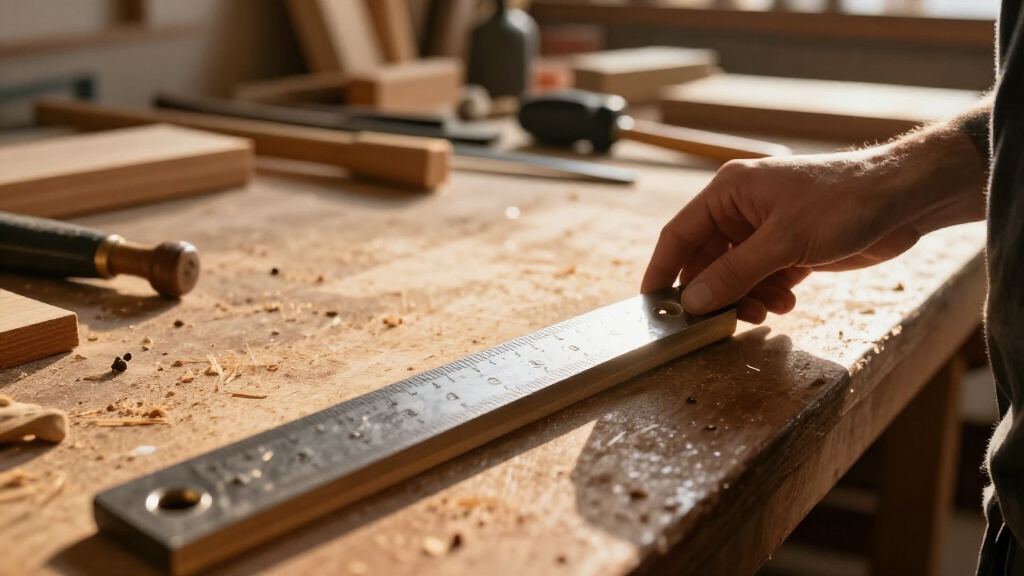
The hole near the end of many rulers is primarily a way to hang and store them, according to Family Handyman. The report also describes older classroom uses and specialized rulers with openings for binder storage, circle drawing and craft tasks.
A hole near the end of a ruler is mainly there to make the tool easier to hang and store, according to a Family Handyman report. The opening can keep a ruler on a hook, nail or pegboard rather than in a drawer, while other rulers use holes for tasks such as binder storage, drawing circles or marking craft patterns.

Get business pricing on tools and workshop supplies
- Business-only prices and quantity discounts
- Tax-exempt purchasing
- Multiple users, one account, clear invoices
The report says the storage function is especially useful for longer metal rulers, which may not fit easily in a toolbox. Some designs have one hole near an end; others have openings at both ends or several along one side. The placement and number of holes depend on the ruler’s intended use and its manufacturer.
Family Handyman also describes a historical classroom use. Before paper notebooks became common, students wrote on small slate boards that could be wiped clean with a damp cloth. The report says some students attached the cloth to their ruler with string threaded through its hole, keeping it close at hand. It does not provide a date for when this practice was used or establish how widespread it was.
Other holes are designed for specific jobs. Three holes along a school ruler may line up with the rings of a three-ring binder. On some specialty rulers, a pin can hold one opening in place while a pencil in another traces a circle. Quilting and craft rulers may include openings to mark shapes or align fabric, while some paper-craft and stitching tools have small, evenly spaced holes for marking patterns. These features are not standard across all rulers.
A Small Feature With Practical Uses
For most people, the hole is a minor convenience rather than a measuring feature. A ruler can still measure accurately without one, and the report says the openings generally do not change its everyday measuring function. Their value depends on how someone stores or uses the tool.
The distinction matters when choosing a ruler. Someone looking for a tool to hang in a workshop may value a storage hole, while a student might use binder holes to keep supplies together. Craft openings can support particular marking or cutting tasks, but they do not make every ruler suitable for every project. The report cautions that a compass remains a better choice when exact circle measurements matter.
Products Worth Considering

Google Nest Smart Thermostat, Snow

iRobot Roomba 105 Combo Robot Vacuum and Mop with AutoEmpty Dock

TCL 85-Inch QM6K QLED Mini LED 4K HDR Smart Google TV, 144Hz
As an affiliate, we earn on qualifying purchases.
How Ruler Designs Differ
Rulers are made for different settings, from classroom measuring and drawing to workshop and craft use. The supplied report references product information from STAEDTLER, Kapro and Westcott, alongside a University of Wisconsin–Madison object-history resource on slate. These sources provide context for the range of rulers and the older slate-board practice described in the article.
Not every ruler has a hole. According to Family Handyman, smaller plastic rulers may omit one, while longer metal versions may have an opening at one or both ends. Some specialty models add several holes or shaped edges for particular tasks. The presence of a hole is therefore a design choice, not a requirement for accurate measurement.
“The hole at the end of a ruler is mainly there for storage.”
— Family Handyman report
What the Report Does Not Establish
The supplied material does not give a dated history of the ruler hole or document when manufacturers first added it. Its account of students attaching slate-cleaning cloths to rulers is presented as a past use, but the article gives no specific school, period or source quotation confirming how common the practice was.
It is also not clear how frequently each design appears across the market. The report describes examples, including rulers with binder holes and specialty craft openings, but does not provide sales figures, manufacturer-wide specifications or a survey of current products. The uses of any particular hole should be checked against that ruler’s design and instructions.
Check the Ruler’s Intended Use
No further announcement or product change is reported. For readers, the practical next step is to look at the ruler itself: a single end hole is likely intended for hanging, while several spaced holes or purpose-shaped openings may signal a specialized use. Manufacturer guidance can clarify the function where the design is not obvious.
For ordinary measuring, the hole does not require any special action, and a ruler without one can serve the same basic purpose. Anyone using openings to draw or mark shapes should treat the result as appropriate to the tool’s design; for circles requiring precise dimensions, the report recommends a compass instead.
Key Questions
What is the hole at the end of a ruler for?
According to Family Handyman, it is mainly for hanging and storage, such as on a hook, nail or pegboard.
Did ruler holes have an older classroom use?
The report says some students used string through the hole to attach a damp cloth for wiping slate boards. It does not specify how widespread or long-running that practice was.
Can holes in a ruler be used to draw circles?
Some specialty rulers have openings that can help trace circles by anchoring one point and moving a pencil at another. For exact measurements, the report says a compass is a better choice.
Do ruler holes improve measuring accuracy?
No accuracy benefit is described. The report says rulers with and without holes can measure equally well for everyday use.
Source: familyhandyman.com