
If you’re choosing between rotary laser levels and standard models, consider your project size and environment. Rotary laser levels are best for large outdoor areas, offering 360-degree coverage and great precision, but they can be costly and bulkier. Standard laser levels are more affordable and ideal for indoor, smaller tasks, providing quick setup and accuracy. Keep exploring to find out which type suits your needs best and gain more tips for your projects.
Key Takeaways
- Rotary laser levels provide 360-degree coverage suitable for large outdoor projects, while standard laser levels are ideal for indoor, smaller tasks.
- Rotary levels offer greater outdoor accuracy and handle uneven terrain better than standard laser levels.
- Standard laser levels are more affordable, lightweight, and easier to set up for quick, indoor applications.
- Rotary laser levels feature automatic leveling and advanced features for extensive, precise outdoor use.
- Both types improve accuracy but differ significantly in scope, environment suitability, and cost.
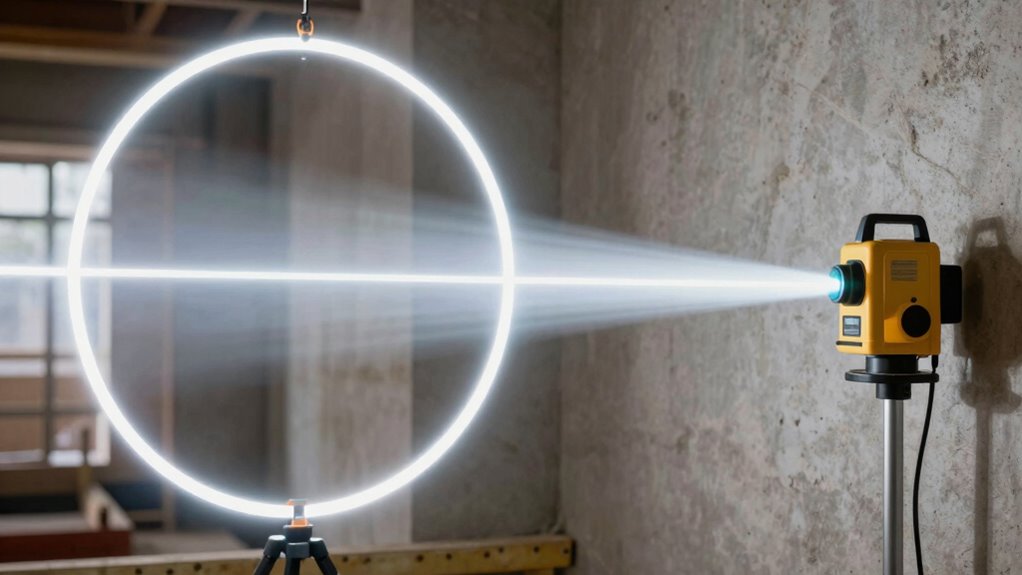
When choosing between rotary laser levels and standard laser levels, understanding their differences can considerably impact your project’s success. Both tools serve to improve accuracy and efficiency, but they do so in distinct ways. Your decision depends on the scope of your work and the environment you’re working in. Rotary laser levels are known for their ability to project a 360-degree level line, making them ideal for large-scale projects like excavations, framing, or installing ceilings. They offer exceptional precision accuracy across wide areas, which minimizes mistakes and ensures everything lines up perfectly. Plus, many rotary laser levels are designed for ease of use; they come with automatic leveling features that save you time and effort. You simply set up the device, calibrate it once, and it does the rest, allowing you to focus on the task rather than fussing with adjustments. Their ability to project a full 360-degree line also makes rotary laser levels especially useful in outdoor environments where comprehensive coverage is essential. You can easily monitor multiple points around a site without repositioning the device. Additionally, their ability to handle outdoor environments with uneven terrain is a significant advantage for construction projects. Incorporating features like self-leveling mechanisms further enhances their reliability in challenging conditions. Recognizing the importance of accuracy in construction highlights why these features are so valuable in demanding work settings.
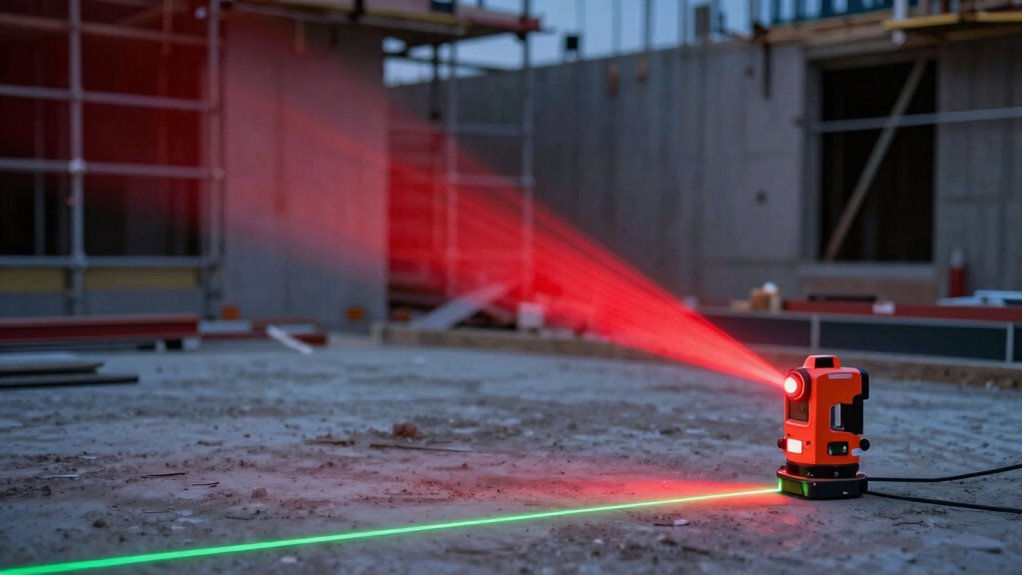
Standard laser levels, on the other hand, are more straightforward and typically project a single line or a cross line. They are best suited for smaller projects or indoor applications such as hanging cabinets, installing tiles, or aligning shelves. While they might not offer the same 360-degree coverage, they excel in providing high precision accuracy in confined spaces. Because they are generally simpler to operate, they’re a great choice if you want an intuitive tool that’s quick to set up and easy to master. Their ease of use makes them particularly attractive for DIY enthusiasts or professionals who value straightforward functionality without a steep learning curve. They are also usually more affordable and portable, making them convenient for quick or smaller jobs. Their lightweight design can be especially beneficial when working in tight or awkward spaces.
When considering precision accuracy, rotary laser levels usually have a slight edge because of their ability to cover larger areas uniformly and their often advanced leveling systems. They tend to be more versatile, especially in outdoor environments where wind and uneven surfaces can affect smaller, more sensitive laser lines. Conversely, standard laser levels are often more affordable and portable, making them a practical option for smaller jobs or indoor use. They also tend to be lighter and easier to carry around, which can be a significant advantage if you’re moving between multiple sites.
Ultimately, your choice hinges on your specific needs. If you’re tackling large, complex projects that demand extensive coverage and ultra-precise alignment, a rotary laser level is probably your best bet. But if you’re working on smaller, indoor tasks where simplicity and portability matter most, a standard laser level will serve you well. Both types of lasers can enhance your accuracy and efficiency, but understanding their strengths ensures you pick the right tool for your project.

VEVOR Rotary Laser Level Kit, 984ft 360-Degree Self Leveling Red Horizontal Laser Transit,with Tripod,Receiver,Remote Control, Scale, Toolcase, IP54 Waterproof, 0.12in/100ft Precision for Construction
- 360-Degree Self-Leveling Rotation: Efficient site-wide leveling with manual mode
- Long Working Range: Up to 984 ft with receiver included
- Rechargeable Power Source: Runs 8-12 hours on four NiMH cells
As an affiliate, we earn on qualifying purchases.
As an affiliate, we earn on qualifying purchases.
Frequently Asked Questions
How Do Rotary Laser Levels Perform Outdoors Compared to Standard Laser Levels?
Rotary laser levels outperform standard laser levels outdoors because they provide better precision accuracy over larger areas, especially on uneven terrain. You’ll find them more reliable for outdoor projects like grading or landscaping. Although they tend to be more expensive, their cost considerations are justified by their durability and ability to project 360-degree lines. This makes them ideal for jobs requiring consistent accuracy across expansive outdoor sites.
What Is the Typical Battery Life Difference Between Rotary and Standard Laser Levels?
Rotary laser levels typically have longer battery life than standard laser levels because of their better battery efficiency and lower power consumption. You might find that rotary models can run for 8 to 20 hours on a single set of batteries, depending on the features and usage, while standard laser levels often last around 4 to 8 hours. This makes rotary levels more suitable for extended outdoor or large-scale projects.
Are Rotary Laser Levels Easier to Set up for Large Projects?
Think of setting up as guiding a gentle tide over vast sands; rotary laser levels make large projects feel smoother. Their calibration procedures are straightforward, saving you time and effort. While they might seem pricier upfront, the cost comparison often favors their efficiency on big jobs. You’ll find that, with fewer adjustments needed, rotary laser levels simplify complex tasks, allowing you to focus on the big picture without getting bogged down in setup details.
Can Rotary Laser Levels Operate Effectively in Windy Conditions?
Yes, rotary laser levels can operate effectively in windy conditions if you address wind interference and stability requirements. You should use a sturdy tripod and secure the laser tightly to prevent movement. Additionally, choosing a model with a protective housing and a beam rotation speed suited for outdoor use helps uphold accuracy. Proper setup ensures the laser remains stable despite wind, enabling reliable measurements even in challenging outdoor environments.
What Maintenance Is Required for Rotary Laser Levels?
You need to regularly maintain your rotary laser level to guarantee accuracy. Calibrate it at least once a year or after significant impacts or changes in temperature. Keep dust protection in mind by cleaning the device gently with a soft cloth and avoiding dust-heavy environments when not in use. Store it in a protective case to prevent dust and damage, and check batteries regularly for consistent performance.
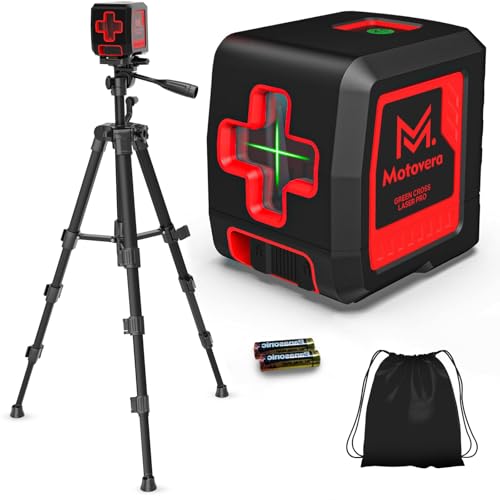
Motovera Self Leveling Laser Level 100ft, Green Cross Line with Tripod, 4 Brightness Modes & Pulse Function, Manual & Self-Leveling Modes, IP54 Waterproof for Picture Hanging, Tile, DIY Construction
- Bright Green Laser Beam: Visible up to 100ft indoors
- High Precision Accuracy: ±1/9 inch at 33ft
- Dual Mode Functionality: Self-leveling and manual modes
As an affiliate, we earn on qualifying purchases.
As an affiliate, we earn on qualifying purchases.
Conclusion
Imagine walking into a room where lines are perfectly aligned, whether you’re hanging cabinets or installing a ceiling. Rotary laser levels cast an all-encompassing 360-degree glow, like a steady lighthouse guiding your project through the night. Standard laser levels, on the other hand, focus their beam straight ahead, like a spotlight on a stage. Both tools help you achieve precision, but choose the one that best illuminates your project’s path and makes your work effortless.

LotaTools Self-Leveling 0.11"/100' Rotary Laser, 2000' Rotary Laser Level Kit, IP66 with Aluminum Tripod, Grade Rod for Grading
- Laser Accuracy: ±1/8 inch at 100 feet
- Working Range: Up to 2000 feet with receiver
- Self-Leveling: Automatic ±5° adjustment
As an affiliate, we earn on qualifying purchases.
As an affiliate, we earn on qualifying purchases.

VEVOR Rotary Laser Level 1650ft,360 Degree Self Leveling Red Cross Line Laser,5 Rotation Speeds&4 Scanning Angles Adjustment,IP66 Waterproof Remote Control Manual Self-leveling Mode,Battery Included
- 360° Rotating Scanning: Variable speeds and angles for full coverage
- Long Working Distance: 1650 ft range with laser detector included
- Self-Leveling & Manual Mode: Automatic leveling with manual adjustment option
As an affiliate, we earn on qualifying purchases.
As an affiliate, we earn on qualifying purchases.