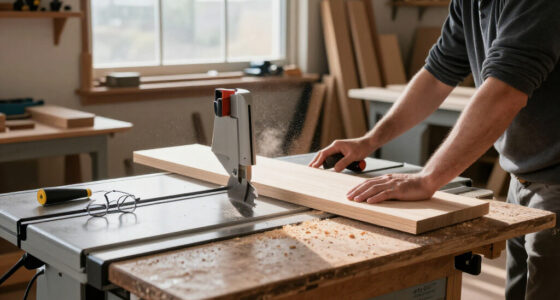

Corded electric miter saws suit buyers who want steady power without managing batteries. The DEWALT DWS780 is my best overall pick for its 12-inch blade and double-bevel sliding design, while the SKIL MS6305-00 stands out for dual-bevel sliding cuts and the Metabo HPT C10FCG2 offers a simpler 10-inch format. The main tradeoffs are cut capacity versus portability, single- versus double-bevel convenience, and whether a sliding or compound saw fits your projects. Compact models can be easier to store, but they may limit how wide a board you can cut. Read on for the full breakdown of all 12 options and how I’d match them to different workshops and jobs.

Get business pricing on tools and workshop supplies
- Business-only prices and quantity discounts
- Tax-exempt purchasing
- Multiple users, one account, clear invoices
Complete the kit


Key Takeaways
- The DEWALT DWS780 leads for broad capability: its 12-inch blade, sliding rails, and double-bevel design cover more demanding crosscuts and angled work than the fixed-head saws in this group.
- Sliding action matters more than blade size alone for wide stock: the SKIL MS6305-00 and SKIL 7-1/4-inch sliding model add crosscut reach, while a larger fixed-head blade does not automatically provide the same width capacity.
- Double bevel reduces setup work, not every cutting challenge: the DWS780 and SKIL MS6305-00 can tilt both directions, while single-bevel models require flipping or repositioning work for matching compound cuts.
- Compact saws trade capacity for easier handling: the SKIL 7-1/4-inch, Evolution R185SMS+, and Evolution R210CMS are more suited to lighter or space-limited work than frequent wide-board cutting.
- Special-purpose designs need a clear use case: the Hoteche’s miter-saw/table-saw combination adds versatility, but buyers should compare its dual-purpose setup against the more focused cutting performance of conventional miter saws.


| corded electric miter saw | Motor | Weight | Blade diameter | Power source |
|---|---|---|---|---|
| SKIL 10-Amp 7-1/4-Inch Single- | 10 amp | 31 pounds | — | Corded electric |
| Hoteche 8-1/4-Inch 2-in-1 Comp | 10 amp | — | — | Corded electric |
| Makita LS1040 10-Inch Compound | 15 A direct drive with soft start | — | 10 inches | — |
| Evolution Power Tools R185SMS+ | — | — | 7-1/4 inches | Corded electric |
| DEWALT DWS780 12-Inch Double-B | 15 amp | 24.8 kg | 12 inches | Corded electric |
| Marvtool 10-Inch Compound Mite | 15 A | 20.5 lb | 10 inches | — |
| Metabo HPT C10FCG2 10-Inch Sin | 15 A | 24.2 lb | 10 inches | 120 V corded electric |
| DEWALT DWS713 10-Inch Single B | 15 A | 31 lb | 10 inches | — |
| Evolution Power Tools R210CMS | — | 5.8 kg | 8-1/4 inches (210 mm) | — |
| DEWALT DWS715 12-Inch Single-B | 15 A | 42.8 lb | 12 inches | — |
| SKIL 10-Inch Dual-Bevel Slidin | 15 A, 1,800 W | 39.4 lb | 10 in | Corded electric |
| Yumark 10-inch Corded Miter Sa | — | Approximately 20 lb | — | Corded electric |
More Details on Our Top Picks
SKIL 10-Amp 7-1/4-Inch Single-Bevel Sliding Miter Saw with Compact Rail System and LED Shadow Line
I’d choose this SKIL when a sliding saw’s wider crosscut capacity matters, but shop space is tight. Its compact rail system lets it sit close to a wall, unlike sliding designs that need extra clearance behind the saw, and the LED shadow line gives a visible blade-alignment guide. It cuts up to 2 × 10 inches at 0 degrees, a useful reach for trim and smaller framing tasks, though the 7-1/4-inch blade gives less capacity than the Makita LS1040’s 10-inch blade or the DEWALT DWS780’s 12-inch setup. The tradeoff is a single bevel that tilts only left, so some compound cuts require repositioning the workpiece. At 31 pounds, it is movable, but not especially light; the stand is also separate.
Pros:- Compact rail system allows placement close to a wall.
- LED shadow line helps align the cut without relying on a laser.
- Slides across stock up to 2 × 10 inches at 0 degrees.
- Quick miter lock and included clamp make setup and workpiece holding more straightforward.
Cons:- Single-bevel design tilts left only, requiring workpiece repositioning for some cuts.
- The 7-1/4-inch blade has less capacity than the 10-inch Makita LS1040 and 12-inch DEWALT DWS780.
- Weighs 31 pounds, and the compatible stand is sold separately.
Best for: Home renovators and trim workers who need sliding crosscut capacity in a workshop where the saw must sit near a wall.
Not ideal for: Buyers who frequently make compound angles in both directions or need a larger blade’s capacity for broad stock.
- Power source:Corded electric
- Motor:10 amp
- Maximum speed:4,800 RPM
- Blade:7-1/4-inch, 24-tooth carbide
- Bevel capacity:0–45 degrees left
- Miter capacity:47 degrees left; 50 degrees right
- Maximum crosscut at 0 degrees:2 × 10 inches
- Weight:31 pounds
Our verdict“Choose this SKIL for wall-friendly sliding capacity and clear cut alignment, but pick a larger or dual-bevel saw for heavier stock and frequent compound cuts.”
Hoteche 8-1/4-Inch 2-in-1 Compound Miter Saw & Table Saw
The Hoteche’s main distinction in this group is its two-in-one layout: it combines a compound miter saw with a table-saw mode, which may suit a small workspace where separate tools are impractical. Its 10-amp motor runs at 4,500 RPM, and the 8-1/4-inch blade offers a middle ground between the SKIL’s compact 7-1/4-inch sliding format and the larger Makita LS1040. That versatility comes with a compromise: the listed data gives a 45-degree miter angle but little detail about mode-specific capacity, so I’d favor it for mixed, space-conscious work rather than demanding repeat production cuts. The single-bevel design also limits angle flexibility compared with the dual-bevel DEWALT DWS780, while the cord keeps it tied to an outlet.
Pros:- Combines miter-saw and table-saw functions in one tool.
- 10-amp motor runs at 4,500 RPM.
- 8-1/4-inch blade provides a size between compact 7-1/4-inch and standard 10-inch options.
- Includes a clamp and extension rods, according to the product description.
Cons:- Single-bevel design offers less angle flexibility than the dual-bevel DEWALT DWS780.
- Product data does not specify crosscut capacity or detailed table-saw capabilities.
- Corded operation requires an outlet and restricts where the tool can be used.
Best for: DIY woodworkers with limited storage who want one corded tool for occasional miter and table-saw tasks.
Not ideal for: Carpenters who need clearly specified cut capacities, frequent dual-bevel work, or a dedicated saw optimized for repeated precision cuts.
- Power source:Corded electric
- Voltage:120 V
- Motor:10 amp
- No-load speed:4,500 RPM
- Blade:8-1/4-inch, 24-tooth
- Arbor size:5/8 inch
- Maximum miter angle:45 degrees
- Blade material:High-speed steel
Our verdict“Pick the Hoteche if combining two saw functions matters more than dedicated miter-saw capacity and well-documented cutting limits.”
Makita LS1040 10-Inch Compound Miter Saw
For buyers who want a straightforward 10-inch corded saw rather than a sliding mechanism, the Makita LS1040 is the most balanced fit here. Its 15-amp direct-drive motor has soft start, while the machined aluminum base and dual slide rails support a stable work surface. Nine positive miter stops help speed up common angle settings, and the blade turns up to 52 degrees right—more right-side range than the SKIL MS6306-00 lists. This is not a sliding saw, however, so it gives up the SKIL’s wider crosscut reach and the DEWALT DWS780’s much larger stated capacity. Its bevel tilts left only, which can mean resetting the material for certain compound cuts. I’d treat it as a practical choice for standard trim and framing angles, not oversized stock or frequent two-direction bevel work.
Pros:- 15-amp direct-drive motor includes soft start.
- 10-inch blade suits common trim and general crosscut work.
- Nine positive miter stops simplify repeat settings.
- Machined aluminum base and included vertical vise provide a solid workpiece platform.
Cons:- Does not have the sliding capacity of the SKIL MS6306-00.
- Bevels left only, unlike the dual-bevel DEWALT DWS780.
- The listed weight varies between 24.2 and 27.3 pounds.
Best for: DIYers and trim carpenters who prefer a stable 10-inch saw for common crosscuts and miter angles without needing a slider.
Not ideal for: Buyers cutting wide stock that calls for sliding capacity, or those who routinely need bevels in both directions.
- Model:LS1040
- Motor:15 A direct drive with soft start
- Speed:4,600 RPM
- Blade diameter:10 inches
- Miter range:45 degrees left; 52 degrees right
- Bevel range:Up to 45 degrees left
- Positive miter stops:9
- Base material:Machined aluminum
Our verdict“Choose the Makita for a capable, traditional 10-inch compound saw and common angle work, but look to a slider for wider boards.”
Evolution Power Tools R185SMS+ 7-1/4-Inch Sliding Compound Miter Saw
The Evolution R185SMS+ is the pick I’d examine first when projects move beyond wood: its tungsten carbide-tipped blade is specified for cutting wood, plastic, and metal. That sets it apart from the Makita LS1040, which is presented as a conventional wood-focused compound saw, and gives this Evolution a useful role for renovation jobs involving mixed materials. The sliding action, 210 mm slide length, 45-degree bevel, and 50-degree miter angle add flexibility for smaller stock, but the 7-1/4-inch blade does not match the larger cutting format of the DEWALT DWS780. Its 3,700 RPM speed is also lower than the SKIL MS6306-00’s 4,800 RPM, though speed alone does not settle cut quality. The product data does not state crosscut capacity, so I’d confirm the fit for your stock before buying.
Pros:- Blade is specified for cutting wood, plastic, and metal.
- Sliding design extends reach beyond a fixed-head saw.
- Offers a 45-degree bevel and 50-degree miter angle.
- Includes a tungsten carbide-tipped blade and dust bag.
Cons:- The 7-1/4-inch blade has less capacity potential than the 12-inch DEWALT DWS780.
- Product information does not provide a maximum crosscut capacity.
- Corded operation limits use to locations with an available outlet.
Best for: Renovators and DIYers who need one corded sliding saw for occasional cuts in wood, plastic, and metal.
Not ideal for: Users who need a specified large crosscut capacity, extensive angle stops, or a dedicated high-capacity saw for production work.
- Power source:Corded electric
- Voltage:120 V
- Wattage:1,200 W
- Speed:3,700 RPM
- Blade diameter:7-1/4 inches
- Blade:60-tooth tungsten carbide
- Bevel angle:45 degrees
- Miter angle:50 degrees
- Slide length:210 mm
Our verdict“Choose the Evolution for mixed-material renovation cuts in a compact sliding format, but verify its capacity if you work with wide stock.”
DEWALT DWS780 12-Inch Double-Bevel Sliding Compound Miter Saw
The DWS780 earns its place as the high-capacity choice for buyers who need broad stock coverage and frequent angled cuts. Its 12-inch blade and sliding design reach a stated 13-7/8-inch horizontal cut capacity, well beyond the SKIL MS6306-00’s 2 × 10-inch crosscut at 0 degrees. The dual-bevel range reaches 49 degrees in either direction, reducing the need to flip material for opposing compound cuts; ten miter stops and the XPS shadow line add useful setup and alignment help. Dust collection is listed as capturing over 75% of generated dust. The tradeoff is size and commitment: at 24.8 kg, it is much less convenient to move than the 27.3-pound Makita LS1040, and its larger format is excessive for occasional small trim projects.
Pros:- 12-inch sliding blade supports a 13-7/8-inch horizontal cut capacity.
- Dual bevels tilt up to 49 degrees left and right.
- XPS LED shadow line aids cut alignment without recalibration.
- Dust collection is specified to capture over 75% of generated dust.
Cons:- At 24.8 kg, it is substantially heavier than the Makita LS1040 and less convenient to move.
- Its large capacity and footprint may be unnecessary for small, occasional jobs.
- Corded use requires access to an outlet.
Best for: Professional carpenters and serious remodelers who regularly cut wide boards, crown molding, and compound angles.
Not ideal for: Occasional DIYers with limited storage or anyone prioritizing a lightweight saw for small trim and short stock.
- Power source:Corded electric
- Motor:15 amp
- Speed:3,800 RPM
- Blade diameter:12 inches
- Bevel range:49 degrees left and right
- Miter range:50 degrees left; 60 degrees right
- Positive miter stops:10
- Horizontal cut capacity:13-7/8 inches
- Weight:24.8 kg
Our verdict“Choose the DWS780 when wide cuts and two-way bevel flexibility justify its heavy, large-format design.”
Marvtool 10-Inch Compound Miter Saw, 15-Amp, 5000 RPM, Single Bevel
The Marvtool pairs a 15-amp motor and 5,000-RPM speed with a practical set of setup accessories: a vise clamp, dust bag, and two extension tables. Those tables can help support longer stock without buying a separate stand, while its 20.5-pound weight makes it easier to move than the 24.2-pound Metabo HPT C10FCG2. Its 0°–45° miter and bevel ranges handle common compound cuts, but the single-bevel layout means you must reposition the workpiece for bevels on the opposite side. Unlike the Metabo, it has no listed shadow line for blade alignment, and its 36-tooth blade is a more basic starting point than the Metabo’s 40-tooth blade. I’d choose it for an accessory-ready, portable setup, not for frequent bevel work or demanding metal cutting.
Pros:- 15-amp motor reaches up to 5,000 RPM.
- Includes two extension tables, a vise clamp, and a dust collection bag.
- At 20.5 pounds, it is lighter than the Metabo HPT C10FCG2.
- Supports miter and bevel adjustments from 0° to 45°.
Cons:- Single-bevel design requires repositioning the workpiece for opposite-side bevels.
- The included 36-tooth blade is less finely toothed than the Metabo HPT’s 40-tooth blade.
- Listed cutting materials are wood, plastic, and soft metal, limiting its appeal for broader metal-cutting needs.
Best for: DIYers setting up a compact workshop who want extension tables and basic work-holding and dust-collection accessories included.
Not ideal for: Trim installers who make frequent bevel cuts in both directions or buyers who need a saw specified for substantial metalworking.
- Blade diameter:10 inches
- Motor:15 A
- No-load speed:Up to 5,000 RPM
- Miter range:0°–45°
- Bevel range:0°–45°, single bevel
- Blade:36-tooth alloy steel
- Weight:20.5 lb
- Included accessories:Two extension tables, vise clamp, dust collection bag
- Warranty:2 years
Our verdict“Choose the Marvtool if you want a lightweight 10-inch corded saw with useful setup accessories, and skip it if two-direction beveling is part of your routine.”
Metabo HPT C10FCG2 10-Inch Single-Bevel Compound Miter Saw
The Metabo HPT C10FCG2 stands out among these 10-inch corded saws for its shadow line system, which helps show where the blade will meet the workpiece. That visual guide is useful when placing cuts, while the 0°–52° miter range left and right gives it more miter adjustment than the Marvtool’s 45° limit. Its 40-tooth carbide blade and included vise make it a more complete ready-to-cut package, and the five-year warranty is longer than the Marvtool’s two years. The compromise is its single bevel, which tilts only left; the DEWALT DWS713 also favors one side, but offers a different balance with molding-support fences and a more asymmetric bevel range. At 24.2 pounds, this Metabo is portable, though not the lightest option here.
Pros:- Shadow line helps indicate blade position on the workpiece.
- Miter range extends to 52° left and right.
- Includes a 40-tooth tungsten carbide blade, vise assembly, and dust bag.
- Five-year warranty is longer than the Marvtool’s stated two-year coverage.
Cons:- Single-bevel head tilts left only.
- At 24.2 pounds, it weighs more than the Marvtool.
- Corded power requires access to an outlet at the cutting location.
Best for: Home renovators and trim DIYers who want a blade-positioning shadow line, broad miter adjustments, and a longer stated warranty.
Not ideal for: Carpenters who routinely need right-side bevels or buyers seeking the lightest saw for frequent jobsite carrying.
- Blade diameter:10 inches
- Motor:15 A
- No-load speed:Up to 5,000 RPM
- Miter range:0°–52° left and right
- Bevel range:0°–45° left
- Blade:40-tooth tungsten carbide
- Weight:24.2 lb
- Power source:120 V corded electric
- Warranty:5 years
Our verdict“Pick the Metabo HPT if clear blade positioning and a wide miter range matter more than right-side bevel capacity or minimum carry weight.”
DEWALT DWS713 10-Inch Single Bevel Compound Miter Saw
The DWS713 earns its place for buyers who value repeatable angle settings and support for trim stock more than a lightweight build. Its stainless-steel detent plate has 14 positive stops, and the tall sliding fences support crown molding vertically—useful when making repeated cuts without improvising extra workpiece support. Compared with the Metabo HPT C10FCG2, the DEWALT’s appeal is its stated molding support rather than the Metabo’s shadow line and wider left-right miter range. The tradeoff is a strongly asymmetric bevel range: it tilts 48° left but only 3° right, so right-side bevel cuts may call for flipping or repositioning the work. At 31 pounds, it is also heavier than both the Metabo and Marvtool, making frequent carrying less appealing.
Pros:- Stainless-steel miter detent plate provides 14 positive stops.
- Tall sliding fences support crown molding vertically.
- 15-amp motor runs at up to 5,000 RPM.
- Includes a carbide-tipped blade, dust bag, and vertical clamp.
Cons:- Right-side bevel capacity is limited to 3°.
- At 31 pounds, it is heavier than the Metabo HPT C10FCG2 and Marvtool.
- Does not provide the Metabo HPT’s listed shadow line system.
Best for: Trim carpenters and careful DIYers making repeated miters or vertically supported crown-molding cuts with a 10-inch saw.
Not ideal for: Users who need substantial right-side bevel capacity or regularly carry a saw between distant work areas.
- Blade diameter:10 inches
- Motor:15 A
- Speed:5,000 RPM
- Miter detents:14 positive stops
- Bevel range:0°–48° left; 0°–3° right
- Crosscut capacity at 90°:2 × 6 inches
- Crosscut capacity at 45°:2 × 4 inches
- Weight:31 lb
- Included components:Carbide-tipped blade, wrench, dust bag, vertical clamp
Our verdict“Choose the DWS713 for repeated trim angles and vertical molding support, but look elsewhere if you need balanced beveling or easier carrying.”
Evolution Power Tools R210CMS 8-1/4-Inch Compound Miter Saw
The R210CMS takes a different route from the 10-inch saws here: its 8-1/4-inch blade and compact footprint favor easier storage and smaller home projects over maximum crosscut capacity. Its included tungsten-carbide-tipped blade is specified for wood, steel, aluminum, and plastic, giving it broader material coverage than the Marvtool, which is listed for wood, plastic, and soft metal. Miter cuts reach 45° in either direction, and the head bevels up to 45°, so it offers flexible angle settings despite its smaller size. The tradeoff is a 2-3/16-inch maximum cutting depth; for wider or deeper lumber, the DEWALT DWS715’s 12-inch blade and stated 2 × 8-inch crosscut capacity are a better fit. Its 1,200-watt motor also has a lower listed speed than the 15-amp saws.
Pros:- Included TCT blade is specified for wood, steel, aluminum, and plastic.
- Compact 8-1/4-inch format takes up less space than the 10- and 12-inch saws.
- Miter range reaches 45° left and right, with bevel cuts up to 45°.
- Includes a top hold-down clamp and a three-year limited warranty.
Cons:- Maximum cutting depth is 2-3/16 inches, limiting stock size.
- Listed 1,200-watt motor and 3,750-rpm speed are lower than the 15-amp, 5,000-rpm options.
- The corded design still needs an outlet near the work area.
Best for: Home DIYers who cut a mix of wood, aluminum, plastic, and steel in smaller stock and need a saw that stores compactly.
Not ideal for: Builders cutting wider dimensional lumber or users who want the greater capacity and faster listed speed of a 10- or 12-inch saw.
- Blade diameter:8-1/4 inches (210 mm)
- Motor power:1,200 W
- Speed:3,750 RPM
- Miter range:45° left to 45° right
- Bevel range:Up to 45°
- Maximum cutting depth:2-3/16 inches
- Listed cutting materials:Wood, steel, aluminum, plastic
- Weight:5.8 kg
- Warranty:3-year limited manufacturer warranty
Our verdict“Choose the R210CMS for compact storage and multi-material work on smaller stock, not for large lumber or high-capacity crosscuts.”
DEWALT DWS715 12-Inch Single-Bevel Compound Miter Saw, 15 Amp
The DWS715 is the capacity-first choice in this group. Its 12-inch blade and stated 2 × 8-inch crosscut capacity at 90° handle wider stock than the 10-inch DEWALT DWS713, whose listed 90° capacity is 2 × 6 inches. The 14 positive miter stops and tall sliding fence also suit repeat cuts and vertically supported molding, while the included 80-tooth carbide-tipped blade is a more finely toothed starting point than the 10-inch DEWALT’s listed blade details. Capacity comes with a real portability penalty: at 42.8 pounds, it is substantially heavier than the DWS713 and the compact Marvtool. Like the DWS713, it is single bevel and tilts only 3° to the right, so buyers who often bevel both ways may prefer a double-bevel model from the wider roundup.
Pros:- 12-inch blade and 2 × 8-inch 90° crosscut capacity handle wider stock than the DWS713.
- Stainless-steel miter detent plate has 14 positive stops.
- Tall sliding fence supports base and crown molding vertically.
- Includes an 80-tooth carbide-tipped blade, dust bag, and vertical clamp.
Cons:- At 42.8 pounds, it is much heavier than the DWS713 and the smaller saws in this group.
- Single-bevel design allows only 3° of right bevel.
- Its larger dimensions require more storage and setup space than compact options such as the R210CMS.
Best for: Remodelers and trim workers who regularly crosscut wider dimensional lumber and want positive miter stops plus molding support.
Not ideal for: People who prioritize frequent jobsite carrying or need generous bevel adjustment in both directions.
- Blade diameter:12 inches
- Motor:15 A
- Power:1,800 W at 120 V
- Miter detents:14 positive stops
- Bevel range:0°–48° left; 0°–3° right
- Crosscut capacity at 90°:2 × 8 inches
- Crosscut capacity at 45°:2 × 6 inches
- Vertical base molding capacity:5-1/2 inches
- Weight:42.8 lb
Our verdict“Pick the DWS715 when wider crosscuts matter more than portability, and skip it if you need a lighter saw or frequent right-side bevels.”
SKIL 10-Inch Dual-Bevel Sliding Compound Miter Saw (MS6305-00)
The SKIL MS6305-00 is the more versatile choice here for repeat trim and framing work: its dual-bevel head, 11 miter stops, and sliding 10-inch blade cover varied angles and wider stock without requiring a flip to bevel from the other side. It can cut 2×12 lumber at 90°, a useful capacity advantage over compact saws such as the Evolution R210CMS. The LED shadow line gives a visible cut reference, while the quick clamp helps hold material steady. At 39.4 pounds, it is movable between work areas, but it is substantially less convenient to carry than the roughly 20-pound Yumark. Its cord also ties it to an outlet, and buyers who mostly make basic straight cuts may find a simpler single-bevel saw easier to justify.
Pros:- Dual-bevel capability reduces the need to reposition work for opposite-side bevel cuts.
- Slides through 2×12 lumber at 90° and 2×8 at 45°.
- LED shadow line and 11 positive miter stops support repeatable alignment.
- Horizontal grip and center trigger accommodate left- or right-handed operation.
Cons:- At 39.4 pounds, it is less convenient to transport than the lightweight Yumark.
- Corded operation requires access to a suitable outlet.
- Its sliding and dual-bevel features may be more saw than occasional straight-cut users need.
Best for: DIYers and trim or framing workers who need wide crosscuts, frequent bevel changes, and common angle stops in one corded saw.
Not ideal for: Buyers who need to carry a saw often, work far from outlets, or mainly make straightforward cuts that do not call for sliding or dual-bevel capacity.
- Power source:Corded electric
- Motor:15 A, 1,800 W
- Speed:4,800 RPM
- Blade diameter:10 in
- Bevel capability:Dual bevel; positive stops at 48° and 45° left, 0°, and 45° right
- Miter range and stops:50° left and right; 11 positive stops
- Cutting capacity:2×12 lumber at 90°; 2×8 lumber at 45°
- Weight:39.4 lb
Our verdict“Choose the SKIL if you want broad cutting capacity and dual-bevel flexibility, but skip it if portability or simple, occasional cuts matter more.”
Yumark 10-inch Corded Miter Saw with 6000 RPM Motor and 45° Adjustable Table
The Yumark’s clearest advantage is its roughly 20-pound weight: compared with the 39.4-pound SKIL MS6305-00, it is easier to move and store, making it a more plausible fit for a small workshop or occasional jobs at different locations. Its stated 6,000 RPM motor and 45-degree adjustable table offer a basic setup for angled cuts, while the listing says it can handle wood, plastic, aluminum, and soft metals. That material range is broader on paper than the SKIL’s stated lumber capacity, but the supplied data does not specify cut capacities or detailed angle stops, so I would not choose it for demanding, repeat production work on that basis alone. The foldable frame aids storage; the plastic handle and semi-closed cover are tradeoffs for buyers prioritizing portability over a more substantial, fully enclosed design.
Pros:- At approximately 20 pounds, it is easier to move and store than the SKIL MS6305-00.
- Foldable frame supports compact storage.
- Listed compatibility includes wood, plastic, aluminum, and soft metals.
- Dust collection structure and spiral exhaust are designed to manage debris and motor cooling.
Cons:- The product data does not state cutting capacity or a range of positive angle stops.
- A plastic handle may feel less durable than a more substantial handle on a job-site saw.
- The semi-closed cover offers less comprehensive guard coverage than a fully enclosed design.
Best for: Home DIYers with limited storage who want a lightweight corded saw for occasional wood, plastic, or soft-metal projects and nearby outlet access.
Not ideal for: Framing or trim workers who need documented wide-stock capacity, detailed angle stops, or a more fully enclosed guard for frequent job-site use.
- Power source:Corded electric
- Motor speed:Up to 6,000 RPM
- Voltage and wattage:120 V; 1,800 W
- Blade size:10 in
- Cutting angle:45 degrees
- Compatible materials:Wood, plastic, aluminum, and soft metal
- Weight:Approximately 20 lb
- Dimensions:16.9 × 15.7 × 18.7 in
Our verdict“Pick the Yumark for a lightweight, space-conscious occasional-use saw, but favor the SKIL if documented capacity and dual-bevel flexibility matter more.”

How We Picked
I compared the 12 saws on the factors that shape day-to-day results: blade diameter, sliding reach, bevel direction, stated motor details, portability, and the range of work each design can reasonably serve. I also considered setup and handling features, such as compact rail layouts and cut-line indicators, while treating them as useful aids rather than substitutes for checking cut capacity and alignment. Since the lineup includes compact, fixed-head, sliding, dual-bevel, and combination designs, I judged each against the needs it is built to meet rather than treating blade size as the only measure of capability.
The ranking favors useful capability across a broad range of projects, followed by ease of use and specialization. That puts the DEWALT DWS780 first for its combination of large blade, sliding capacity, and double bevel; the SKIL MS6305-00 follows as a capable alternative with dual-bevel sliding action. Simpler 10-inch saws rank well for buyers who value straightforward crosscutting over added reach, while compact and combination models are placed for narrower use cases. I also account for drawbacks: larger saws need more room and support, single-bevel designs add repositioning, and compact blades can limit the size of stock they handle.
Factors to Consider When Choosing Corded Electric Miter Saws
Choosing among corded miter saws is less about finding the biggest blade and more about matching the saw’s movement and cut range to the work you do. These broader checks can help prevent a mismatch that product features alone may not reveal.
Match Cut Capacity to Your Stock
Start with the widest and thickest material you expect to cut, not the size of the blade you find most appealing. A sliding head moves forward and back to increase crosscut reach, while a larger blade on a fixed-head saw may still have limited width capacity. Check the manufacturer’s capacity figures at common angles, since a saw’s maximum straight crosscut can shrink when the head is set for a bevel or miter. If you mostly cut trim and narrow boards, a compact saw may be easier to carry and store. For shelving, framing, or wide boards, prioritize stated capacity and plan for adequate material support. Avoid assuming that a sliding model will cut any board width without checking its published limits.
Choose Bevel Features Around Repeated Cuts
A single-bevel saw tilts in one direction, which is often enough for basic trim, framing, and occasional angled work. For compound cuts that repeat on both sides of a room or project, a double-bevel model can save time by letting you tilt the head left or right without turning the workpiece around. That convenience matters most when pieces are long, awkward, or cut in batches. It does not make the saw more accurate by itself; fence alignment, blade condition, and careful setup still matter. If you rarely bevel, paying extra for dual-direction tilt may add complexity without changing your results. Think about how often you make mirrored cuts before choosing.
Decide Whether Sliding Rails Fit Your Workspace
Sliding rails increase crosscut capacity, but they also affect the saw’s footprint and how it must sit on a bench. Some designs let the rails move in a more compact arrangement, while conventional rails may need clearance behind the saw. Measure the available space at the back and sides of your stand, including room for long stock to extend past the table. On a small bench, a compact rail system can be more useful than a larger blade that cannot move freely in the space. At a fixed workshop, the extra reach of a slider may justify its bulk. For frequent transport, check the saw’s weight and carrying setup as well as its cutting range.
Treat Blade Size as One Part of the Cutting System
Blade diameter influences depth and the types of blades available, but it does not tell the whole story about cut quality or project fit. Tooth count and tooth geometry affect the finish, while the material and condition of the blade influence heat, tear-out, and cutting effort. A saw’s fence, table, and ability to hold the work securely also shape the result. Buyers sometimes focus on a large blade and overlook the cost and availability of suitable replacement blades. Before buying, check that the saw accepts blades suited to the materials you cut and that its capacity matches those materials. A smaller saw with the right blade can be a better fit for trim than a larger one with a general-purpose blade.
Plan for Dust, Support, and Electrical Setup
A corded saw needs a stable place to work, a suitable power connection, and room to handle the cord without pulling it across the cut path. Dust collection varies, so consider where chips will go and whether your workspace needs a vacuum connection or added cleanup measures. Long boards also need support at the same height as the saw table; unsupported stock can shift and spoil an otherwise accurate cut. A stand can improve setup, but it adds storage and transport needs of its own. Check the work area for clearance around the saw head, rails, and miter table before settling on a model. These practical details can matter more than a feature you use only occasionally.
Pay for Features You Will Use Repeatedly
More capability makes sense when it removes a regular bottleneck, such as limited width capacity or repeated bevel repositioning. For occasional home projects, a straightforward compound saw may be easier to set up and maintain than a larger sliding model. A dual-purpose saw can appeal when space is tight, but confirm that its table-saw function suits the actual tasks you plan to perform rather than assuming one tool replaces two specialized machines. Consider blade replacement, calibration, storage, and transport as part of ownership. If your projects are likely to grow, buying for a realistic next step can be sensible; buying for every possible future task can leave you with a bulkier saw than you need.
Frequently Asked Questions
Is a 12-inch corded miter saw automatically better than a 10-inch model?
No. A 12-inch blade can offer greater cutting depth and a broad range of compatible blades, but the saw’s design and published capacity determine what it can cut. A sliding 10-inch saw may crosscut wider stock than a larger fixed-head model. Larger saws can also take up more room and be harder to move. Compare cut capacity at the angles you use, not just blade diameter. For occasional trim or smaller boards, a 10-inch saw may be the more practical choice.
Should I choose a sliding saw or a compound saw without rails?
Choose a slider when you regularly cut wide boards and need more crosscut reach. A non-sliding compound saw can suit narrower stock and may take up less space or cost less to set up around. Sliding rails also need clearance and can add bulk, so measure the intended bench or stand before deciding. Check the capacity figures for both designs, since they vary by model. If most of your work is trim, the extra reach may rarely earn its footprint.
When is a double-bevel miter saw worth choosing?
A double-bevel design is most useful when you make repeated compound cuts that need opposite bevel directions. It lets you tilt the saw head each way instead of turning long or awkward pieces around. For basic crosscuts, miters, and occasional bevels, a single-bevel saw can handle the work with more repositioning. Double bevel does not remove the need to check angles or support the stock. Consider how often you repeat mirrored cuts before making that feature a priority.
Can a compact 7-1/4-inch saw handle regular workshop projects?
It can handle many smaller jobs, including trim and narrower stock, if its stated capacity fits your materials. Compact models are easier to store and may be more convenient to move than larger saws. Their smaller blade can limit depth and the size of workpieces they can cut in one pass. Frequent wide-board or thick-stock work may call for a larger or sliding model instead. Check the model’s capacity charts against your usual material before choosing a compact saw as your only saw.
Does a miter-saw and table-saw combination replace two dedicated tools?
It can save space for buyers whose projects need both functions occasionally, but a combination design is not automatically a full substitute for two dedicated machines. Compare the cutting capacities, setup steps, stability, and safety arrangements for each mode with the work you actually do. Switching functions may interrupt a workflow if you alternate between crosscutting and ripping often. Buyers who rely on either operation every day may prefer specialized equipment. Treat the combination as a space-saving compromise and verify that both modes meet your requirements.
Conclusion
For the broadest mix of capacity and flexibility, I’d choose the DEWALT DWS780 as best overall; its 12-inch sliding, double-bevel design makes it the most capable general pick in this lineup. The Metabo HPT C10FCG2 is my best value-style choice for buyers who want a straightforward 10-inch compound saw without needing sliding reach or double bevel. Beginners who prioritize a manageable setup can look to the SKIL 7-1/4-inch sliding model, while accepting its more limited blade size. For a premium feature set, the SKIL MS6305-00 offers sliding and dual-bevel operation as an alternative to the larger DEWALT. Choose the Hoteche combination saw only if having miter-saw and table-saw functions in one tool addresses a real space constraint; for wide boards, prioritize a slider, and for repeated mirrored bevels, choose a double-bevel model.