
The best paint identification tools help you match an existing color without relying on memory or a tiny paper chip. My best overall pick is the Spectro 3 Mobile Spectrophotometer for shoppers who want a dedicated paint-matching device, while the Nix Mini 3 is a simpler portable option and the Astro Pneumatic 50SL helps reveal color under more reliable lighting. The main tradeoff is between a device that reads a surface and a light that helps you judge it visually; app support, display controls, and portability also shape the choice. A colorimeter can narrow down a match, but surface texture and lighting still affect results. Read on for the full comparison and guidance on which type suits your project.

Get business pricing on tools and workshop supplies
- Business-only prices and quantity discounts
- Tax-exempt purchasing
- Multiple users, one account, clear invoices
Complete the kit

Key Takeaways
- The Spectro 3 Mobile leads for dedicated matching: it is the strongest starting point for buyers seeking a paint-focused spectrophotometer rather than a viewing light.
- Device type matters more than a long feature list: colorimeters and spectrophotometers read color, while the Astro 50SL and Master Elite lights improve visual inspection but do not independently identify paint.
- Portable app-connected picks serve different workflows: the Nix Mini 3, COLOR MUSE 2, Color Muse, and Datacolor ColorReader suit quick readings, but buyers should check how each device delivers color results before choosing.
- The VEYKOLOR display offers a different interaction: its built-in screen may appeal to buyers who want readings visible on the device, while app-based models lean more heavily on a phone.
- The LS173 D/8 is the specialist option: its portable digital colorimeter format suits buyers with more technical color-measurement needs, but it may be more device than a casual touch-up requires.
| Spectro 3 Mobile Spectrophotometer and Paint Color Matching Tool | 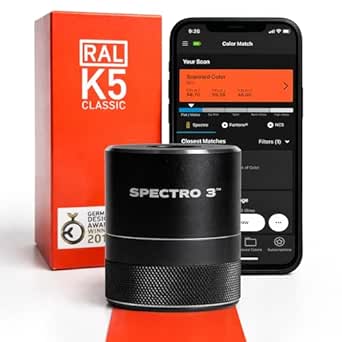 | Best for Multi-Material Color Quality Checks | Measurement: Color and 60° gloss | Optical geometries: 45/0° and d/8° | Battery life: 1,000+ measurements per charge | VIEW LATEST PRICE | See Our Full Breakdown |
| VEYKOLOR Color Sensor Colorimeter with Display and App |  | Best for Standalone Readouts and Color Formats | Display: 1.14-inch screen | Measurement repeatability: ΔE00 ≤ 0.08 | Color formats: sRGB, CMYK, CIELAB, HEX, LCH, LRV, and opacity | VIEW LATEST PRICE | See Our Full Breakdown |
| Astro Pneumatic Tool 50SL Rechargeable Color Match Light, 400 lm, CRI 97 |  | Best for Inspecting Paint by Eye | Model: 50SL | Brightness: 400 lumens | Color rendering index: CRI 97 | VIEW LATEST PRICE | See Our Full Breakdown |
| Spectro 1 Pro Spectrophotometer Paint Color Matching Tool |  | Best for Paint-Brand Fan Deck Matching | Manufacturer: Variable, Inc. | Part number: 9200SCI | Model number: 9200SCI | VIEW LATEST PRICE | See Our Full Breakdown |
| Nix Mini 3 Portable Color Sensor and Colorimeter |  | Best for Broad Paint-Color Library Matching | Brand: Nix | Model: NIXMINI003 | Color values: RGB, HEX, CMYK, and more | VIEW LATEST PRICE | See Our Full Breakdown |
| COLOR MUSE 2 Colorimeter Paint Color Matching Tool with Protective Case |  | Best for Larger Interior Projects | Brand: COLOR MUSE | Model: 9000Bundle | Connectivity: Bluetooth | VIEW LATEST PRICE | See Our Full Breakdown |
| Color Muse Colorimeter, Mobile Color Matching Tool |  | Best for Portable App-Based Color Work | Brand: COLOR MUSE | Model number: 9600 | Item weight: 27.22 g | VIEW LATEST PRICE | See Our Full Breakdown |
| Datacolor ColorReader Paint Color Matching Tool |  | Best for Detailed Digital Color Values | Model: CR100 | Measurement accuracy: 92% | Light source: Six high-CRI white LEDs | VIEW LATEST PRICE | See Our Full Breakdown |
| LS173 D/8 Portable Digital Colorimeter |  | Best for Professional Measurement and Records | Optical geometry: D/8, including specular reflected light | Measurement time: Approximately 1 second | Measurement repeatability: ΔE*ab standard deviation within 0.03 | VIEW LATEST PRICE | See Our Full Breakdown |
| Master Elite Rechargeable LED Color Matching Light, 500 Lumens |  | Best for Visual Paint Inspection | Light output: 500 lumens | Color temperatures: 2700K, 4500K, and 6500K | Color rendering index: 96+ CRI | VIEW LATEST PRICE | See Our Full Breakdown |
| paint identification tool | Connectivity | Included components |
|---|---|---|
| Spectro 3 Mobile Spectrophotom | Spectro by Variable mobile app | — |
| VEYKOLOR Color Sensor Colorime | — | Stand, cards, and storage box |
| Astro Pneumatic Tool 50SL Rech | — | — |
| Spectro 1 Pro Spectrophotomete | Wireless | — |
| Nix Mini 3 Portable Color Sens | — | Diagnostics tile, lanyard, and soft USB-C cable |
| COLOR MUSE 2 Colorimeter Paint | Bluetooth | Bluetooth module, Color Muse app, and protective case |
| Color Muse Colorimeter | Wireless connection to the Color Muse app | Device, micro USB charging cable, and user guide |
| Datacolor ColorReader Paint Co | Bluetooth | ColorReader device, Micro USB cable, and calibration cap |
| LS173 D/8 Portable Digital Col | — | — |
| Master Elite Rechargeable LED | — | — |
More Details on Our Top Picks
Spectro 3 Mobile Spectrophotometer and Paint Color Matching Tool
The Spectro 3 is the most versatile pick here for buyers who need more than a paint match: it measures both color and 60° gloss across paint, plastic, fabric, leather, and printed material. Its dual optical geometries and built-in UV detection can help distinguish samples that appear similar under ordinary viewing, making it better suited to material comparison and quality-control workflows than the paint-focused Spectro 1 Pro. The mobile app adds a way to save readings and compare colors, while the stated capacity of 1,000+ measurements per charge supports repeated use away from a desk. The tradeoff is added complexity for a buyer who only needs a paint-library match; advanced quality tracking also requires the optional QC Module. At 11.7 ounces, it is portable, but not the lightest tool in this group.
Pros:- Measures color and 60° gloss in one device
- Works across paints, plastics, fabrics, leather, and printed materials
- Dual optical geometries and UV fluorescence detection support more detailed sample comparisons
- Rated for more than 1,000 measurements per charge and connects to a mobile app
Cons:- Advanced quality-control tracking requires the optional QC Module
- More involved than a basic paint-matching sensor for occasional household use
Best for: Paint and materials professionals who compare colors and gloss across several surface types and want app-based measurement records.
Not ideal for: Homeowners seeking a simple paint-chip match; its broader measurement capabilities may be unnecessary, and advanced QC tracking needs an optional module.
- Measurement:Color and 60° gloss
- Optical geometries:45/0° and d/8°
- Battery life:1,000+ measurements per charge
- Connectivity:Spectro by Variable mobile app
- UV detection:Built-in UV illumination for fluorescence detection
- Item weight:11.7 ounces
- Package dimensions:6 x 3 x 3 inches
- Battery:One included lithium-ion battery
Our verdict“Choose the Spectro 3 if your paint identification work also involves gloss and color checks across multiple materials.”
VEYKOLOR Color Sensor Colorimeter with Display and App
The VEYKOLOR Color Sensor suits buyers who want a colorimeter that can show readings on the device itself, without making a phone the only way to access results. Its 1.14-inch display and support for formats including CIELAB, HEX, CMYK, LCH, and LRV make it more data-oriented than the Nix Mini 3, whose central advantage is searching a large paint-color library. VEYKOLOR’s app can match color cards and save or share measurements, and its listed repeatability is ΔE00 ≤ 0.08. The limitation is sample handling: readings need a flat, solid, light-tight surface, and paper is the recommended surface. That makes it less suited to scanning textured walls in place. App availability also deserves a check for Android users, since Google Play availability was still under review in the supplied product information.
Pros:- On-device screen provides readings without relying solely on a phone
- Reports multiple color formats, including CIELAB, HEX, CMYK, LCH, and LRV
- App supports color-card matching plus saving and sharing measurements
- Listed measurement repeatability is ΔE00 ≤ 0.08
Cons:- Reliable readings require a flat, solid, light-tight sample
- Paper is the recommended surface, limiting convenience for direct wall scans
- Google Play app availability was still under review in the supplied product information
Best for: Color-conscious DIYers, print or design users, and paint buyers who want on-device readings in several digital color systems.
Not ideal for: People who need to scan rough, curved, or installed wall surfaces, or Android buyers who require confirmed Google Play app access.
- Display:1.14-inch screen
- Measurement repeatability:ΔE00 ≤ 0.08
- Color formats:sRGB, CMYK, CIELAB, HEX, LCH, LRV, and opacity
- App color cards:Pantone Coated/Uncoated and RAL 5
- Surface recommendation:Paper
- Included components:Stand, cards, and storage box
- Power note:Charge for 20 minutes if the device does not turn on
Our verdict“Pick VEYKOLOR if you value a standalone display and detailed color values more than direct scanning of uneven walls.”
Astro Pneumatic Tool 50SL Rechargeable Color Match Light, 400 lm, CRI 97
The Astro Pneumatic 50SL takes a different approach to paint identification: it does not scan a color or return a database match. Instead, its CRI 97 light helps reveal color differences, coverage flaws, and surface imperfections under a more color-faithful light. That makes it a useful companion for judging a repair or comparing paint in place, while a sensor such as the Spectro 1 Pro is the better choice when you need a measured reading and app-based matching. The 50SL’s magnetic base and rotating hook free up your hands and allow flexible positioning; its impact-resistant build suits workshop use. The tradeoff is clear: this is an inspection light, not a substitute for a colorimeter, and the supplied details do not specify battery runtime or measurement functions.
Pros:- CRI 97 illumination helps expose color variation and paint imperfections
- Removable lens can be cleaned
- Rotating hook and folding magnetic base support flexible, hands-free placement
- Impact-resistant construction is suited to workshop conditions
Cons:- Provides illumination rather than a measured color reading or database match
- Supplied product details do not specify battery runtime
Best for: Auto-body, maintenance, and DIY users who need to inspect paint color, finish, and imperfections under high-CRI illumination.
Not ideal for: Buyers who need a numerical color reading, paint-library lookup, or saved app-based comparisons.
- Model:50SL
- Brightness:400 lumens
- Color rendering index:CRI 97
- Power:Rechargeable
- Lens:Removable and cleanable
- Hook:Collapsible, 360-degree rotating
- Base:180-degree folding magnetic
- Durability:Impact resistant
Our verdict“Choose the 50SL to inspect paint accurately by eye, but pair it with a colorimeter if you need an exact digital match.”
Spectro 1 Pro Spectrophotometer Paint Color Matching Tool
For buyers focused on identifying a paint color rather than checking a range of materials, the Spectro 1 Pro keeps the job centered on handheld color reading and matching through the Spectro app. Its support for major paint-brand fan deck libraries gives it a more direct paint-selection role than the broader Spectro 3, which adds gloss and multi-material measurements. Wireless connection works with iOS and Android, and the included pouch and charging cable make it straightforward to carry between rooms or job sites. At 8 ounces, it is also lighter than the Spectro 3. The tradeoff is narrower stated functionality: the supplied specifications do not list gloss measurement, UV detection, or measurement capacity per charge. Buyers needing those capabilities should look to the Spectro 3 instead.
Pros:- Supports fan deck libraries from major paint brands
- Wireless connection to the Spectro app on iOS and Android
- Portable 8-ounce handheld design
- Includes a USB charging cable and protective carrying pouch
Cons:- Supplied specifications do not list gloss measurement or UV detection
- Does not have the Spectro 3’s stated multi-material and color-plus-gloss scope
Best for: Painters and homeowners who want a portable scanner linked to major paint-brand fan deck libraries on iOS or Android.
Not ideal for: Users comparing gloss or multiple material types, or anyone who needs specified battery measurement capacity and UV detection.
- Manufacturer:Variable, Inc.
- Part number:9200SCI
- Model number:9200SCI
- Weight:8 ounces
- Dimensions:8 x 2.5 x 2 inches
- Connectivity:Wireless
- Compatible platforms:iOS and Android
- Included accessories:USB charging cable and protective carrying pouch
Our verdict“Choose the Spectro 1 Pro for portable paint-library matching, and step up to the Spectro 3 if gloss or cross-material checks matter.”
Nix Mini 3 Portable Color Sensor and Colorimeter
The Nix Mini 3 is the strongest fit for buyers whose main question is, “Which available paint color is closest to this surface?” Its library of 300,000+ brand-name paint colors and support for Pantone, RAL, and NCS databases give it a broader lookup emphasis than the Spectro 1 Pro, whose supplied details highlight major paint-brand fan decks. Nix also returns digital values such as RGB, HEX, and CMYK, needs no calibration, and carries an IPX4 water-resistance rating. Those conveniences make it approachable for home projects and design references. The caveat is sample coverage: the library may vary by country or region, and performance is better with matte samples. If you need gloss readings or color checks across varied materials, the Spectro 3 offers capabilities this compact sensor does not claim.
Pros:- Paint library includes more than 300,000 brand-name colors
- Supports Pantone, RAL, and NCS databases
- Provides digital values including RGB, HEX, and CMYK
- Requires no calibration and has an IPX4 water-resistance rating
Cons:- Paint-library availability varies by country or region
- Coverage is better for matte samples than glossy surfaces
- Does not claim the Spectro 3’s gloss measurement or multi-material functions
Best for: Homeowners and designers who want to identify a surface color against a large paint library and retrieve digital color values.
Not ideal for: Buyers matching glossy or highly varied materials, or users who need guaranteed access to every library entry in their region.
- Brand:Nix
- Model:NIXMINI003
- Color values:RGB, HEX, CMYK, and more
- Paint library:300,000+ brand-name paint colors
- Supported color databases:Pantone, RAL, and NCS
- Water resistance:IPX4
- Included components:Diagnostics tile, lanyard, and soft USB-C cable
- Color:Black
Our verdict“Choose the Nix Mini 3 for broad paint-library lookup and digital color values, especially when your samples are matte.”
COLOR MUSE 2 Colorimeter Paint Color Matching Tool with Protective Case
The COLOR MUSE 2 is a focused choice for identifying paint colors and sheen on smooth, flat interior walls. Its app links scans to libraries from Sherwin-Williams, Behr, PPG, and Benjamin Moore, giving you more brand routes than the Datacolor ColorReader, whose listed compatibility covers three major brands. A protective case also makes it easier to carry between rooms or job sites. The key limitation is the intended use: the product description says spot touch-ups are not recommended, so it is better for planning a larger repaint than matching a tiny patch. You will also need to judge colors on physical samples, since phone-screen color can differ from the scanned result.
Pros:- Identifies both paint color and sheen
- App provides access to several major paint-brand libraries
- Bluetooth connects scans to the Color Muse app
- Protective case helps when carrying the device between locations
Cons:- Not recommended for spot touch-ups
- Phone-screen colors may not match the scanned color’s appearance
- Requires smooth, flat surfaces for scanning
Best for: Homeowners or painting contractors comparing smooth interior walls against several major paint-brand libraries before repainting a room or larger area.
Not ideal for: DIYers matching a small touch-up or scanning textured, curved, wet, or outdoor surfaces; it is designed for smooth, flat surfaces and is not waterproof.
- Brand:COLOR MUSE
- Model:9000Bundle
- Connectivity:Bluetooth
- Matching:Paint color and sheen
- Supported paint libraries:Sherwin-Williams, Behr, PPG, and Benjamin Moore
- Recommended surface:Smooth, flat surfaces
- Included components:Bluetooth module, Color Muse app, and protective case
- Waterproof:No
Our verdict“Choose the COLOR MUSE 2 for app-based color and sheen identification across larger smooth interior surfaces, not small patch repairs.”
Color Muse Colorimeter, Mobile Color Matching Tool
The original Color Muse Colorimeter suits people who want more than a paint-name match: its app can show RGB, CMYK, and LAB values, coordinate colors, and save or share scans. At just 27.22 g, it is the more travel-friendly pick beside the larger touchscreen LS173 D/8, which is built for broader measurement and data-storage work. The Color Muse’s strength is a straightforward phone-linked workflow across paint brands and products, rather than the LS173’s extensive standalone color-space and record-keeping features. That simplicity has limits: scans work best on smooth, flat surfaces, the device is not water resistant, and displayed colors can differ from what a phone screen shows. It makes sense for mobile color reference, not demanding field conditions.
Pros:- Lightweight at 27.22 g for carrying between rooms or locations
- App provides RGB, CMYK, and LAB color values
- Supports saving, comparing, and sharing scans
- App connects scans to a broad library of paint brands and products
Cons:- Not water resistant
- Best results require a smooth, flat scanning surface
- Phone-screen appearance may differ from the scanned color
Best for: Decorators, homeowners, and color consultants who need a lightweight scanner with digital color values and app tools for saving, comparing, and sharing results.
Not ideal for: Users who need a rugged or water-resistant meter, a standalone display, or reliable scans from textured and uneven surfaces.
- Brand:COLOR MUSE
- Model number:9600
- Item weight:27.22 g
- Color accuracy:Over 90%
- Connectivity:Wireless connection to the Color Muse app
- Digital color values:RGB, CMYK, and LAB
- Water resistance:Not water resistant
- Included components:Device, micro USB charging cable, and user guide
Our verdict“Pick this Color Muse for lightweight, app-led color matching and digital values, but choose the LS173 if you need a standalone screen and deeper measurement records.”
Datacolor ColorReader Paint Color Matching Tool
The Datacolor ColorReader is a strong fit when paint identification needs to feed into design or documentation work. It reports an unusually broad set of values, including CIELAB, HEX, RGB, CMYK, LCh, LRV, and Delta E, then uses its app to cross-reference colors with Sherwin-Williams, Benjamin Moore, and Behr. Compared with the Color Muse Colorimeter, its listed advantage is the wider set of named output formats; the Color Muse, by contrast, adds tools to coordinate, save, and share scans. Six high-CRI white LEDs illuminate the measurement area to support consistent readings, while its pocket-sized build suits on-site use. The tradeoff is app dependence for brand matching, so it is less useful as a self-contained tool than the touchscreen LS173 D/8.
Pros:- Reports a wide range of color formats, including LRV and Delta E
- App cross-references scans with Sherwin-Williams, Benjamin Moore, and Behr
- Six high-CRI LEDs provide consistent illumination for readings
- Pocket-sized design supports on-site scanning
Cons:- Requires the mobile app for paint-brand matching
- Listed brand compatibility covers fewer paint libraries than the COLOR MUSE 2
- Included connection cable is Micro USB rather than USB Type-C
Best for: Interior designers, decorators, and paint professionals who need portable scans with multiple digital color formats and matches from three major paint brands.
Not ideal for: Buyers who want paint-brand matches without a phone app, or who need a standalone display and extensive onboard measurement storage.
- Model:CR100
- Measurement accuracy:92%
- Light source:Six high-CRI white LEDs
- Color data formats:CIELAB, HEX, RGB, CMYK, LCh, LRV, Delta E, and Lab
- Compatible paint brands:Sherwin-Williams, Benjamin Moore, and Behr
- Connectivity:Bluetooth
- Warranty:1 year
- Included components:ColorReader device, Micro USB cable, and calibration cap
Our verdict“Choose the ColorReader when detailed digital color output matters more than standalone operation or the broader paint-library list of the COLOR MUSE 2.”
LS173 D/8 Portable Digital Colorimeter
The LS173 D/8 is the most measurement-focused option in this group, suited to users who need repeatable readings, stored results, and exports—not just a suggested paint match. Its 3.5-inch touchscreen and onboard electronic color cards make it less dependent on a phone than the Color Muse and Datacolor tools, while USB and Bluetooth provide routes to move data elsewhere. The one-second reading time and stated ΔE*ab repeatability within 0.03 support frequent comparison work; its many color spaces and difference formulas extend well beyond routine home repainting. That capability comes with more complexity and a 245 g handheld unit, compared with the 27.22 g Color Muse. Water and impact resistance are not specified, and app-based Bluetooth export requires LColor.
Pros:- Supports a wide selection of color spaces and nine color difference formulas
- Stores measurement records and includes 46 electronic color cards with over 20,000 colors
- Exports data by USB or Bluetooth
- Touchscreen, rechargeable battery, and approximately one-second measurements support frequent use
Cons:- More measurement capability and data handling than most casual paint-matching jobs require
- Bluetooth export requires the LColor mobile app
- Water and impact resistance are not specified
Best for: Paint, coatings, and materials professionals who compare colors repeatedly, need onboard records, and use technical color spaces or difference formulas.
Not ideal for: Homeowners seeking a simple paint-name suggestion for an occasional wall repaint; its extensive measurement functions may be unnecessary, and resistance to water or impact is unspecified.
- Optical geometry:D/8, including specular reflected light
- Measurement time:Approximately 1 second
- Measurement repeatability:ΔE*ab standard deviation within 0.03
- Measurement aperture:8 mm
- Display:3.5-inch IPS capacitive touchscreen
- Color spaces and formulas:Multiple color spaces, spectral reflectance, and nine color difference formulas
- Data storage:Up to 1,000 standard colors, 1,000 color difference records, 1,000 measurement records, and 100 spectral curves
- Data transfer:USB to PC software or Bluetooth to the LColor mobile app
- Battery and weight:4,000 mAh rechargeable battery; up to 10,000 measurements per charge; 245 g
Our verdict“Choose the LS173 D/8 for technical color comparison and onboard data management; for simpler app-based paint matching, the Color Muse or ColorReader is more focused.”
Master Elite Rechargeable LED Color Matching Light, 500 Lumens
Unlike the COLOR MUSE 2 and Datacolor ColorReader, the Master Elite LED Color Matching Light does not scan a surface or return a paint formula. It helps you judge color and spot defects under controlled illumination—a useful companion when a meter’s suggested match needs a visual check, especially for automotive paint work. Its three color temperatures let you compare appearance under different light conditions, and the 96+ CRI supports clearer color discrimination. The tilting head, magnet, and hanging hook make it easier to direct light across panels or work areas. The main compromise is endurance: runtime is 2.5 hours against a four-hour recharge, so extended work may require charging breaks. Choose this for inspection, not digital identification.
Pros:- Three color temperatures support visual checks under different lighting conditions
- 96+ CRI helps reveal color variation and paint defects
- Tilting head, built-in magnet, and fold-out hanging hook offer flexible positioning
- Rechargeable design includes a battery status indicator
Cons:- Does not scan surfaces or identify paint colors digitally
- Runtime is limited to 2.5 hours per charge
- Charging takes 4 hours
Best for: Automotive technicians and paint finishers who need adjustable, high-CRI light to inspect color match and reveal surface defects.
Not ideal for: Homeowners who want a scanner to identify a paint name or compare digital color values; this light illuminates surfaces but does not measure or match them in an app.
- Light output:500 lumens
- Color temperatures:2700K, 4500K, and 6500K
- Color rendering index:96+ CRI
- Light source:COB LED
- Power source:Rechargeable lithium-ion battery
- Working time:2.5 hours
- Charging time:4 hours
- Head adjustment and mounting:Tilts up to 180 degrees; fold-out swivel hanging hook and built-in magnet
Our verdict“Choose the Master Elite for visual inspection of paint color and finish, but pair it with a colorimeter if you need an actual paint identification.”

How We Picked
I ranked these options by how directly they help identify paint color, how understandable their readings are, and how well their workflow fits common jobs such as matching a wall, checking a sample, or comparing colors at a store. I also weighed portability, display or app dependence, included protection, and whether a product measures color or only improves the light used for visual judgment.
The order favors dedicated measuring tools with a clear paint-matching purpose, followed by portable colorimeters and then specialist or lighting tools with narrower roles. The Spectro 3 Mobile takes the lead for its direct matching focus; other picks rank higher or lower based on ease of use, measurement workflow, or specialization. Lights are included because lighting can prevent visual misjudgments, but they rank differently from tools that produce a color reading. I did not treat every product as interchangeable: a light cannot replace a colorimeter, and a technical meter may be excessive for a one-time room touch-up.
| paint identification tool | Connectivity | Included components |
|---|---|---|
| Spectro 3 Mobile Spectrophotom | Spectro by Variable mobile app | — |
| VEYKOLOR Color Sensor Colorime | — | Stand, cards, and storage box |
| Astro Pneumatic Tool 50SL Rech | — | — |
| Spectro 1 Pro Spectrophotomete | Wireless | — |
| Nix Mini 3 Portable Color Sens | — | Diagnostics tile, lanyard, and soft USB-C cable |
| COLOR MUSE 2 Colorimeter Paint | Bluetooth | Bluetooth module, Color Muse app, and protective case |
| Color Muse Colorimeter | Wireless connection to the Color Muse app | Device, micro USB charging cable, and user guide |
| Datacolor ColorReader Paint Co | Bluetooth | ColorReader device, Micro USB cable, and calibration cap |
| LS173 D/8 Portable Digital Col | — | — |
| Master Elite Rechargeable LED | — | — |
Factors to Consider When Choosing Best Paint Identification Tools
Before choosing a tool, decide whether you need a measured color result or a more dependable way to inspect color by eye. These broader factors can help you avoid buying a capable device that does not fit your surface, workflow, or level of precision.
Choose Between Measurement and Better Viewing
A colorimeter or spectrophotometer reads a surface and returns color information; a matching light changes the conditions under which you inspect it. Those jobs overlap only partly, so do not buy a light expecting it to identify a paint formula. For a repair where you need a close starting match, a measuring device is usually the more direct tool. For comparing swatches or checking how a color shifts under different light, a high-CRI light can be more useful. Some projects benefit from both, but occasional touch-ups rarely justify buying two tools at once. Start with the part of the process that is currently causing mistakes.
Match the Tool to the Surface
Color readings depend on the surface placed against the sensor, not just on the paint’s original formula. Gloss, texture, dirt, fading, and repairs can change what a device sees, so a reading from a rough or curved wall may not represent a clean sample. When possible, scan a flat, clean area or a removable sample painted with the same coating. Avoid assuming that a device can identify a brand or formula from every surface it can touch. A useful reading is a starting point for comparison, not a guarantee that a new can will disappear into an aged wall. If the surface is inconsistent, take readings from more than one representative area and compare them.
Check How Results Reach You
Some tools rely on a phone app, while others include a display or use a more technical interface. App-based workflows can make it convenient to save or share readings, but they add phone compatibility and connectivity to the setup. A built-in display can be easier when you want to read results without switching between devices. Before buying, check whether the product’s output is useful for your actual task: identifying a nearby color, recording a measurement, or communicating with a paint counter. Do not assume every sensor provides a ready-to-order paint formula. If you will use the tool away from home, prioritize a workflow you can complete without a complicated setup.
Set Realistic Expectations for Accuracy
A color tool can reduce guesswork, but it cannot erase differences in paint age, sheen, substrate, or application. A close color match in a small sample may look different across a large wall or under another room’s lighting. Treat a reading as a way to narrow options, then verify a sample in the intended space before committing to a full repaint. Buyers often focus on sensor precision while overlooking whether the finish is matte, eggshell, or glossy; finish affects how color appears. For repairs on an older surface, blending a larger area may matter more than finding the nominal color name. Pay for more technical measurement when repeatability matters, not just because a specification sounds advanced.
Weigh Portability Against Handling and Protection
A small sensor is easy to carry to a store or from room to room, but compact size can make careful placement harder on uneven surfaces. A protective case, such as the one supplied with COLOR MUSE 2, can help keep a sensor safer between jobs. Larger or more technical meters may be a better fit for regular work where consistent handling matters more than pocketability. Lights have a different portability question: think about whether you need hands-free inspection, broad illumination, or a compact light you can aim at a sample. Check charging and storage needs before buying, especially if the tool will live in a work bag. Choose the smallest form that still lets you take repeatable readings comfortably.
Decide When a Specialist Tool Is Worth It
A specialist meter such as the LS173 D/8 can suit users who need a more technical measurement workflow, but extra capability is not automatically useful for household matching. Professional painters, finish specialists, and people comparing many samples may benefit from a dedicated instrument more than someone fixing one scuffed corner. Beginners often get more practical value from a portable device with a straightforward app or display and clear instructions. A matching light is a sensible specialist purchase when visual color checks happen often, but it should complement rather than replace measurement when a named match is required. Write down how often you will use the tool and what decision it must support. That simple test helps separate a worthwhile upgrade from equipment that will sit unused.
Frequently Asked Questions
Can a paint identification tool tell me the exact brand and formula?
Not every tool provides a brand-specific formula, and a color reading is not the same as a paint maker’s original recipe. A sensor may return a color value or suggest a close match from a supported library, while the paint counter may still need to translate that result into its own system. Surface age, sheen, and texture can also make a reading differ from the original paint. Ask what the device reports and which paint databases or workflows it supports before buying. For a patch repair, test the suggested match on a sample and check it after it dries.
Should I buy a colorimeter or a color-matching light?
Buy a colorimeter or spectrophotometer when you need a reading to help identify or compare a color. Choose a matching light when you already have colors to compare but need more consistent viewing conditions. The Astro Pneumatic 50SL and Master Elite lights help with visual inspection; they do not perform the same job as the Spectro, Nix, or Color Muse sensors. If you are unsure, start with the task you need solved most often rather than buying both types. A light can still be a useful companion when room lighting makes visual comparisons unreliable.
Will these tools match paint on a textured or glossy wall?
They may provide a reading, but textured and glossy surfaces can make that reading less representative or harder to repeat. Texture can prevent a sensor from sitting evenly, while gloss and reflections affect how color is perceived and measured. Try a clean, flat section and take several readings if the wall varies. For a dependable comparison, a smooth sample painted with the same finish can be easier to scan than the wall itself. Even a close reading should be checked in the room where the paint will be used.
Is an app-based color tool a poor choice if I do not want to depend on my phone?
Not necessarily, but app reliance should be part of your buying decision. Phone-connected tools can make it easier to save and share results, while a model with a display, such as the VEYKOLOR, may suit someone who prefers to see information on the device. Check compatibility and the steps required to get a usable result before purchasing. If you expect to work where your phone is unavailable or inconvenient, favor a workflow that can show readings directly. The right choice depends on whether you value saved records or fewer device handoffs.
When does a specialist portable colorimeter make sense over a simple sensor?
A specialist instrument is more compelling when you take readings often, need a repeatable technical workflow, or compare many samples as part of paid work. The LS173 D/8 sits in a more technical part of this roundup than compact consumer-oriented sensors, so casual users may not benefit from its added complexity. For a single room or occasional touch-up, a more approachable portable device can be easier to operate and carry. Consider who will use the tool, how often, and what decisions depend on its readings. If those answers point to routine measurement rather than occasional matching, the specialist route may fit.
Conclusion
For most buyers seeking a dedicated paint-matching tool, I recommend the Spectro 3 Mobile as the best overall starting point. The best value direction is a compact consumer sensor such as the Color Muse or Nix Mini 3, chosen according to the workflow and support you prefer; compare current included features before deciding. For a best premium, specialist choice, look at the LS173 D/8 when technical measurement matters more than simplicity. Beginners may find the VEYKOLOR appealing if an on-device display suits them, while the COLOR MUSE 2 adds a protective case for portable use. For specific visual-inspection needs, pick the Astro Pneumatic 50SL or Master Elite light, knowing neither replaces a measuring device. Match the tool to the job: read a surface, inspect a color under better light, or do both when your work calls for it.
Fall Picks
fall essentials
As an affiliate, we earn on qualifying purchases.