
Disclosure: Gewerkton is built by our publisher — we build it ourselves and write down what we learn.

Get tools and workshop supplies delivered free — and shop member deals
- Fast, free delivery on millions of items
- Access to Prime Big Deal Days deals on October 6–7
- Prime Video, Amazon Music and more included
On a site walk, a defect is spotted in seconds and written up hours later: on a notepad, in the phone’s camera roll, back in the site office at the end of the day. By then the exact location, the responsible trade or the deadline has often gone missing. Gewerkton, a documentation platform for construction sites, aims at that gap. In Field, its line for work on site, a defect is spoken rather than typed, backed by a photo and given a deadline while the person is still standing in front of it. The result is a proposal. It only becomes binding once site management approves it.
One sentence instead of a form
The Field page on gewerkton.com puts it in one line: “One sentence during your walk-through becomes a pre-filled defect — trade and deadline included.” The tour of the app is shorter still: “Dictate a defect instead of typing. Gewerkton prepares the form.” And the next step: “Every defect lands with a trade, a company and a deadline.”
In practice, the defect is no longer pieced together afterwards from memory and photos. It is described where it can be seen. Whoever mentions location, trade, responsible company and deadline in the same breath gets a form with those details already filled in. Anything unknown can be left out and added during review.
Quick dictation: one defect, one recording
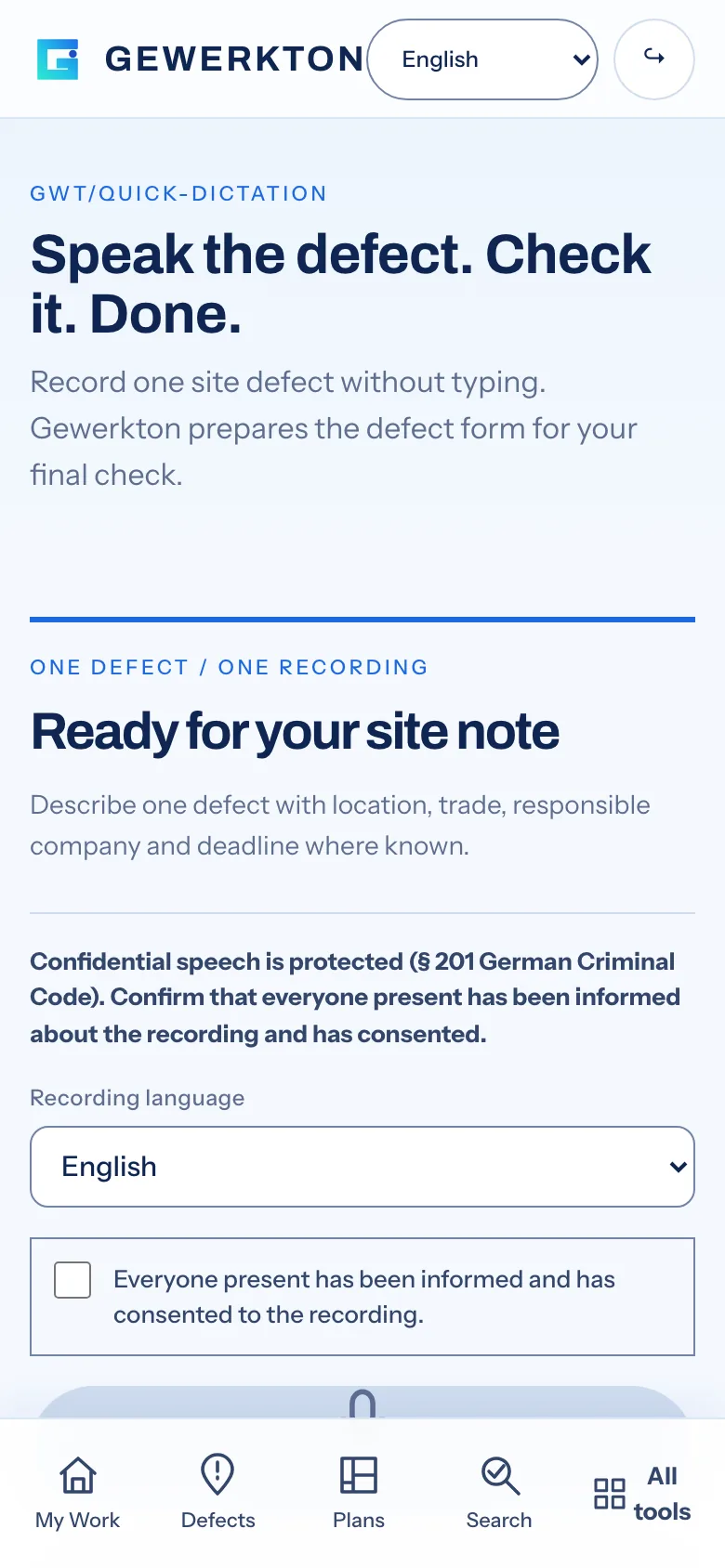
In the web app the feature is called quick dictation, under the headline “Speak the defect. Check it. Done.” The rule is deliberately narrow: one defect per recording. Before starting, the page asks for a description of that one defect, with location, trade, responsible company and deadline where known. The recording language is chosen up front.
The recording is then transcribed and turned into exactly one editable proposal. A human check is required. The proposal can be corrected, and only saving creates the defect, which closes the dictated item in the same step. If the system does not recognise a defect, it asks for a new recording that names the action or fault as specifically as possible.
Consent comes before every recording. The web app points out that confidential speech is protected under Section 201 of the German Criminal Code and asks for confirmation that everyone present has been informed and has agreed.
In the app: sentence, photo, deadline
In the app for iPhone and Android, the path starts on the home screen. There, “Speak instead of typing” records a voice note, even with gloves on, and “Write down a defect” leads step by step through room and photo. The defect form insists on one thing only: a short description of the problem. It is saved immediately, with or without a connection.
The deadline is tapped rather than typed: no deadline, today, tomorrow or in a week. Urgency works the same way: can wait, normal or urgent. If a room is active on the device, it already appears as the location. If the location or an overview photo is missing, the app recommends adding them but saves the defect regardless.
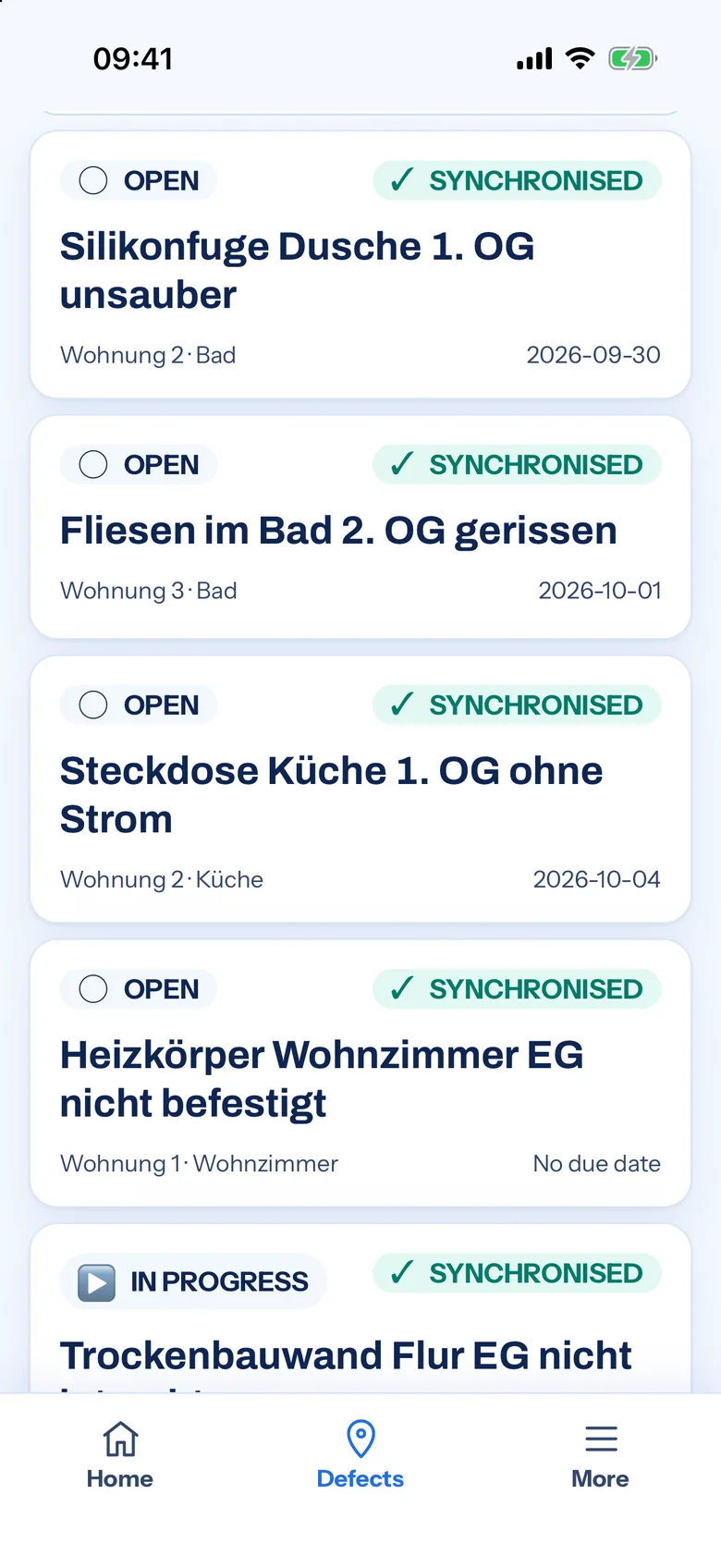
Photos have their own path, defect from photo: up to five pictures that stay on the device until there is a connection again. They turn into a proposal that a person reviews. Inside a defect, the app keeps before and after photos apart, and a defect can only be reported as fixed once at least one confirmed after-photo is on the server. A voice note can be attached directly to the defect once it has synced for the first time.
When the basement has no signal
Basements, underground car parks, stair cores: where there is no reception, the app still records under offline voice commands. The recording stays encrypted on the device. Once a connection is back, it runs exactly once through Gewerkton’s existing speech recognition, and the app states plainly that there is no cloud fallback. Four commands are available:
- Dictate defect: the speech becomes a proposal when the connection returns.
- Photo defect: speak first, then take the photo in the usual flow.
- Completion report: stays a proposal until it has been reviewed.
- Note: keeps the original audio safely for later.
Templates for individual trades are optional. In free dictation, the trade is simply named in the sentence and its assignment checked in the proposal afterwards. Longer dictations can be worked through segment by segment in the dictation stack, approving or discarding each part.
So that a long recording does not fail in a dead zone, the app stores it in five-minute chunks, hashes each chunk locally and deletes it from the device only after the server confirms receipt. While recording, a beta indicator shows whether speech is coming through clearly. When it gets too loud, it suggests moving closer, shielding the noise source and repeating important statements.
The original stays within reach
What was said on site is often disputed weeks later. That is why Gewerkton keeps the original as part of the record. The Field page says: “Every task links to the original spot in the transcript — with audio playback. When someone says “I never said that”, one click settles it.” Recording starts only after documented consent of everyone present.
Built, but not yet in use at a customer, is speech correction in dictation: misheard trades, components and numbers can be corrected without losing the original recording. Also built is the closing window. Before a layer is closed, Field asks for the photo, so that whatever disappears behind plaster, screed or ceiling is documented beforehand.
On privacy, Gewerkton’s website says transcription runs without external speech services. On premises, the recording never leaves the building; in the cloud, it stays in the EU system environment.
A proposal is not a decision
One principle runs through every screen: the software prepares, people decide. The defect detail in the app says that approval stays with site management, and the website states that nothing becomes binding without human approval by the site manager. A spoken defect starts life as an observation with location, photo and deadline.
On a busy site, that distinction matters. Whoever logs what they see during a walk-through is not yet issuing an instruction to a trade. Site management reviews the proposals, corrects whatever the recognition got wrong and approves. Foremen and trades then work with a defect that already carries location, deadline and evidence, instead of a note that someone still has to type up.
Where things stand
Gewerkton is in beta: 2026 is the beta year, and general availability is planned for 2027 but not promised. Field is in beta ahead of the public beta. The apps for iPhone and Android are at version 0.5.0. In a device test of the Android build on 3 October 2026, creating defects with and without a connection, taking a before-photo and recording audio with upload all passed.
Anyone who wants to try Field on their own site can request access at gewerkton.com. The beta page shows where each product line currently stands.
Fall Picks
fall essentials
As an affiliate, we earn on qualifying purchases.