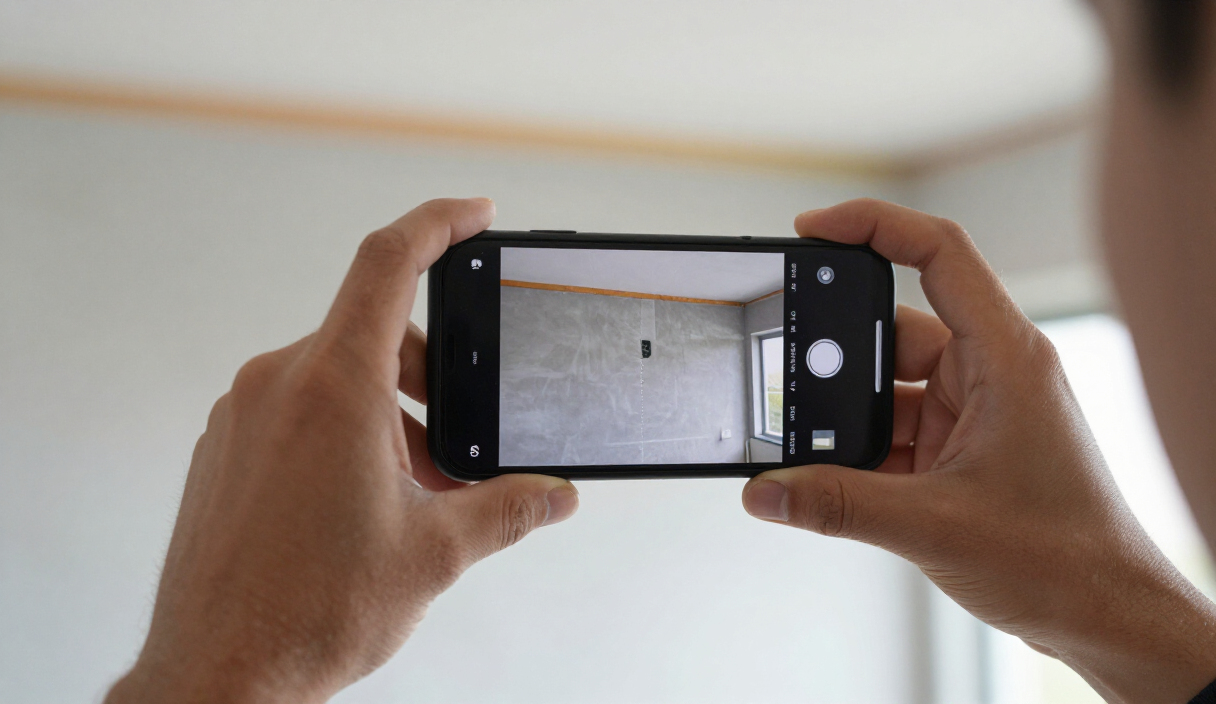
A construction site loses information in remarkably ordinary ways. A defect is photographed, but the image disappears into a crowded camera roll. An instruction is given beside the work, but nobody writes it down. A daywork report is reconstructed three weeks later from memory, messages and whatever fragments are still available.

Get business pricing on tools and workshop supplies
- Business-only prices and quantity discounts
- Tax-exempt purchasing
- Multiple users, one account, clear invoices
DIY & Bau · The usable job-site record
Capture the moment before it becomes reconstruction
Gewerkton’s site-manager story begins where information is usually lost: between seeing the work and turning it into structured, findable evidence.
The speakable daywork report
From live context to signed evidence
The report begins while the facts and people are still present—not three weeks later among memories, messages and fragments.
on site
the evidence
at handover
Capture ≠ evidence
A photograph is not yet a defect record
A camera-roll image shows that something was noticed. Field connects the defect to a photo, deadline and next action so it can be found when review matters.
One site story
Three connected product lines
Global architecture, original evidence
Multilingual capture without one forced AI vendor
Cross-border teams can work in their own language while the evidence original remains unambiguous. Organisations choose their provider, AI region and data location.
Product reality
Clear direction, still in beta
Gewerkton is not presented as a finished system with every workflow settled. The platform is in beta now, with a public beta planned for fall 2026.
Public beta: fall 2026
“On site, what counts is what’s proven.”
From a site manager’s perspective, that is the real documentation problem. The information often existed at the right moment. Someone saw the defect, gave the instruction or watched the work happen. What failed was the conversion of that moment into a structured, usable record.
Gewerkton approaches that gap through voice. It is a voice-first construction documentation and defect management platform for global markets, built around a straightforward principle: capture information where the work happens, then turn it into evidence that can be found and acted upon. The marketing line puts it neatly: “On site, what counts is what’s proven.”
The product is in beta now, with a public beta planned for fall 2026. That status matters. This is not a finished system being presented as if every workflow has already settled into its final form. It is a beta platform with a clear direction, and the most convincing part of that direction is the speakable daywork report.
construction site digital defect report device
As an affiliate, we earn on qualifying purchases.
As an affiliate, we earn on qualifying purchases.
The daywork report should begin on site
A daywork report becomes less reliable the further it moves away from the day itself. Reconstructing one weeks later means trying to recover details that were obvious at the time but difficult to separate afterwards. Which trade was involved? Who was responsible? What deadline was attached to the work? What was actually handed over?
Gewerkton Field makes dictation the starting point. The site manager speaks while the context is still present. That spoken account becomes structured evidence containing the trade, deadline and responsible person. At handover, the report can be signed on the device.
That sequence is the heart of the product line: dictate on site, structure the evidence, then collect the signature at handover. It keeps the record close to the work instead of turning reporting into a separate exercise that competes with the work.
The value is not merely that speaking can be quicker than typing. Voice also changes when documentation can happen. A report no longer has to wait until someone reaches a desk or opens a browser workspace. It can begin at the point where the facts are visible and the people involved are still available.
For a site manager, that matters because daywork is only one part of the information load. Defects, instructions, deadlines, responsibilities, takt and handovers all move through the same working day. If capture requires too much distance from the site, some of those details will inevitably be postponed. Once postponed, they become reconstruction.
voice-activated construction site documentation tool
As an affiliate, we earn on qualifying purchases.
As an affiliate, we earn on qualifying purchases.
A photograph is not yet a defect record
Taking a picture feels like documentation, but a photograph without structure can be difficult to use. The image may show the issue clearly while saying nothing about the responsible person, deadline or trade. Even when the site manager remembers the full context, that context may live only in memory.
Field is designed to take dictation into evidence and connect defects with a photo and deadline. The point is not to replace the photograph. It is to stop the photograph from becoming an isolated file that cannot be found when the defect needs to be reviewed.
This is the difference between capture and evidence. Capture proves that someone noticed something. Evidence gives that observation a place in the project record. It identifies what the item relates to and what needs to happen next.
The same discipline applies to verbal instructions. Infrastructure and tunnel projects may run for long periods and involve many change orders. In those environments, Gewerkton can back instructions with the original audio. The structured record supports the workflow, while the original audio preserves the source behind it.
That approach also matters on a much smaller project. A tinyhouse43-style self-builder may not be coordinating the same number of trades as a data centre or industrial plant, but the underlying problem remains familiar. A defect still needs a photo and deadline. A verbal instruction still needs to become a record. Daywork still becomes harder to reconstruct once the details have faded. Scale changes the volume, not the need for discipline.
construction project management tablet
As an affiliate, we earn on qualifying purchases.
As an affiliate, we earn on qualifying purchases.
Field carries the site story
Gewerkton has three product lines under one brand: Field, Studio and Cloud. Field is the voice-first construction site app and the part that carries this site-manager story. Its scope covers dictation to evidence, defects, daywork reports, takt and a portal.
That combination reflects how information appears on a live project. A site manager does not experience documentation as a neat series of separate software categories. A dictated observation may become a defect, a daywork item or a trade-specific action. A deadline may need to be assigned. A handover may require a signature on the device. The practical question is whether the record survives the transition from spoken moment to structured follow-up.

Housing and building construction provide the clearest expression of this workflow: defects recorded with photo and deadline, dictated daywork reports, and a signature on the device at handover. Yet the same Field principles extend well beyond conventional building sites.
- Wind farms and renewable-energy projects have distributed sites and rotating crews. Field supports field acceptance and offline capture in dead zones.
- Data centres and industrial plants involve many trades working in parallel against tight deadlines. Meeting decisions can become trade-sorted task lists.
- Infrastructure and tunnel projects run over long durations, often with many change orders. Instructions can be supported by their original audio.
- Cross-border projects can involve teams in the EU, US and APAC, with each person working in their own language while the evidence original remains unambiguous.
- Projects in Asia can include Chinese, Korean and Vietnamese crews, with multilingual handling from capture to report and data residency selected by the project.
These are different deployment fields, but they share the same weak point: useful information is easy to lose between the place where it was created and the system where it is supposed to live.
construction site photo and defect tracking app
As an affiliate, we earn on qualifying purchases.
As an affiliate, we earn on qualifying purchases.
Plans, models and coordination beyond the device
Field is the centrepiece on site, but it does not stand alone. Gewerkton Studio is the browser workspace for plans and models. Where no model exists, the site team can create one in the browser.
That gives captured site information a broader project context. The voice-first app handles the immediate record, while the browser workspace provides a place for plans and models. The distinction is useful: the tool used beside the work does not need to carry every coordination task, but the information captured there still needs somewhere to connect.
Gewerkton Cloud handles operations and model or data coordination between Field, Studio and third parties. Together, the three product lines form one branded house rather than unrelated tools.
For the site manager, the important point is continuity. A dictated report should not become another disconnected file. A defect with a photograph and deadline should remain part of the wider project information. Plans, models, site evidence and third-party coordination have different roles, but they must not become separate islands.
Multilingual capture without forcing one AI provider
Gewerkton was born in the German market and has its deepest German commercial integration through GAEB, REB, XRechnung and DATEV. Its intended market, however, is global. The platform supports 27 content languages and offers regional AI-provider choice across the EU, US and Asia, including mainland China.
The BYO-AI model covers 13 AI providers. Organisations can bring their own keys and select the region, avoiding dependence on a single vendor. For projects spread across borders, that means language handling and provider selection are both part of the architecture rather than afterthoughts.
This is particularly relevant when site teams do not all speak or document in the same language. Gewerkton’s cross-border deployment model allows people in the EU, US and APAC to work on the same project in their own language while keeping the evidence original unambiguous. For Chinese, Korean and Vietnamese crews, the workflow can remain multilingual from capture through to the report.
Data residency is also a choice: the EU cloud or the organisation’s own infrastructure. Combined with selectable AI regions, that gives projects control over where the system is operated and which provider handles the AI work.
Offline work matters because sites are not offices
Voice-first capture is only credible if it reflects the conditions in which site teams actually work. Wind farms and renewable projects make the issue particularly visible. Sites may be distributed, crews may rotate, and connectivity may disappear. Gewerkton Field supports offline capture in those dead zones.

That capability fits the basic purpose of the platform. If evidence can only be recorded after connectivity returns, the system once again creates a delay between observation and documentation. Offline capture keeps the record tied to the moment, even when the site cannot provide a reliable connection.
It also reinforces why Field is the right centrepiece for the product story. Studio and Cloud handle wider plans, models, operations and coordination. Field deals with the edge of the project, where information first enters the system and where working conditions are least like a conventional office.
A technically unusual beta
Gewerkton is being built by a solo founder directing a fleet of coding agents using Codex and Claude. In one night, that fleet shipped 21 software packages, verified with negative controls and mutation tests.
That development model is unusual, but it does not change the product’s present status: Gewerkton is in beta now, and the public beta is planned for fall 2026. Prospective users should evaluate it as a beta rather than treating the breadth of the platform as proof that every detail is final.
The surrounding marketing infrastructure follows the same technical direction. The Gewerkton website is available in 27 languages, uses zero trackers and requires no cookie banner. It is built with a fully egress-free architecture. A media bank contains more than 51 self-produced clips and posters.
Those details do not replace the need to test the actual site workflow. They do, however, show that language coverage, regional operation and information handling are being considered across the wider product, not only inside the mobile experience.
The record has to survive the working day
The strongest case for Gewerkton Field is not that construction needs more documentation. Site managers already deal with plenty of it. The stronger case is that documentation should begin where the facts are freshest and require less reconstruction later.
A photographed defect needs to remain findable and connected to its deadline. A spoken instruction needs a durable record and, where relevant, its original audio. A daywork report should be dictated while the work is still clear, structured by trade, deadline and responsible person, and signed on the device at handover.
That is a practical standard for large industrial projects, distributed renewable sites, housing, tunnels and cross-border teams. It is equally sensible for a disciplined self-builder working at tiny-house scale. The number of people and the size of the programme may change, but forgotten instructions and untraceable photographs create the same basic problem.
Gewerkton is still a beta product, so its promise should be judged through real use rather than polished claims. Yet its central idea is already easy to understand. Site information is most valuable at the moment it is observed. Field aims to turn that moment into structured evidence before it has the chance to disappear.
Fall Picks
fall essentials
As an affiliate, we earn on qualifying purchases.