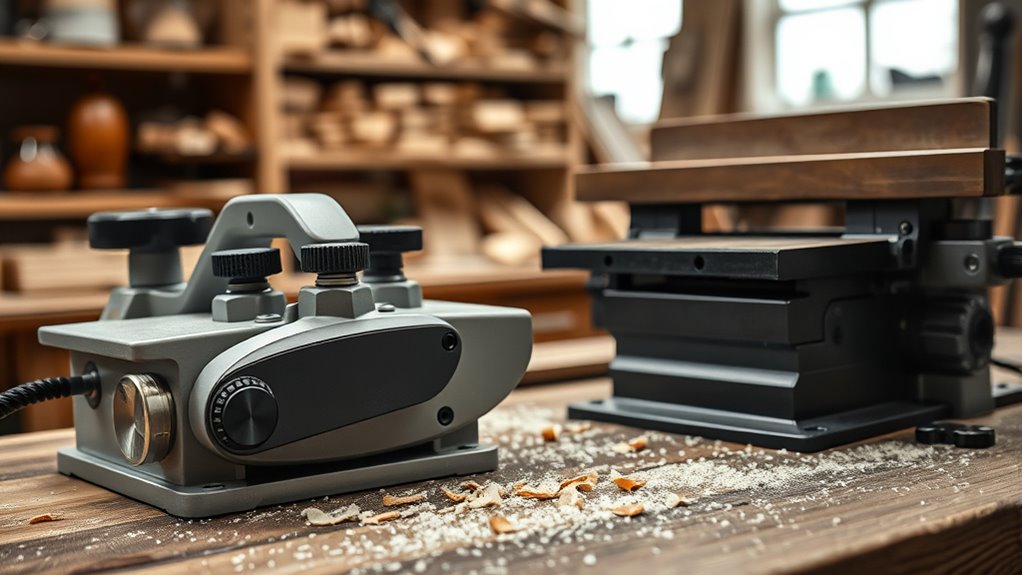
A planer and a jointer each play a key role in woodworking but serve different purposes. The jointer flattens and straightens rough or uneven surfaces and edges, ensuring grain runs smoothly. The planer, on the other hand, reduces thickness and creates uniform, parallel surfaces across large boards. Understanding how they differ helps you choose the right tool for each task. Keep exploring further to master how to use them effectively in your projects.
Key Takeaways
- A jointer flattens and straightens edges and faces, preparing wood for accurate joinery, while a planer reduces thickness and smooths large surfaces.
- Jointers cut with the grain facing down, focusing on straightening, whereas planers remove material uniformly regardless of grain orientation.
- Jointers establish flat, square edges; planers produce consistent thickness and smooth surfaces after jointing.
- Proper operation of each tool extends their lifespan and prevents damage: jointers avoid gouging, planers prevent rough finishes.
- Mastering both tools ensures precise shaping, with the jointer for flattening and the planer for finishing and thickness consistency.
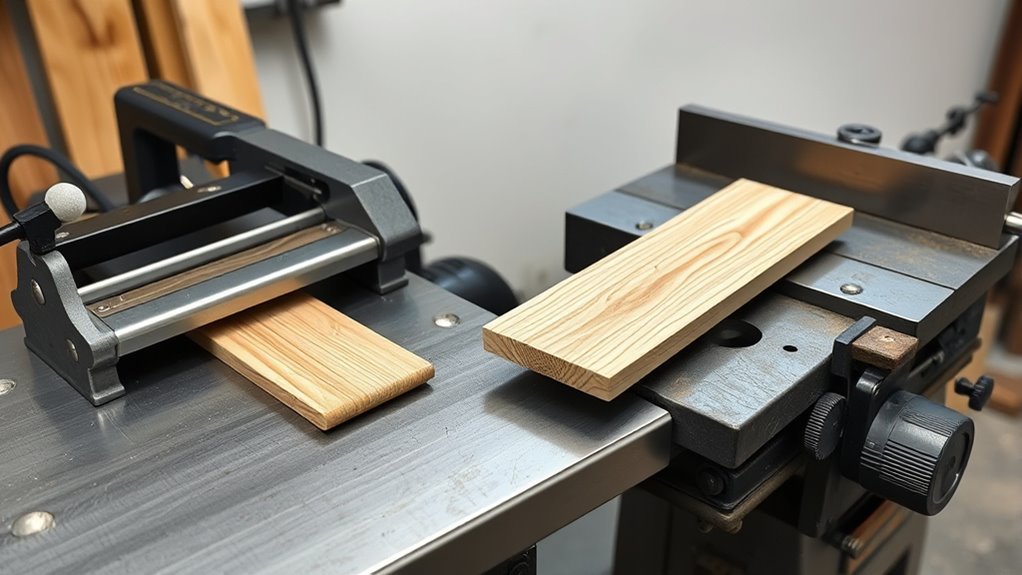
When establishing your woodworking shop, grasping the difference between a planer and a jointer is crucial. Both tools are fundamental for preparing lumber, but they serve distinct purposes. A jointer primarily focuses on flattening and straightening the face and edges of a board, ensuring the grain runs smoothly and uniformly. It’s especially useful when you need to establish a flat surface or a true, square edge before further processing. On the other hand, a planer’s job is to reduce the thickness of a board and make its surfaces parallel, giving you a consistent thickness across your project.
One key difference lies in how each tool interacts with the grain direction. When using a jointer, you typically feed the wood with the grain facing down the cutter head to minimize tear-out and achieve a clean, smooth surface. Properly aligning the grain direction with the cutter head reduces chances of splintering and ensures a cleaner cut. Meanwhile, a planer works differently; it removes material uniformly from the surface, regardless of grain direction, but it’s still important to think about grain orientation for maximum results. Running the board through a planer with the grain properly aligned helps prevent tear-out and produces a smoother finish.
Cutting speed also plays an important role in how these tools operate and how you should use them. Jointers operate at a relatively high cutting speed to shear off thin slices of wood efficiently. This speed helps produce a clean cut and reduces tear-out, especially when you’re working with rough or uneven surfaces. When you feed the board into the jointer, keep a steady pace to maintain a consistent cut and avoid gouging or uneven surfaces. In contrast, planers typically have a slower feed rate, designed to remove material gradually and evenly. If you push too quickly through a planer, you risk uneven thickness, rough surfaces, or even damaging the machine. Additionally, understanding the importance of cutting speed and grain direction can significantly improve your woodworking results and tool longevity.
Understanding how grain direction and cutting speed influence each tool’s performance will help you get better results and keep your equipment in good shape. When setting up your workshop, remember that the jointer’s main role is to straighten and flatten edges with attention to grain direction, while the planer is best suited for thicknessing and smoothing large, flat surfaces. Mastering these distinctions ensures you’ll produce high-quality, precise wood pieces while extending the lifespan of your tools.
Frequently Asked Questions
Can a Planer Replace a Jointer in Woodworking Projects?
A planer can’t fully replace a jointer in woodworking projects. While it’s great for thickness planning and smoothing flat surfaces, it doesn’t perform edge jointing, which is essential for creating tight, straight edges. For proper edge jointing, you need a jointer. Using a planer alone risks uneven edges and compromised glue joints. So, both tools are necessary for precise, high-quality woodworking results.
Which Tool Is Better for Flattening Uneven Wood Surfaces?
When it comes to flattening uneven wood surfaces, a planer is your best bet, like a surgeon smoothing out rough patches. It efficiently evens out surface irregularities while respecting the grain direction, ensuring surface uniformity. A planer excels at removing high spots and creating a consistent thickness across the board. While a jointer excels at edge jointing, for flatness, the planer’s your go-to tool for a smooth, even finish.
How Do I Choose Between a Planer and a Jointer for My Workshop?
When choosing between a planer and a jointer, consider your project needs. Use a jointer to straighten and flatten edges, paying attention to grain direction and blade adjustment for smooth results. Opt for a planer when you need to achieve uniform thickness across large surfaces. If you often work with rough or uneven wood, having both tools will give you the best flexibility and precision in your workshop.
Are There Safety Concerns Specific to Each Tool?
Think of each tool as a guardian with its own armor. When using a planer or jointer, you need to wear protective gear like goggles and ear protection to guard against flying debris. Also, guarantee electrical safety by inspecting cords and switches regularly. Always follow manufacturer instructions, keep hands clear of blades, and turn off the machine before adjustments. Respecting these safety concerns keeps your workshop safe and your projects smooth.
What Maintenance Is Required for Planers and Jointers?
You need to regularly maintain your planers and jointers by sharpening blades to make certain of clean cuts and efficient operation. Check and replace blades when dull, and clean or replace dust collection systems to prevent buildup. Keep the tables and fences aligned, and lubricate moving parts as needed. Proper maintenance extends the lifespan of your tools and keeps your woodworking projects safe and precise.
Conclusion
Remember, a tool is only as good as the hands that wield it. While a planer smooths and reduces thickness, a jointer straightens and flattens edges. Knowing when to use each ensures your woodworking projects come out just right. As the saying goes, “A chain is only as strong as its weakest link.” Mastering both tools will make your craftsmanship stronger and your projects more polished. Keep learning and keep creating!