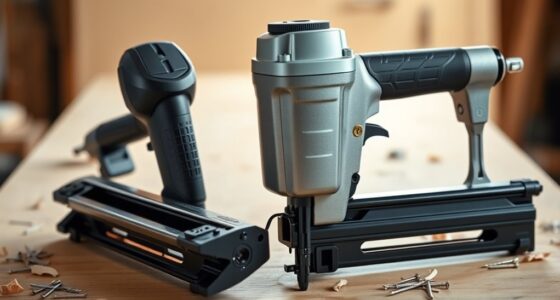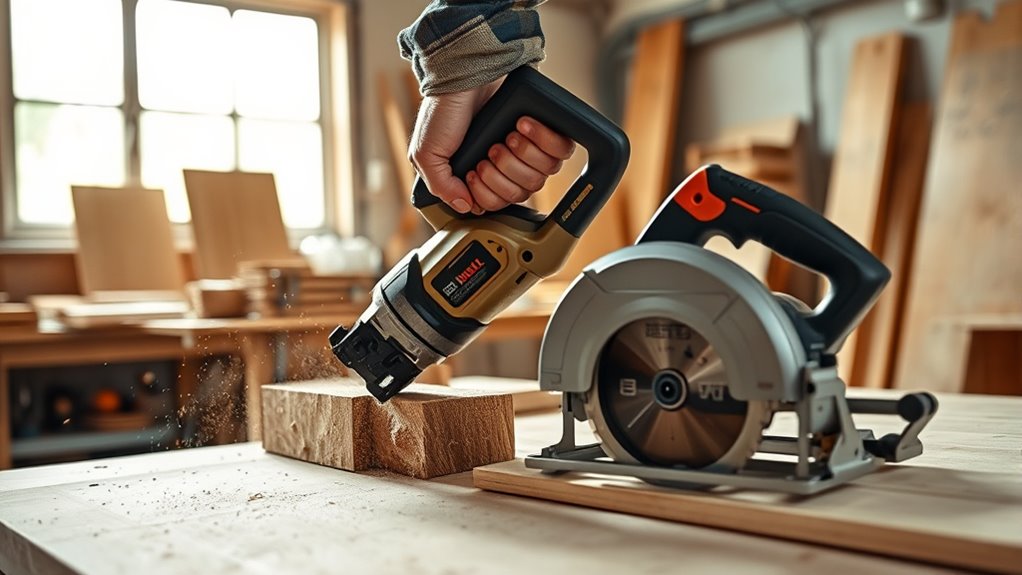
Use a reciprocating saw when you need to make rough cuts, work in tight spaces, or cut through materials like metal pipes, drywall, or wood with irregular shapes. It’s versatile for demolition or remodeling projects. On the other hand, choose a circular saw for precise, straight cuts in lumber, plywood, or other stable materials, especially for framing or finishing tasks. To discover which tool fits your project best, keep exploring the details below.

Get business pricing on tools and workshop supplies
- Business-only prices and quantity discounts
- Tax-exempt purchasing
- Multiple users, one account, clear invoices
Key Takeaways
- Use a reciprocating saw for demolition, irregular cuts, and working in tight or awkward spaces.
- Opt for a circular saw when precise, straight cuts in lumber or plywood are required.
- Choose a reciprocating saw for cutting metal pipes, drywall, and rough materials.
- Use a circular saw for framing, cabinetry, and projects needing clean, accurate edges.
- Select a reciprocating saw for versatility and demolition, and a circular saw for speed and precision in stable environments.
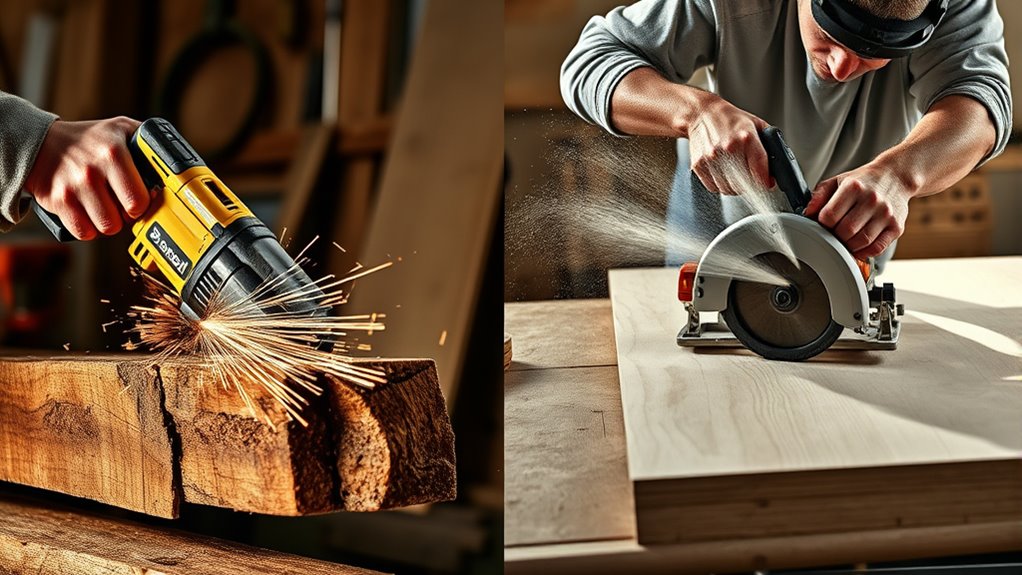
When choosing between a reciprocating saw and a circular saw, understanding their differences is essential to selecting the right tool for your project. One of the key factors to consider is blade types. Reciprocating saws, often called Sawzalls, use long, straight blades with a serrated edge that move back and forth rapidly. These blades come in various lengths and tooth configurations, designed for cutting through wood, metal, drywall, and more. Circular saw blades, by contrast, are circular discs with sharp teeth around the edge, typically made from carbide or steel, and are optimized for straight cuts in wood, plywood, and similar materials. Their blade options vary depending on the cut you need—ripping, crosscutting, or finishing.
Power sources also play a significant role in choosing between these tools. Reciprocating saws are usually cordless or corded, giving you flexibility and portability on the job site. Cordless models run on rechargeable batteries, making them ideal for work in tight or remote spaces where electrical outlets aren’t readily available. Corded reciprocating saws, on the other hand, offer consistent power, which is advantageous for heavy-duty tasks over extended periods. Circular saws are primarily powered by electricity, either through a cord or, in some portable models, via rechargeable batteries. Corded circular saws tend to deliver more power and are better suited for demanding cuts and thicker materials. Battery-powered circular saws provide mobility but may have limitations in runtime and cutting capacity depending on the battery’s capacity.
When deciding which saw to use, think about the nature of your project. If you’re working on demolition, remodeling, or cutting irregular shapes and materials like metal pipes or drywall, a reciprocating saw is your best bet. Its blade flexibility and rapid reciprocating motion make it versatile for rough cuts and demolition work. For precise, straight cuts in lumber, plywood, or similar materials, a circular saw offers cleaner, faster results. It’s a staple for framing, cabinetry, and finishing tasks due to its stability and accuracy.
Recognizing the importance of power source versatility can also help you choose the most suitable tool for different work environments. Ultimately, your choice hinges on understanding these differences: blade types determine what materials you can cut, while power sources influence how and where you can work. Recognize the specific demands of your project, and you’ll select the right saw—either the versatile reciprocating saw for demolition and irregular cuts or the efficient circular saw for straight, precise cuts.
reciprocating saw blades for metal and drywall
As an affiliate, we earn on qualifying purchases.
As an affiliate, we earn on qualifying purchases.
Frequently Asked Questions
Can I Cut Metal With a Reciprocating Saw?
Yes, you can cut metal with a reciprocating saw, especially for demolition tasks or rough cuts. Just guarantee you use a metal-cutting blade designed for the material, and set the saw to a slower speed for precise control. This tool is ideal for cutting pipes, bars, or sheet metal quickly and efficiently. Always wear safety gear, and double-check the blade compatibility before starting your metal cutting project.
Is a Circular Saw Suitable for Curved Cuts?
A circular saw isn’t the best tool for curved cuts because its blade isn’t flexible, making it hard to trace intricate lines. If you need cutting precision along curves, a jigsaw or a reciprocating saw with a flexible blade works better. Think of a circular saw as a straight arrow—great for straight cuts, but when curves call for finesse, you need a tool that bends to your will.
Which Saw Is Better for Demolition Work?
For demolition tasks and heavy-duty cutting, a reciprocating saw (Sawzall) is your best choice. It’s designed to handle rough, aggressive work, making it ideal for tearing down walls, cutting through nails, and working in tight spaces. While a circular saw excels at precise, straight cuts on clean materials, the reciprocating saw’s versatility and power make it unbeatable for demolition work where speed and durability matter most.
Do Both Saws Require Different Safety Gear?
Think of your safety gear as armor in a battle; yes, both saws demand different protective gear. For a reciprocating saw, you’ll need safety accessories like gloves and eye protection to shield from splinters and debris. For a circular saw, ear protection and sturdy goggles are essential to guard against loud noises and flying chips. Always wear the right protective gear to stay safe, regardless of the saw you wield.
Can I Use a Reciprocating Saw for Precise Woodworking?
You can use a reciprocating saw for precise woodworking, but it’s not ideal for fine cuts. Its design prioritizes rough, fast cuts over accuracy, so achieving high precision is challenging. For detailed, delicate projects, a jigsaw or a circular saw with fine blades offers better control and cleaner edges. Use a reciprocating saw mainly for demolition, rough cuts, or when working with thick or tough materials.
cordless circular saw for woodworking
As an affiliate, we earn on qualifying purchases.
As an affiliate, we earn on qualifying purchases.
Conclusion
So, next time you’re faced with a cutting job, remember that choosing between a reciprocating saw and a circular saw isn’t just about tools—it’s about coincidence. You might find yourself reaching for the Sawzall for rough cuts or demolition, only to discover the perfect smooth cut with a circular saw moments later. Sometimes, your best tool surprises you when you least expect it, proving that the right saw can make all the difference in your project.
reciprocating saw for demolition projects
As an affiliate, we earn on qualifying purchases.
As an affiliate, we earn on qualifying purchases.
As an affiliate, we earn on qualifying purchases.
Fall yard work Picks
leaf blowers
As an affiliate, we earn on qualifying purchases.