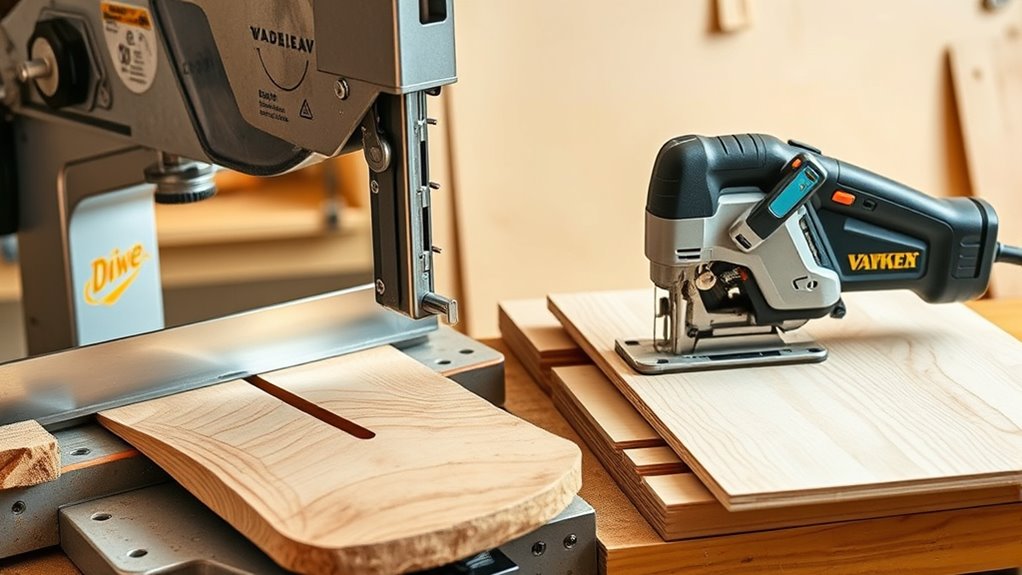

When choosing between a bandsaw and a jigsaw for cutting curves in wood, consider your project’s needs. A bandsaw offers greater precision and stability for smooth, long curves, but it’s less flexible for tight turns. A jigsaw is portable and better suited for intricate shapes and tight corners, though it may require more guiding to maintain accuracy. To explore which tool suits your work best and discover detailed tips, keep learning about their features and applications.

Get business pricing on tools and workshop supplies
- Business-only prices and quantity discounts
- Tax-exempt purchasing
- Multiple users, one account, clear invoices
Key Takeaways
- Bandsaws provide consistent, smooth, and precise curves due to their stable, continuous blades.
- Jigsaws excel at intricate, tight curves with high maneuverability, ideal for complex shapes.
- Bandsaws are better for larger, thicker wood pieces requiring accuracy and clean, long curves.
- Jigsaws are faster and more versatile for small, detailed, or tight-radius cuts.
- The choice depends on project size, complexity, and need for precision versus speed.
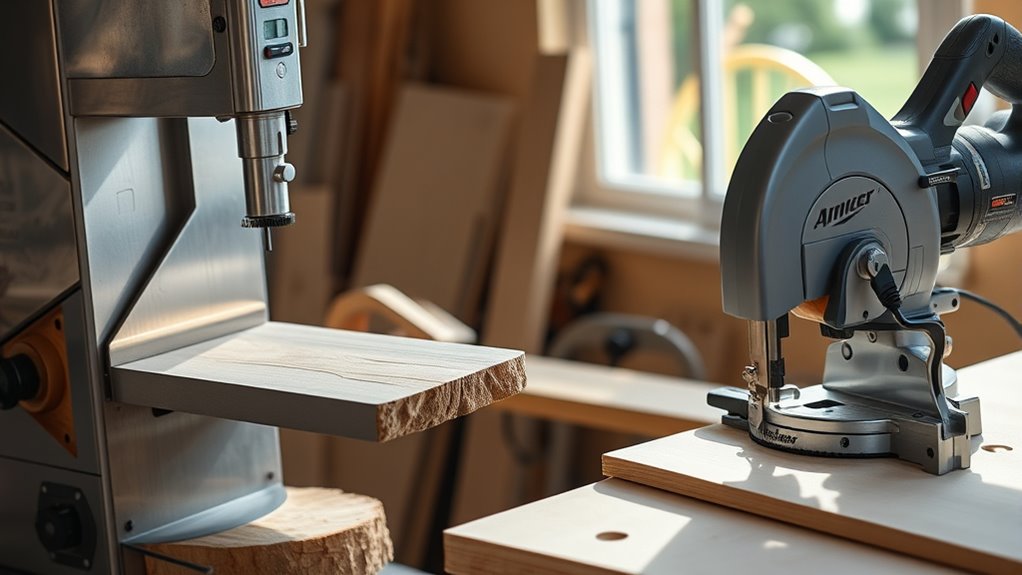
When choosing between a bandsaw and a jigsaw, understanding their differences is essential to making the right tool choice for your project. If you need to cut curves in wood, both tools have their strengths, but they operate differently when it comes to blade precision and cutting speed. A bandsaw features a continuous loop blade that runs on two wheels, providing a stable, straight cut with high blade precision. This stability means you can make long, smooth curves and intricate cuts with consistent accuracy. The blade’s rigidity helps maintain precision, especially on thicker or denser wood, and ensures your curves stay true to your pattern. While a bandsaw generally offers slower cutting speeds compared to a jigsaw, the trade-off is a cleaner, more controlled cut, which is ideal for detailed work that demands accuracy. Additionally, the blade stability of a bandsaw reduces wobbling, making it well-suited for precise projects.
A jigsaw, on the other hand, is a handheld tool with a reciprocating blade that moves up and down rapidly. Its portability and ease of handling allow you to follow complex curves and tight turns more easily than with a bandsaw. When it comes to cutting speed, a jigsaw can be considerably faster, especially for smaller, intricate cuts or when working on detailed designs. However, because the blade is less rigid and more flexible, achieving the same level of blade precision as a bandsaw can be challenging. You might find that the jigsaw requires more careful guiding and slower movement to prevent wobbling or uneven cuts, which can affect the overall accuracy of your curves.
Choosing between the two depends on your project’s specific demands. If your focus is on precision, especially for larger or thicker pieces, a bandsaw will give you cleaner, more accurate curves thanks to its stable blade and controlled cutting speed. Conversely, if you need to make quick, detailed cuts on smaller pieces or work on complex shapes with tight turns, a jigsaw offers greater maneuverability and speed, even if it sacrifices some blade precision. Ultimately, understanding how each tool handles blade stability, cutting speed, and curve complexity helps you select the right one for your woodworking needs. Both tools can produce excellent results when used appropriately, but knowing their differences ensures you approach each project with confidence, choosing the best tool to achieve your desired outcome.
As an affiliate, we earn on qualifying purchases.
Frequently Asked Questions
Can Both Tools Cut Metal or Only Wood?
Both tools can cut metal, but they require specific blades designed for metal cutting. The bandsaw’s blade durability makes it well-suited for thicker or tougher metal work, while a jigsaw can handle smaller, detailed cuts more easily. Always use the appropriate blade for metal to guarantee safety and efficiency. Remember, using the right blade enhances cutting performance and prolongs tool lifespan, especially when working with metal.
Which Tool Offers More Precise Control for Intricate Cuts?
You’ll find that a jigsaw offers more precise control for intricate cuts due to its superior maneuverability. While a bandsaw provides greater blade stability for larger, straight cuts, the jigsaw’s smaller, flexible blade makes it easier to navigate tight curves. The maneuverability comparison clearly favors the jigsaw, making it the better choice when detailed, delicate cuts are essential. This control makes your work more accurate and refined.
Are There Safety Concerns Unique to Either Tool?
Yes, there are safety concerns unique to each tool. When using a bandsaw, you should always wear protective gear like safety glasses and keep your hands away from the blade to prevent accidental cuts. For jigsaws, blade safety is essential; make sure the blade is secure and sharp to avoid kickbacks. Always follow safety instructions, stay alert, and use push sticks or guides to keep your hands safe during operation.
How Do Blade Types Differ Between Bandsaws and Jigsaws?
You’ll notice blade types differ between bandsaws and jigsaws mainly in blade material and thickness. Bandsaws use wider, thicker blades made of high-speed steel or carbide for stability during straight or curved cuts. Jigsaws, on the other hand, feature thinner blades, often with teeth designed for fine, intricate curves. The blade material varies based on the wood type, helping you achieve precise cuts while maintaining safety and efficiency.
Can a Jigsaw Replace a Bandsaw for Large Projects?
A jigsaw can’t fully replace a bandsaw for large projects because it lacks the tool versatility and power needed for bigger cuts. While jigsaws excel at making curved cuts and detailed work, they’re not designed for the stability and precision required for large, straight, or heavy-duty tasks. For extensive projects, a bandsaw offers the efficiency, accuracy, and capacity you need, making it the better choice.
As an affiliate, we earn on qualifying purchases.
Conclusion
So, now you’re armed with the knowledge to choose between a bandsaw and a jigsaw. Think of the bandsaw as your steady steed, slicing through wood with regal precision, perfect for straight, powerful cuts. Meanwhile, the jigsaw is your nimble dancer, weaving graceful curves with ease. Whichever you pick, remember it’s your creative brushstroke — turning raw wood into art. Now go ahead, carve your masterpiece and let your imagination run wild!
As an affiliate, we earn on qualifying purchases.
As an affiliate, we earn on qualifying purchases.
Fall Picks
fall essentials
As an affiliate, we earn on qualifying purchases.