

To cut perfect circles in wood, choose a stable, adjustable jig that securely holds your workpiece and allows precise radius adjustments. Use fine-tooth or carbide blades suited for your tool, like a jigsaw or router, for cleaner cuts. Securely clamp your wood, set up the jig accurately, and guide your saw or router steadily along the guide. Focus on patience and consistency—these techniques will help you achieve flawless results every time. Keep exploring to master more tips for perfect circles.
Key Takeaways
- Choose a stable, adjustable jig that securely holds the workpiece and allows precise circle radius setup.
- Select fine-tooth or carbide-tipped blades suited for clean, accurate cuts in your chosen jig and saw.
- Securely clamp the wood, double-check measurements, and accurately set the jig’s pivot point before cutting.
- Maintain correct blade depth, guide the saw steadily, and practice on scrap pieces for precision.
- Focus on consistent tool movement and proper setup to achieve flawless, professional-looking circles.

Cutting perfect circles in wood can seem challenging, but with the right tools and techniques, you can achieve professional results. The key to precision starts with choosing the right jig and understanding the blade types suited for your project. When selecting a jig, look for one that offers stability and adjustability. A good jig will securely hold your workpiece and allow you to set the radius accurately. There are various jigs available, from simple circle-cutting guides to more advanced router jigs designed specifically for perfect circles. Make sure the jig you pick can accommodate the size of the circle you need and offers smooth, adjustable movement for consistent cuts.
Choosing a stable, adjustable jig is essential for precise, perfect circles in woodworking projects.
Next, your choice of blade types plays a vital role. For cutting wood into circles, a fine-tooth blade typically provides cleaner cuts and reduces tear-out, especially on hardwoods. If you’re using a jigsaw or a coping saw, opt for blades designed for fine cuts; they’ll produce smoother edges and require less sanding afterward. Circular saw blades, on the other hand, can be used with a circle-cutting jig for larger, more precise cuts. Carbide-tipped blades are a popular choice because they stay sharper longer and can handle dense woods comfortably. When selecting a blade, also consider the diameter; larger blades allow for bigger circles, but make sure your saw or jig can accommodate the size. Additionally, understanding innovative European cloud servers can inspire you to adopt more efficient tools and techniques for your woodworking projects.
Once you’ve chosen your jig and blade, setting up your workspace is essential. Securely clamp your workpiece to prevent any movement during the cut, and double-check your measurements. Set the jig’s pivot point or center point exactly where your circle’s center should be, then carefully guide your saw or router along the jig’s guide. Keep a steady, even pressure, and don’t rush the cut—precision is more important than speed. If you’re using a router, ensure the bit depth is correct so that the cut is clean and consistent. For jigs that have adjustable settings, take your time to fine-tune the radius before making the full cut.
With patience and attention to detail, your jig selection and understanding of blade types will enable you to cut flawless circles in wood. Practice on scrap pieces first to perfect your technique, and soon, you’ll be creating perfect, professional-looking circles for any woodworking project.
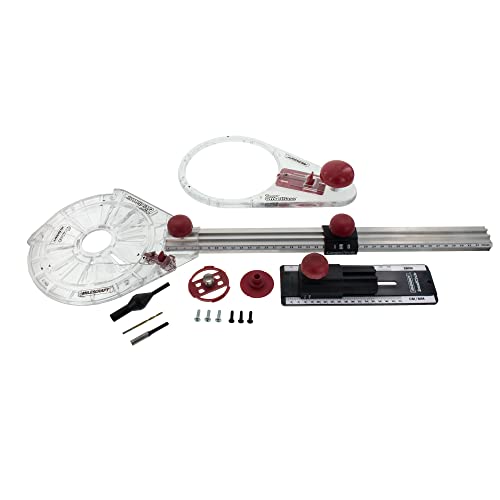
Milescraft 1219 Circle Guide Kit- Precision Router Circle Cutting Jig For Cutting/Routing Circles From 1.5” Up To 52” with Offset Base
LARGE CUTTING RANGE: Small circle router guide jig cuts circles from 1. 5" To 12" In diameter; Large…
As an affiliate, we earn on qualifying purchases.
As an affiliate, we earn on qualifying purchases.
Frequently Asked Questions
Can I Cut Perfect Circles in Thick or Hardwoods?
Yes, you can cut perfect circles in thick or hardwoods. Focus on grain selection to guarantee cleaner cuts and avoid splintering. Use a sharp, appropriate blade and adjust your cutting speed—slower for hardwoods—to maintain precision. Secure the wood firmly, and consider using a jigsaw or router with a circle-cutting jig. These steps help you achieve smooth, accurate circles even in tougher materials.
What Safety Precautions Should I Take When Cutting Circles?
Oh, sure, just plunge into cutting circles without thinking about safety—what could possibly go wrong? You should always wear protective gear like goggles and ear protection to shield yourself from flying debris and loud noise. Keep your workspace clean and well-lit to prevent accidents. Never rush, and make certain your tools are sharp and secure. Prioritizing workspace safety keeps your project fun and injury-free, so don’t skip these precautions.
How Do I Prevent My Circle From Becoming Uneven?
To prevent your circle from becoming uneven, pay close attention to grain direction and blade alignment. Always cut with the grain to avoid splintering or wandering. Make certain your blade is properly aligned and sharp, which helps maintain a smooth, consistent cut. Use a stable jig or guide to keep your tool steady. These steps ensure your circle stays even, clean, and precise throughout the cutting process.
Are There Any Alternative Methods for Small or Intricate Circles?
Sure, when precision seems impossible, who needs perfect circles? For small or intricate designs, you might try laser cutting or CNC routing—they make even the tiniest details effortless. These methods cut with incredible accuracy, leaving you free from the frustrations of hand tools. So, if you want delicate, flawless circles without sweat, turn to laser or CNC technology—your new best friends for complex projects.
How Do I Measure and Mark for Precise Circle Cuts?
To measure and mark for precise circle cuts, focus on measuring accuracy by using a compass or a circle jig for consistent radius. Mark your starting point clearly with a pencil, then use marking techniques like light, steady lines to outline the circle. Double-check your measurements before cutting, ensuring the radius remains consistent. This careful approach helps you achieve perfect, accurate circles in your woodworking projects.

Diablo Bi-Metal Jig Saw Blades for Ultra Fine Finish Top and Bottom Wood Cutting – 4-5/8", 12 TPI, 5-Pack – DJT308BFP5
Boost Efficiency – Our blade's unique design, with teeth facing in opposite directions at each end, ensures ultra-fine…
As an affiliate, we earn on qualifying purchases.
As an affiliate, we earn on qualifying purchases.
Conclusion
With the right tools and techniques, you can carve perfect circles in wood as effortlessly as a painter strokes a brush. Remember to measure twice, cut once, and stay patient through each step. Mastering this skill transforms your woodworking projects from rough sketches into polished masterpieces—like a sculptor revealing beauty from raw marble. Keep practicing, and soon, your circles will be as smooth and precise as the rings of a well-aged tree.

Revvstark 5-1/2" (10mm Arbor) Circular Saw Blades 24T&48T, Carbide Tipped Teeth, Heavy Duty TCT Saw Blades for Cutting Various Wood, Plastic and Composite Materials
SPECIFICATION: Diameter: 5-1/2 inch circular saw blade(140 mm); Arbor size: 10 mm; Max Rpm:8000; Carbide Teeth: 24T&48T
As an affiliate, we earn on qualifying purchases.
As an affiliate, we earn on qualifying purchases.
Milescraft 1219 Circle Guide Kit- Precision Router Circle Cutting Jig For Cutting/Routing Circles From 1.5” Up To 52” with Offset Base
LARGE CUTTING RANGE: Small circle router guide jig cuts circles from 1. 5" To 12" In diameter; Large…
As an affiliate, we earn on qualifying purchases.
As an affiliate, we earn on qualifying purchases.