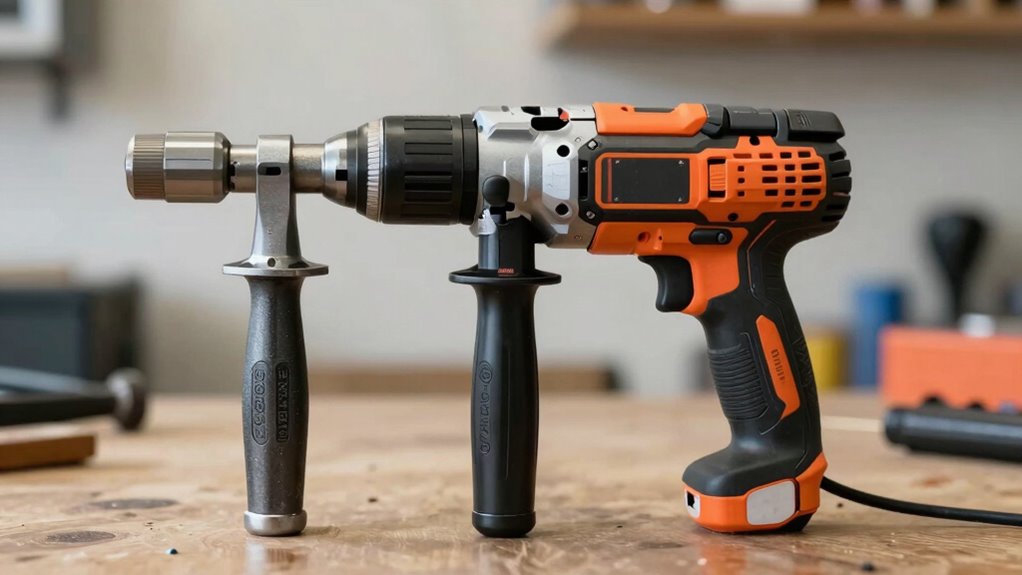

To decide between SDS-Plus and SDS-Max rotary hammers, consider your project size and power needs. Use SDS-Plus for light to medium tasks like drilling masonry or tiles, as it’s lighter and easier to handle. Choose SDS-Max for bigger jobs like concrete breaking or demolition, since it delivers more power but is heavier. Think about battery life, weight, and maneuverability to match your work environment—if you’re curious, you’ll discover more detailed guidance.

Get business pricing on tools and workshop supplies
- Business-only prices and quantity discounts
- Tax-exempt purchasing
- Multiple users, one account, clear invoices
Key Takeaways
- Assess project scope: smaller tasks suit SDS-Plus; heavy-duty, large projects require SDS-Max.
- Consider power and battery life: SDS-Max offers more power and longer runtime for demanding applications.
- Evaluate weight and handling: lighter SDS-Plus models reduce fatigue for overhead or confined space work.
- Match size and maneuverability: compact SDS-Plus drills fit tight spaces; SDS-Max provides more strength for open areas.
- Prioritize ergonomics and comfort: balance power, size, and battery life to ensure safe, comfortable extended use.

Choosing the right rotary hammer can be confusing, especially when deciding between SDS-Plus and SDS-Max models. Both are powerful tools designed for heavy-duty drilling and chiseling, but they serve different needs. To make an informed choice, you need to consider how you’ll use the tool most often. One key factor is battery life, especially if you’re opting for a cordless model. SDS-Plus hammers generally have smaller batteries, which means less runtime but lighter weight. If you’re working on smaller projects or need portability, a cordless SDS-Plus model might be perfect. On the other hand, SDS-Max hammers usually come with larger, more robust batteries that provide longer operation times, suitable for extended jobs. Keep in mind, though, that larger batteries add weight, which can impact your comfort and fatigue level during prolonged use. Battery capacity and runtime are essential for ensuring your tool can handle the scope of your projects properly.
Weight considerations are vital when choosing between these two types. SDS-Plus models tend to be lighter, making them easier to handle for extended periods, especially if you’re working overhead or in tight spaces. The lighter weight reduces fatigue and allows for more precise control. SDS-Max models, while heavier, are built for serious power and durability. They often feature larger engines and more substantial components, which translate to increased weight. If your work involves heavy-duty tasks like breaking through concrete or large-scale demolition, the extra weight is a fair trade-off for the added power and efficiency. But if your tasks are more routine, such as drilling into softer masonry or tile, a heavier SDS-Max might be unnecessary and cumbersome. Additionally, considering ergonomics can help reduce fatigue and improve safety during prolonged use.
Another aspect to consider is the tool’s size and maneuverability. SDS-Plus hammers are generally more compact, making them suitable for tasks that require finesse or working in confined spaces. SDS-Max models are bigger and less maneuverable but excel in high-impact, demanding applications. Battery life also plays into this, as a bigger, more powerful battery will add to the tool’s overall size and weight. If you’re frequently working away from power sources, investing in a model with longer battery life is wise, even if it means carrying a heavier tool. Additionally, understanding the power-to-weight ratio can help you select a model that balances performance with ease of use.
Products Worth Considering

Dyson V9 Motorbar Cordless Vacuum

Dyson Cyclone V10 Origin Cordless Vacuum

Dyson V15 Detect Cordless Vacuum
As an affiliate, we earn on qualifying purchases.
Frequently Asked Questions
Can Sds-Plus and SDS-MAX Chisels Be Interchangeable?
SDS-plus and SDS-max chisels aren’t interchangeable because of different chisel compatibility and tool sizes. SDS-plus tools are smaller and designed for lighter-duty tasks, while SDS-max tools are larger and suited for heavy-duty work. Using the wrong chisel in a rotary hammer could damage the tool or cause safety issues. Always match your chisel to the specific tool’s specifications to guarantee proper tool interchangeability and peak performance.
What Safety Gear Is Recommended for Using These Rotary Hammers?
When using SDS-plus or SDS-max rotary hammers, you should wear protective eyewear to shield your eyes from debris and dust. Hearing protection is essential because these tools generate loud noise that can damage your hearing over time. Additionally, consider wearing gloves and a dust mask for further safety. Always follow the manufacturer’s safety guidelines and make sure your work area is well-ventilated to protect yourself during operation.
How Long Do Sds-Plus and SDS-MAX Tools Typically Last?
SDS-plus tools typically last between 3 to 5 years with proper tool maintenance, while SDS-max tools can last 5 to 7 years or more, depending on usage. Battery compatibility plays a role if your tools are cordless; using batteries suited for your specific model ensures longevity. Regularly inspecting, cleaning, and replacing worn parts helps extend the lifespan of both types, maximizing your investment and maintaining peak performance.
Are There Specific Brands Known for Reliable Sds-Plus or SDS-MAX Hammers?
When it comes to reliable SDS-plus or SDS-max hammers, you can’t go wrong with brands like Bosch, Makita, and Hilti. They’ve built strong reputations for durability and performance. Keep an eye on warranty coverage too—these brands often offer excellent support if something goes awry. Remember, a trusted brand with solid warranty coverage guarantees your investment lasts, so choose wisely to avoid getting stuck with a lemon.
Can I Upgrade From Sds-Plus to SDS-MAX Later?
You can upgrade from SDS-Plus to SDS-Max, but you need to think about tool compatibility and upgrade considerations. Your current drill or hammer might require a new chuck or housing to fit the SDS-Max system. Check if the motor and power supply support the larger, more demanding SDS-Max attachments. Often, upgrading isn’t straightforward, so evaluate whether investing in a dedicated SDS-Max tool makes more sense for your workload.
Conclusion
In the end, choosing between SDS-plus and SDS-max isn’t just a decision—it’s a game-changer for your projects! Imagine wielding a tool so powerful it could move mountains or drill holes in the moon! Whether you’re tackling tiny cracks or massive concrete monsters, picking the right hammer transforms your work from ordinary to legendary. So, gear up wisely—your projects deserve nothing less than the ultimate, earth-shattering power!