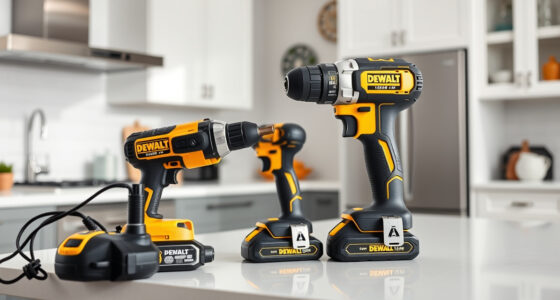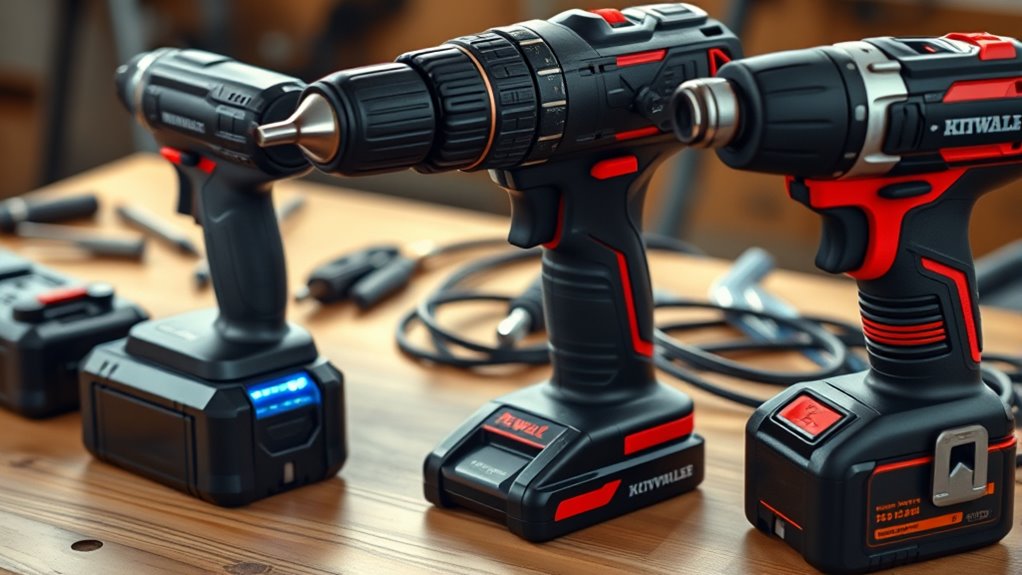

To choose the right power drill, start by evaluating your project needs, such as materials, hole size, and frequency of use. Decide if a corded or cordless model suits your workspace and mobility. Consider size, weight, and comfort features like ergonomic grips. Check key specs like power, battery life, and compatibility with attachments. Budget wisely and compare brands—reading reviews helps. Want to make the best choice? Keep exploring for detailed tips to find your perfect drill.

Get business pricing on tools and workshop supplies
- Business-only prices and quantity discounts
- Tax-exempt purchasing
- Multiple users, one account, clear invoices
Key Takeaways
- Assess your project scope, materials, and required hole size to determine the appropriate drill type and power level.
- Consider corded versus cordless options based on workspace access and mobility needs.
- Evaluate drill features like motor type, speed controls, and safety features for comfort and control.
- Match drill size, weight, and ergonomics to reduce fatigue and improve handling during prolonged use.
- Set a budget, research reputable brands, and review features to ensure long-term durability and value.
Assessing Your Project Needs
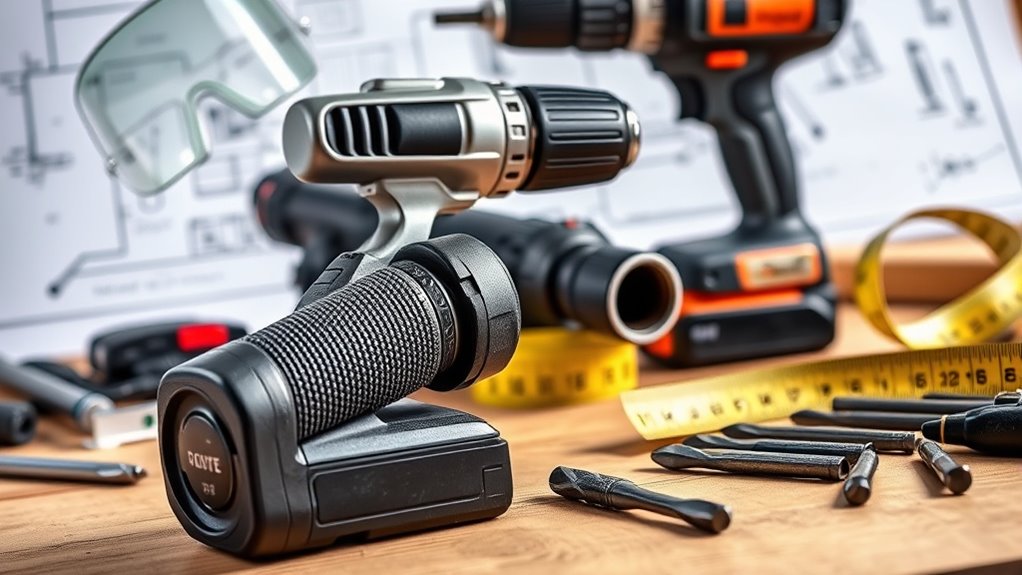
Before choosing a power drill, you need to clearly understand what your project requires. Start by considering your project timeline—how quickly you need to complete the work. If you’re on a tight schedule, a more powerful drill with faster operation might be necessary. Next, evaluate material compatibility; different materials demand specific drill types. For example, wood and plastic are easier to drill into, while metal and masonry require specialized features like hammer functions or higher torque. Think about the size and depth of holes you’ll need to make and whether the drill’s capabilities match these demands. Being clear on these aspects helps you select a drill that fits your project’s scope, avoiding frustration or delays caused by inappropriate equipment. Additionally, understanding the performance metrics of your drill can help ensure it meets your productivity needs effectively. Taking into account the ergonomics and ease of use can also make a significant difference during prolonged or detailed tasks. For optimal results, consider how a water-resistant drill might benefit outdoor or humid environment projects. To further match your needs, assessing the battery life and power source options can ensure reliable operation throughout your project.
Understanding Power and Performance

Understanding power and performance is essential for selecting the right drill because these factors directly influence how effectively the tool handles your tasks. Motor types, such as brushed or brushless, determine the drill’s efficiency and durability, with brushless motors offering longer life and better power management. Power ratings, measured in volts for cordless drills or amps for corded ones, indicate overall strength. Drill chuck sizes matter too—they determine the maximum drill bit diameter the tool can accommodate, affecting versatility. A larger chuck size allows you to work with bigger bits for heavy-duty tasks, while smaller chucks suit precision work. Additionally, knowing the differences in motor technology can help you make a more informed decision tailored to your specific needs. For example, brushless motors tend to deliver more consistent power and require less maintenance, which can be advantageous for frequent use. Considering battery life and charging times is also important, especially for cordless drills, to ensure uninterrupted workflow. Moreover, understanding sound and vibration levels can help you choose a more comfortable and safer tool for prolonged use. By understanding these aspects, you guarantee your drill has the right power and performance to meet your project demands without over- or under-investing.
Choosing Between Corded and Cordless Drills

Choosing between corded and cordless drills depends on your specific needs and work environment. Corded drills have a continuous power source, offering consistent performance for heavy-duty tasks. Cordless drills, powered by batteries, provide greater mobility options, making them ideal for outdoor or remote jobs. Consider your workspace: if you have easy access to power outlets, a corded drill may suit you better. If you need flexibility and move around frequently, a cordless drill offers convenience despite limited battery life. Here’s a quick comparison: power sources and how they influence your choice. Additionally, understanding auditory processing can be analogous to selecting the right tool for the job, as it involves matching the technique to the specific challenge. When choosing a drill, factoring in lease terms such as usage duration and restrictions can help ensure you select the most suitable option for your project.
Considering Size and Weight for Comfort

When selecting a power drill, considering its size and weight is key to ensuring comfortable use, especially for extended periods. A lightweight drill reduces fatigue and allows for better control, making tasks easier to handle. Look for an ergonomic grip that fits comfortably in your hand, reducing strain during prolonged use. Proper weight distribution is also essential; a well-balanced drill feels more stable and less tiring to operate. If the drill feels awkward or too heavy, your accuracy and safety could suffer. Test different models to see how they feel in your hand before making a purchase. Prioritizing size and weight helps you work more efficiently and comfortably, preventing unnecessary strain and enhancing your overall drilling experience. Additionally, understanding power tool ergonomics can guide you in selecting a drill that minimizes discomfort during use. Being aware of ergonomic design principles can further improve your comfort and efficiency when working with power tools, especially when considering tool weight distribution for optimal balance.
Examining Key Features and Settings
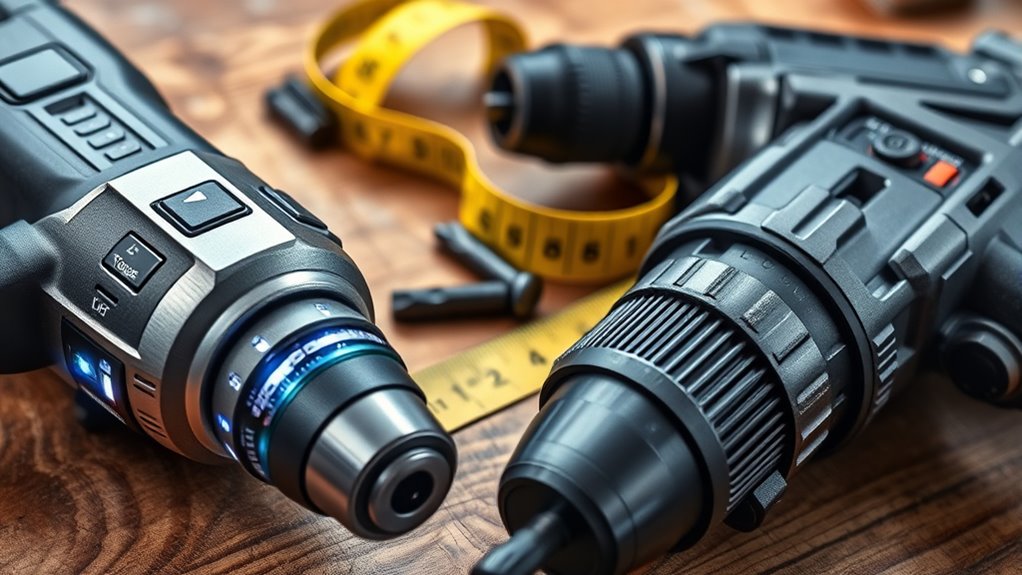
Understanding the key features and settings of a power drill helps you work more efficiently and safely. You should look for adjustable speed options, torque control, and built-in safety features to match your tasks. These features guarantee you have the right control and protection during your projects. Additionally, selecting the appropriate power, connectivity, safety features ensures your drill is suitable for various tasks and minimizes potential hazards. For example, choosing a drill with variable speed settings can make a significant difference in handling different materials effectively. Recognizing ergonomic design elements can also reduce fatigue during prolonged use, enhancing overall safety and comfort. Incorporating features like soft grip handles can further improve user comfort and control.
Adjustable Speed Settings
Adjustable speed settings are a crucial feature to contemplate because they give you greater control over your drilling tasks. With variable speed options, you can easily match the drill’s power to the material you’re working with, whether it’s delicate wood or tough metal. This feature allows for precise control, reducing the risk of slipping or damaging your project. For detailed tasks, lower speeds provide better accuracy, while higher speeds can quickly handle larger holes. Look for drills with easily adjustable speed controls, such as trigger-sensitive settings or a dedicated dial. This flexibility ensures you can adapt to different materials and applications seamlessly. Additionally, variable speed control can help extend the lifespan of your drill by preventing overheating and undue wear. Properly managing heat distribution during operation is essential for maintaining drill performance and durability. Choosing the right oil for airless sprayers can also influence the efficiency and longevity of your power tools, as proper lubrication reduces internal friction and wear. Ultimately, adjustable speed settings help you work more efficiently and produce professional results every time. Mastering Firewood techniques can also benefit from proper drill control, especially when working on woodworking projects. Additionally, understanding piercing care and hygiene can help prevent complications if you’re considering drilling into sensitive areas like the body.
Torque Control Options
Torque control options are essential for preventing overdriving or damaging materials during drilling. With adjustable torque settings, you can fine-tune the power drill to match the task, ensuring you don’t apply too much force. Torque control allows you to set a maximum level, helping you avoid stripping screws or damaging delicate surfaces. Many drills feature a torque control ring or clutch, giving you quick access to adjust the amount of force the drill applies before stopping. This feature is especially useful for driving screws or working with softer materials. By choosing a drill with reliable adjustable torque, you gain better control and reduce the risk of mistakes, making your work more precise and your tools last longer. Incorporating smart gear can further enhance your control and safety during various tasks. Additionally, understanding the different torque settings available helps you select the right drill for both light and heavy-duty projects. Being aware of torque management features can also help extend the lifespan of your tools and improve overall efficiency.
Built-in Safety Features
Built-in safety features are essential for protecting both you and your drill during operation. A safety lock prevents accidental activation, ensuring the drill only runs when you intend it to, reducing injury risk. An anti-slip grip improves control, minimizing slipping and accidental slips that could cause damage or injury. Look for drills with ergonomic designs that include textured, non-slip handles for a secure hold. Some models offer adjustable safety locks to suit different tasks or user preferences. These features enhance safety and make your work more precise. Always check for these built-in safety options before purchasing, so you can operate confidently and reduce the chances of mishaps. Prioritizing safety features guarantees your drilling experience is both effective and secure.
Evaluating Battery Life and Charging Time

When choosing a power drill, you should consider its battery capacity and how long it can run on a single charge. Fast charging options can save you time, but it’s also important to think about how many charge cycles the battery will last over its lifespan. Balancing these factors helps guarantee your drill stays reliable for all your projects.
Battery Capacity & Run Time
Understanding a power drill’s battery capacity and run time is essential to choosing the right tool for your projects. Battery technology plays a key role, as lithium-ion batteries offer higher capacity and longer run times compared to older types. When evaluating your drill, consider its battery capacity, usually measured in amp-hours (Ah), which directly impacts how long it can operate before recharging. Additionally, look into charging options—fast chargers can markedly reduce downtime, allowing you to get back to work quickly. A drill with a larger battery capacity might be heavier but provides more extended use, ideal for demanding tasks. Balancing capacity and convenience ensures you select a drill that meets your project requirements without sacrificing ease of use.
Charging Speed & Convenience
How quickly your drill’s battery charges can make a big difference in your workflow. Faster charging reduces downtime, so consider the battery types and power source. Lithium-ion batteries, for example, charge quicker and hold charge longer, offering convenience. Some drills feature rapid chargers that can fully recharge in under 30 minutes, boosting productivity. Here’s a quick comparison:
| Battery Type | Charging Time | Power Source |
|---|---|---|
| Lithium-ion | 30-60 minutes | Rechargeable battery |
| Nickel-Cadmium | 1-2 hours | Rechargeable battery |
| Corded | Instant power | Mains electricity |
Choosing a drill with efficient charging options means less waiting and more working time. Prioritize those with quick-charge capabilities to keep your projects moving smoothly.
Battery Life Expectancy
A battery’s lifespan directly impacts your drill’s long-term performance, making it important to contemplate both its overall longevity and how quickly it loses capacity over time. Battery degradation occurs gradually, reducing the power and runtime after numerous recharge cycles. Typically, rechargeable batteries can handle between 300 to 500 cycles before their capacity markedly diminishes. This means that if you use your drill frequently, you might need to replace the battery sooner. Look for batteries with high-quality cells and longer cycle life, which preserve their capacity longer. Charging habits also influence battery life—avoid overcharging or letting the battery fully drain regularly. By understanding your drill’s battery life expectancy, you can select a model that offers reliable performance over the long haul.
Determining Compatibility With Attachments and Accessories
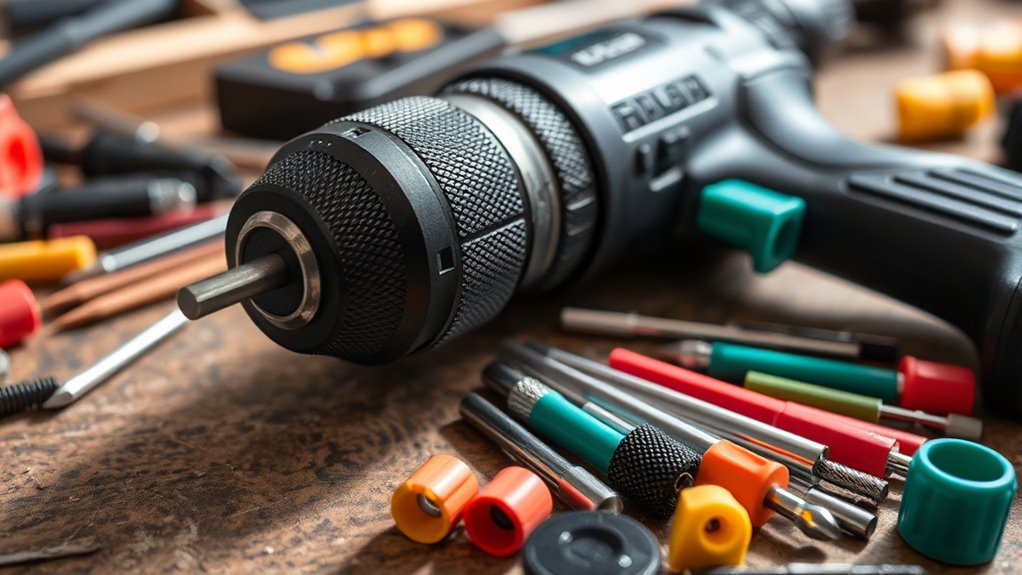
Before selecting a power drill, it’s vital to check if it’s compatible with the attachments and accessories you plan to use. Not all drills support every attachment, so understanding attachment compatibility guarantees you can expand your tool’s functionality. Look for drills with a universal chuck or specific accessory adapters that match your needs. When considering accessory selection, confirm the drill’s chuck size and type, as these determine which accessories fit securely. Some drills feature quick-change chucks for ease, while others require specific adapters. Ensuring compatibility prevents frustration and saves money, allowing you to confidently choose a drill that can handle drilling, screwdriving, sanding, or other tasks with the right attachments. Proper compatibility makes your tool versatile and ready for various projects.
Setting a Realistic Budget
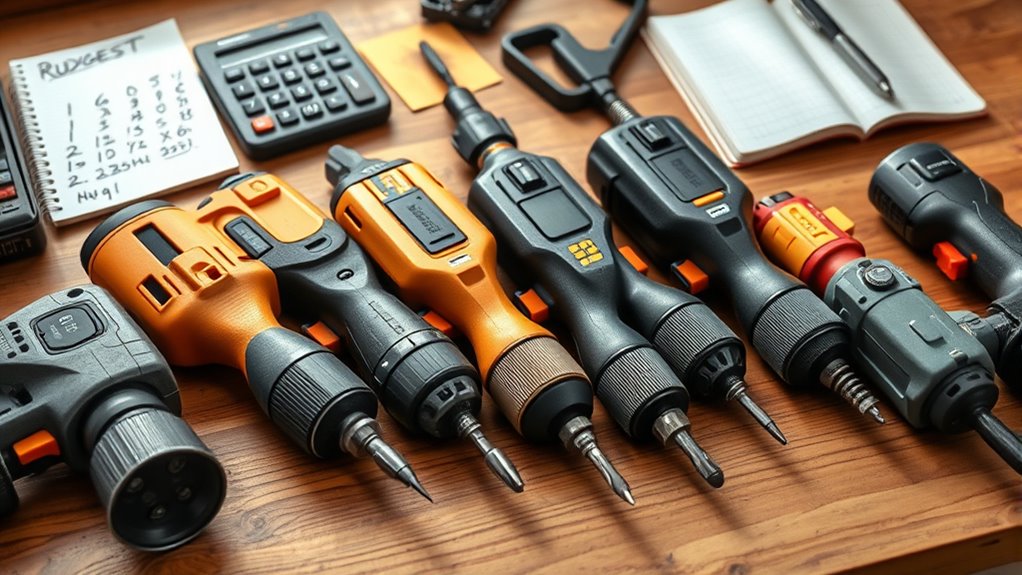
Setting a realistic budget is a key step after confirming your drill’s compatibility with attachments. Knowing your budget constraints helps you focus on options within your price range without overspending. Remember, a reputable brand often offers better durability and service, which can save money long-term. To help you decide, consider this:
| Budget Range | Brand Reputation |
|---|---|
| Low | Budget-friendly, basic models |
| Mid | Reliable, good performance |
| High | Premium features, durability |
Stick to your budget, but don’t compromise quality for the lowest price. Investing in a trusted brand ensures you get a drill that lasts and meets your needs without unexpected costs.
Reading Reviews and Testing Before Buying

Have you checked what other users say about a drill before making your purchase? Reading reviews gives you valuable insights into a tool’s performance, durability, and ease of use. Look for honest feedback on how well the drill handles different tasks and if there are common issues. Testing the drill in-store, if possible, helps you assess its grip, weight, and comfort firsthand. Pay attention to features that matter most to you, such as battery life or speed settings. Combining reviews and testing ensures you make an informed decision, avoiding surprises after buying. By doing this due diligence, you’ll select a power drill that matches your needs, saving you time and money in the long run.
Frequently Asked Questions
How Often Will I Need to Replace or Upgrade My Drill?
You might need to replace or upgrade your drill every few years, depending on usage and maintenance. If your battery life decreases considerably or you notice performance drops, it’s time for an upgrade. Regular maintenance can extend its lifespan, so keep batteries charged and clean. Heavy daily use may require more frequent replacements, while occasional projects might mean your drill stays reliable for longer. Keep an eye on performance to know when it’s time.
Can I Use My Drill for Professional or Industrial Tasks?
Yes, you can use your drill for professional applications if it has industrial compatibility. Look for features like higher power output, durable construction, and a comfortable grip to handle demanding tasks. For frequent or heavy-duty use, choose a drill designed for industrial environments to guarantee longevity and reliable performance. Always verify the specifications to match your professional needs, so your drill can efficiently tackle industrial tasks without compromising safety or effectiveness.
What Safety Features Should I Look for in a Drill?
When choosing a drill, look for safety features like a safety lock to prevent accidental activation and guarantee your safety. Also, consider battery life; longer battery life means less frequent recharging and more reliable work sessions. These features help you work efficiently while reducing risks. Prioritize drills with these safety elements to protect yourself and improve your overall experience during projects.
How Does Climate or Environment Affect Drill Performance?
Think of your environment as a silent partner in your drilling projects. Climate affects drill performance more than you realize. If you work outdoors or in humid conditions, look for drills with moisture resistance and high temperature tolerance. These features prevent rust, overheating, and malfunction. Ignoring environmental factors can turn your reliable tool into a frustrating obstacle, so choose a drill built to withstand your specific climate for superior performance.
Are There Specific Drills Recommended for DIY Beginners?
If you’re a DIY beginner, look for beginner-friendly models or entry-level drills that are lightweight and easy to handle. These drills usually come with simple controls and lower power, making them perfect for small projects and learning the basics. Brands like Black & Decker or Bosch offer reliable options. Choosing a drill with adjustable speed and comfortable grip helps you gain confidence while working on your first few projects.
Conclusion
Choosing the right power drill is like finding a trusted partner—you want one that fits your needs perfectly. By evaluating your project, considering features, and balancing your budget, you’ll find a drill that works seamlessly for you. Take your time, read reviews, and test where possible. Just as a key opens the door to new possibilities, the right drill releases your potential—making every task easier and more enjoyable.
Fall yard work Picks
leaf blowers
As an affiliate, we earn on qualifying purchases.