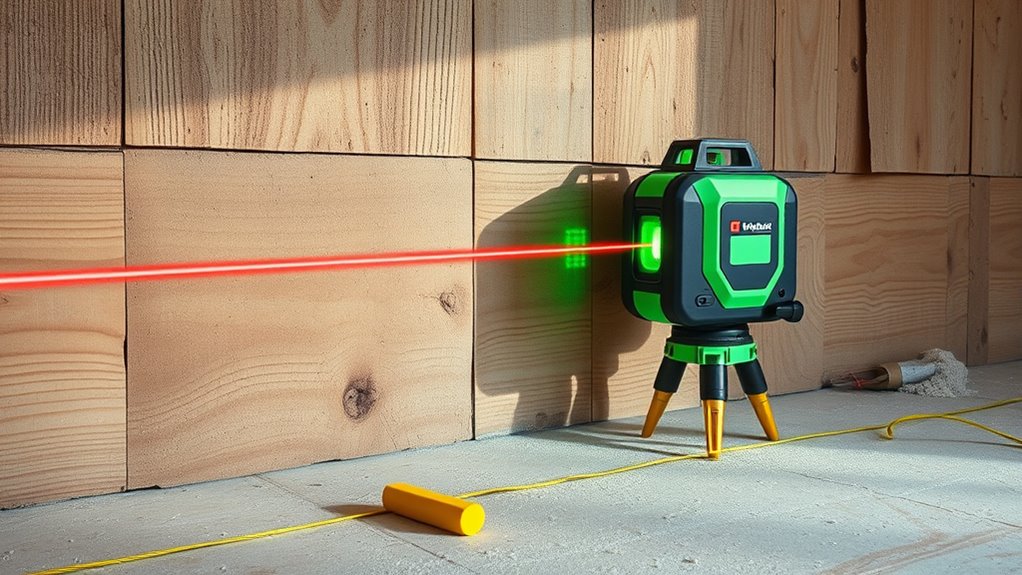

Laser levels are modern tools that project precise, straight lines automatically, making them ideal for detailed, long-distance, or uneven surface projects. Chalk lines are traditional, manual tools that rely on taut strings to mark surfaces quickly and simply, suitable for rough measurements and outdoor work. Both have their place; laser levels offer higher accuracy and ease, while chalk lines are cost-effective and straightforward. If you want to explore which tool suits your project best, keep exploring.

Get business pricing on tools and workshop supplies
- Business-only prices and quantity discounts
- Tax-exempt purchasing
- Multiple users, one account, clear invoices
Key Takeaways
- Laser levels provide high-precision, straight lines suitable for professional tasks, while chalk lines offer quick, rough markings for simpler jobs.
- Modern laser levels feature self-leveling and long-distance capabilities, contrasting with traditional chalk lines that rely on manual tension.
- Laser levels are more expensive but deliver consistent accuracy over various surfaces, unlike chalk lines which can be affected by slack or surface irregularities.
- Chalk lines are inexpensive, portable, and easy to use, making them ideal for quick or outdoor rough markings.
- The choice depends on project complexity: laser levels for precision work, chalk lines for basic, quick measurements.

When it comes to achieving straight, accurate lines for your projects, choosing the right tool can make all the difference. Both laser levels and chalk lines are popular options, but they serve different needs and come with their own advantages. If you’re aiming for precision accuracy and ease of use, understanding these tools will help you decide which one suits your task best. Laser levels are modern tools that use a laser beam to project a straight line or multiple lines onto surfaces, offering a high degree of accuracy that’s hard to match with traditional methods. They’re especially useful for tasks that require perfect alignment, such as installing cabinets, hanging wallpaper, or setting tiles. The laser’s visibility allows you to work more efficiently, reducing the need for repeated measurements or adjustments. Plus, many models are user-friendly, with simple controls and self-leveling features that save you time and effort. Once you set up a laser level, you can trust that the line remains consistent across distances, which minimizes errors and helps you achieve professional results. Modern laser levels often include self-leveling features that automatically correct minor setup errors, further enhancing accuracy.
In contrast, chalk lines rely on a more traditional approach. You snap a taut string coated with chalk to mark straight lines across surfaces. This method is straightforward, doesn’t require power, and is generally inexpensive. While it may lack the technological sophistication of laser levels, a chalk line’s simplicity offers a certain ease of use, especially for quick, rough markings on large surfaces. However, chalk lines don’t provide the same level of precision accuracy, particularly over long distances or uneven surfaces. The line can be affected by slack, uneven tension, or chalk smudges, leading to slight deviations that may impact your final outcome. Despite these limitations, chalk lines remain a reliable choice for rough measurements, framing, or marking guidelines in carpentry and construction.
Ultimately, your choice depends on your project’s requirements. If you need precise, professional-grade lines with minimal effort, a laser level is a smart investment. It offers unparalleled accuracy and ease of use, making complex projects more manageable. On the other hand, if you’re tackling simpler tasks, working outdoors, or need a quick, cost-effective tool, a chalk line might suffice. Each has its place in your toolkit, but understanding their strengths and limitations guarantees you select the right tool for the job. Whether you opt for the modern precision of a laser or the traditional simplicity of chalk, the goal remains the same: achieving clean, straight lines that enhance your craftsmanship.
As an affiliate, we earn on qualifying purchases.
Frequently Asked Questions
Which Tool Is More Cost-Effective for Small Projects?
For small projects, a chalk line is more cost-effective due to its lower price and simplicity. When considering the cost comparison, chalk lines require minimal upfront investment and no batteries or calibration. If budget considerations are key, you’ll save money with traditional tools. Laser levels offer precision but tend to be more expensive, making them less ideal for quick, small-scale tasks where accuracy isn’t critical.
How Do Outdoor Conditions Affect Laser Level Accuracy?
Outdoor conditions can impact your laser level’s accuracy due to weather interference like rain, fog, or dust, which can distort the laser beam. Surface reflectivity also matters; highly reflective surfaces may cause false readings, while non-reflective or uneven surfaces can weaken the laser signal. To guarantee precision, you should check weather conditions beforehand and choose appropriate surfaces or use protective accessories to minimize these effects.
Can Laser Levels Be Damaged Easily?
Laser levels can be damaged if you’re not careful, as their durability varies based on the model and build quality. You should handle them with care to prevent drops or impacts that could harm internal components. Unlike chalk lines, which are simple and last long with minimal maintenance, laser levels require proper storage and protection. Investing in a rugged, durable model helps guarantee your laser level remains accurate and functional over time.
Are There Safety Concerns With Laser Levels?
You should be aware that laser levels can pose safety concerns, especially regarding laser safety. About 70% of laser injuries involve the eyes, so always wear eye protection when operating these tools. Direct exposure to laser beams can cause eye damage, so make certain the laser is properly calibrated and avoid pointing it at people. Following safety guidelines helps you work effectively without risking harm.
How Long Do Batteries Typically Last in Laser Levels?
Battery lifespan in laser levels typically ranges from 4 to 12 hours, depending on the model and usage. You should consider power consumption; higher power levels drain batteries faster. To maximize battery life, use rechargeable batteries and turn off the laser when not in use. Some models feature power-saving modes, which help extend operating time, making your projects more efficient and less interrupted.
As an affiliate, we earn on qualifying purchases.
Conclusion
So, whether you swear by the trusty chalk line or trust the sleek laser level, both tools have their quirks. Ironically, the high-tech laser promises precision but can be finicky, while the humble chalk line offers simplicity but might leave you guessing. Ultimately, it’s about choosing what suits your style—because in the end, both tools are just trying to make your job a little easier, even if one’s a little more high-maintenance.
As an affiliate, we earn on qualifying purchases.
As an affiliate, we earn on qualifying purchases.
Fall yard work Picks
leaf blowers
As an affiliate, we earn on qualifying purchases.