In serial construction, a defect is not a piece of news but a question: how many times have we already built it in? Forty-eight hours at a Hessian modular builder, in which 43 apartments are at stake — and the answer comes from the factory, not the construction site.

Get business pricing on tools and workshop supplies
- Business-only prices and quantity discounts
- Tax-exempt purchasing
- Multiple users, one account, clear invoices
When a Defect Never Comes Alone
48 hours at a Hessian modular builder: one loose vapor-barrier flap becomes a question to the factory — and the answer is a number.
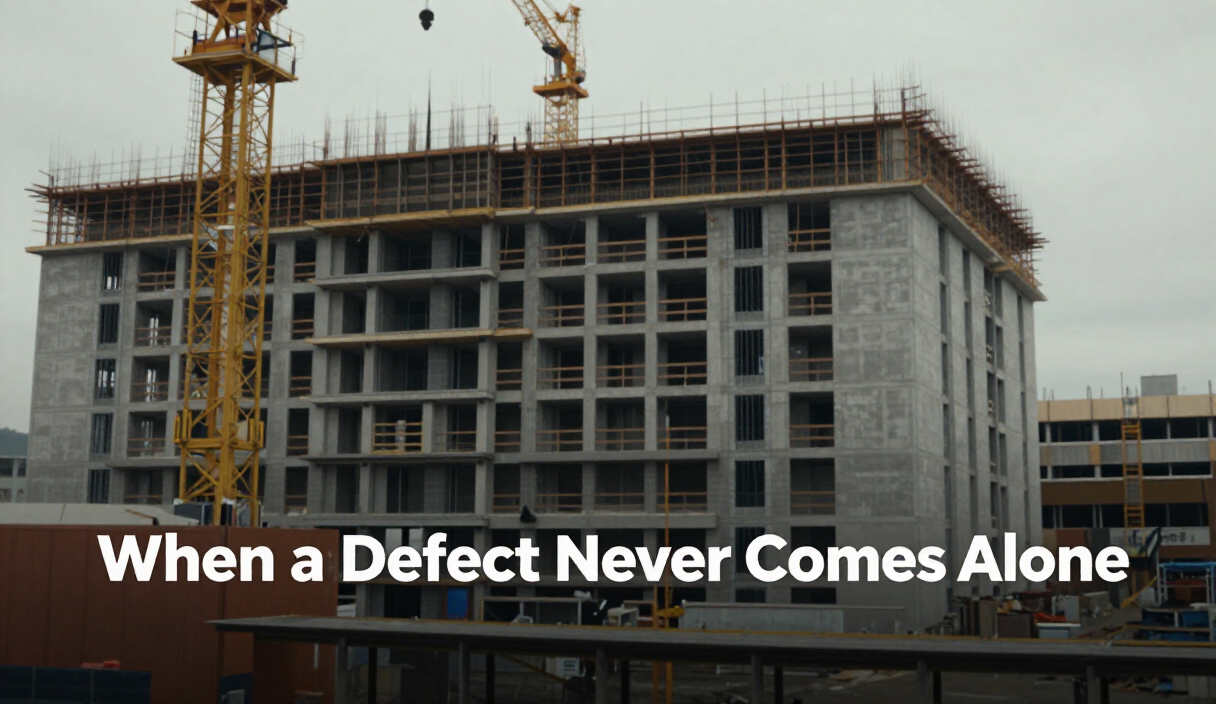
Rooftop extension in Kassel, prefabricated in Korbach, assembled in eleven weeks — while people live underneath.
Same shift, one week in March, same wall type. Four already standing in Kassel, two still at the factory. “It’s not 43. That is the news of the day.”
From Voigt’s finding to a merge suggestion: the neighboring row’s crew reports the same defect in module 11, independently, in different wording.
A loose adhesive flap at the vapor barrier, module 7, second row — spoken into a phone, photographed, and sent as a question, not a defect report.
The finding
Tanja Voigt records the defect with module, axis, component, condition — and asks the factory: whoever built this may have built it thirty times that day.
One case becomes two
A human merges the cases; both photos, dictations and timestamps survive. Lose data on merge, and after three months no one reports duplicates — and the series stays invisible.
Searching backwards
Quality manager Simon Ahlers filters by component type and time period. Sealing-plane images exist for all 43 modules; the defect shows up in 6.
The decision
Two modules opened and corrected before loading; four opened from the inside on site. Residents of affected apartments get an information notice — in their language, via their usual channel.
Closed and documented
Six modules affected, six corrected, every step documented. At handover, the six affected apartments receive the documented correction, unasked.
Scenario Story: Holzwerk Ederbach Modulbau is a fictional example company. The story shows the target build-out of Gewerkton; some features are in beta or in development.
modular construction defect detection tools
As an affiliate, we earn on qualifying purchases.
As an affiliate, we earn on qualifying purchases.
Tuesday, 2:20 p.m. — the finding
Tanja Voigt stands in the seventh module of the second row and sees something that must not be. The vapor barrier is not properly connected at the transition to the partition wall; the adhesive flap is lying loose, about 40 centimeters.
Voigt is site manager on a rooftop extension in Kassel: 43 apartments, prefabricated at the factory in Korbach, assembled in eleven weeks, while people live underneath. She speaks her finding into her phone — module, axis, component, condition — takes photos, and sets the point.
And then she does what makes the difference between one-off construction and serial production: she doesn’t issue a defect report, but a question to the factory. If this connection is wrong in module 7, it was built by someone who may have built it thirty times that day.
As an affiliate, we earn on qualifying purchases.
2:44 p.m. — the second report that was the same
Twenty-four minutes later, the platform suggests merging two cases. The assembly crew of the neighboring row has independently recorded a similar point in module 11, with different wording, unaware of Voigt’s report.
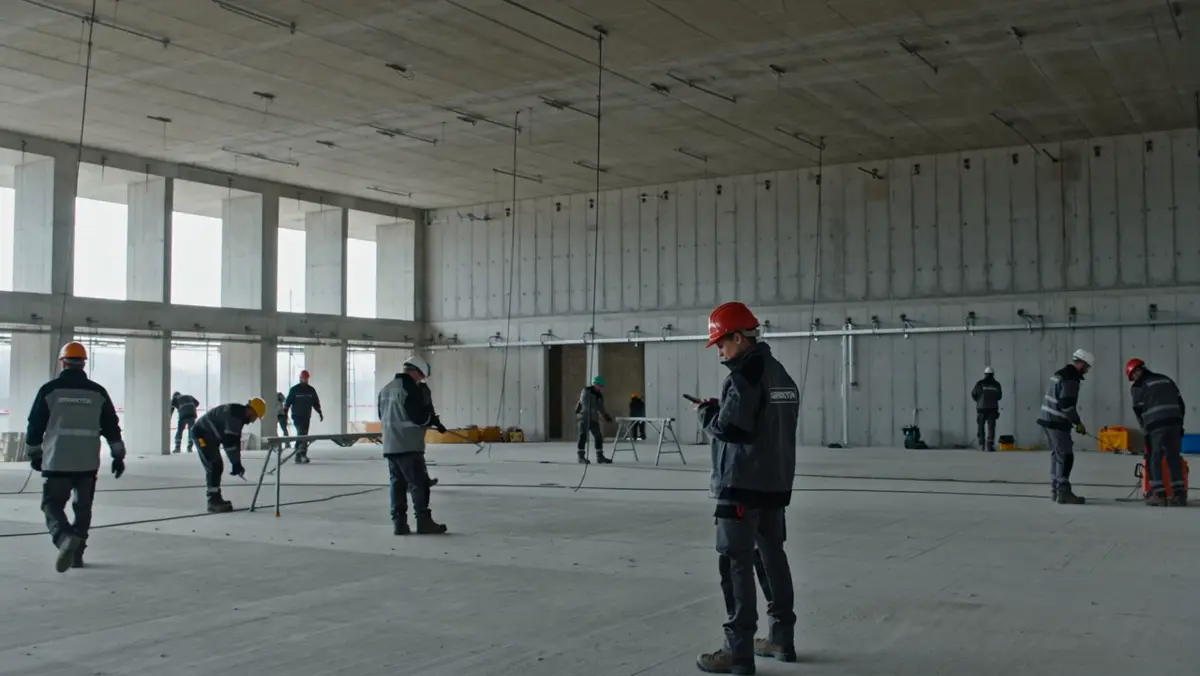
The suggestion is not an automatic merge. A human decides, and when they decide, the history of both cases is preserved — with both photos, both dictations, both timestamps. That matters more than it sounds: in a system that loses data when merging, people stop reporting duplicates after three months, and with it you lose exactly the signal that makes a series visible.
One case becomes two. Two cases become a suspicion.
construction quality inspection camera
As an affiliate, we earn on qualifying purchases.
As an affiliate, we earn on qualifying purchases.
3:30 p.m. — at the factory
Simon Ahlers, quality manager in Korbach, receives the case and now has a task that didn’t exist in this form before the transition: searching backwards.
In the factory, every module is not a box but an identifier with a chain: series, component, factory status, loading unit, delivery, installation target. At every station, records are created — the wall structure before the sheathing is closed, the sealing plane, the installation level, the final inspection. The moment a factory wall is closed is the same moment as on the construction site when a shaft is sealed: afterward, nothing can be seen. The platform enforces a window with a documented last look for this, and unlike on the construction site, it can be fully standardized in the factory — always the same four photo positions, always the same sequence.
Ahlers filters by component type and time period. The images of the sealing plane are available for all 43 modules. He finds the defect in 6 of them, all from the same shift, all from one week in March, all with the same wall type. Four of them are already standing in Kassel. Two have not yet been delivered.
It’s not 43. That is the news of the day.
prefabricated building module repair kit
As an affiliate, we earn on qualifying purchases.
As an affiliate, we earn on qualifying purchases.
Wednesday, 8:00 a.m. — the decision
What happens now is a business decision with a clear set of facts, and that is precisely what is rare.
The two modules at the factory are opened, corrected, and documented with before and after records before they go on the low-loader. The four assembled modules get an opening from the inside, also documented. For the affected apartments — two of them already occupied, because the renovation is carried out while the building is in use — an information notice is created for the residents, in their language, through the same reporting channel they otherwise use for their concerns: what is happening, when, how long, who is coming.
Voigt says that was the moment the tenants didn’t yell at her. “In a renovation of occupied buildings, you’re not fighting the defect. You’re fighting the feeling people have that nobody knows what’s going on.”
The cycle that begins at delivery
Serial construction rarely fails at manufacturing. It fails at the seam between factory and construction site.
At Ederbach, it’s not the calendar that triggers the next batch, but the completion report with records. A module counts as delivered when acceptance, condition, and loading unit are documented; only then does the batch advance on the takt board. When an apartment batch goes into assembly, the associated rooms are created in one go and completely — not half, not duplicated, not with gaps when the network drops out in between. For a construction site producing eight apartments per week, this reliability is unglamorous and carries everything.
Missing parts are not quietly pushed through afterward. Residual points remain residual points until someone closes them with documentation — another detail that only becomes valuable after half a year, when nobody remembers whether the soundproofing seal in module 22 was delivered or not.
Where a model exists here — and where it doesn’t
Serial construction is the one case where a model exists: the module type is planned, the components are library elements, the geometry comes from the factory. Ederbach hands them over to the construction site in an open exchange format, and the findings then attach to the component, not to a room name. If Ahlers wants to know which modules carry the same wall type, he queries the component, not a list.
The existing building below is the other half, and there, nothing exists. The extended building dates from 1974; there are paper plans and a structural analysis. Ederbach’s technical staff member recorded the top existing floor and the connection points in the browser so that the extension and the existing building share a common reference — not a substitute for factory planning, but the prerequisite for two worlds fitting together at all.

What the series does with the evidence
After 48 hours, the case is closed: six modules affected, six corrected, every step documented. What remains is a data set from which Ederbach learns something that cannot be learned in one-off construction.
Recurring defects are the only metric that matters in serial construction. Ederbach reads it quarterly across all projects: which component type generates how many findings, at which factory station they arise, how long it takes from report to correction. The analysis knows stations and shifts, not people — individual performance cannot be tallied from this data, and that is deliberate. The works agreement on this was in place before the introduction, and it was shorter than everyone expected, because the self-restraint can be read off the product.
The technical templates for serial renovation — checking factory documentation status, delivery and acceptance, apartment takt and handover — Ederbach obtained as a package and supplemented with its own serial terms. New factory workers practice on a training project before they stand at the final inspection.
Eleven weeks later
At handover, each of the 43 apartments receives its reading package: fittings, care instructions, maintenance intervals, reporting channel — and the six affected apartments additionally receive the documented correction, unasked. Voigt considers this the most uncomfortable and most important part of the project: “We would never have had to mention it. We mentioned it because it’s in the file anyway, and because a file you don’t show is worthless.”
After that, the operations phase takes over: systems with inspection cycles, deadlines based on the actual acceptance dates, a reporting channel for residents that looks like the one from the construction phase. And at some point the project moves to the archive — read access, chain of evidence intact, stored immutably — because the records for a rooftop extension are needed precisely when nobody thinks of them anymore.
Ahlers, the quality manager, draws a conclusion that applies to the entire industry and only becomes visible faster in serial production: “In one-off construction, a defect is an annoyance. For us, it’s a multiplication. The difference is not whether you make mistakes — but how quickly you know how many there are.”
Transparency: Gewerkton is a product from the house of the publisher of this publication.
[Powered by Thorsten Meyer AI](https://thorstenmeyerai.com/)Learn more about Gewerkton and its lines: Field, Studio and Cloud.
Fall yard work Picks
leaf blowers
As an affiliate, we earn on qualifying purchases.