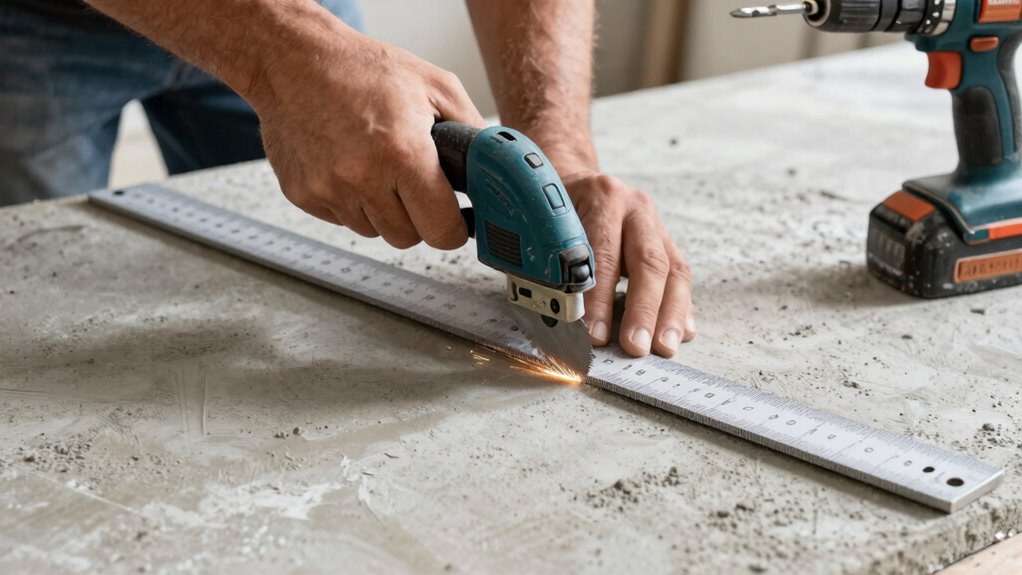
To cut and fasten cement board correctly, start by measuring and marking your cut lines with a pencil. Use a utility knife to score and snap along straight lines or opt for a circular saw with a carbide blade for larger cuts. Always wear safety goggles and a dust mask to protect yourself. Secure the board properly with appropriate fasteners, and smooth edges with a rasp or sandpaper before installation. Keep these tips in mind, and you’ll guarantee a durable, professional tile surface—more detailed guidance awaits if you continue.
Key Takeaways
- Measure and mark cut lines accurately using a pencil before cutting.
- Score the cement board deeply with a utility knife and snap along the line for straight cuts.
- Use a circular saw with a carbide blade for complex or large cuts, following safety precautions.
- Fasten cement board securely with corrosion-resistant screws at regular intervals, ensuring a flat surface.
- Smooth edges with a rasp or sandpaper to prevent damage to tiles and ensure proper installation.
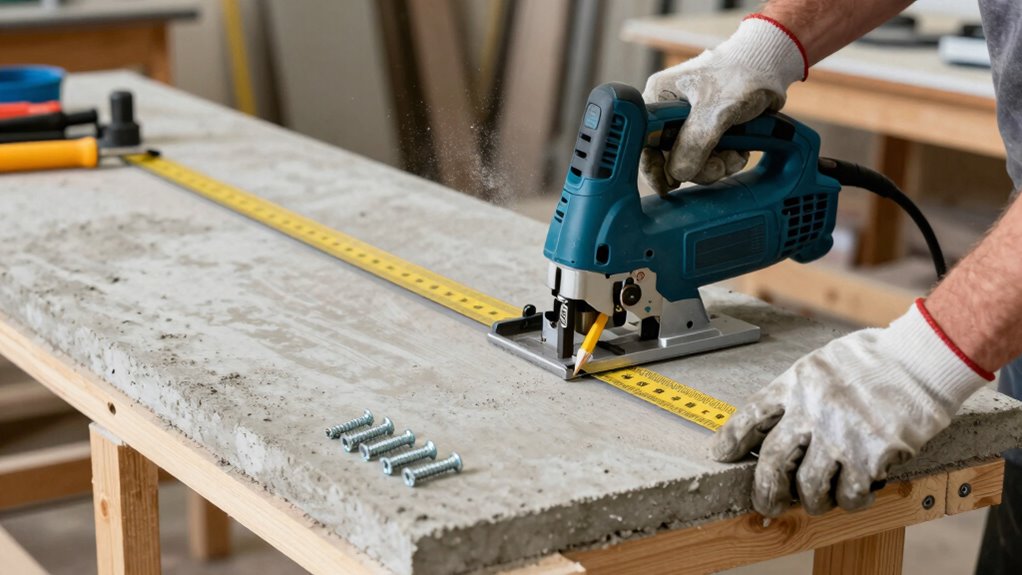
Cutting and fastening cement board may seem intimidating at first, but with the right tools and techniques, you can do it efficiently and safely. When you’re preparing for tile installation, cement board provides a durable, moisture-resistant surface that’s perfect for bathrooms, kitchens, or any area prone to water exposure. Its moisture resistance makes it an excellent underlayment for tiles, preventing issues like mold and deterioration over time. The key is knowing how to cut it properly to guarantee a smooth, even surface and secure fastening to keep your tiles aligned and lasting.
Proper cutting and fastening ensure a durable, moisture-resistant foundation for long-lasting tile installations.
Start by selecting the right tools. A utility knife, straightedge, or carbide-tipped blade works well for scoring and snapping the board, which is ideal for straight cuts. For more complex cuts or larger sections, a circular saw with a carbide blade designed for cutting cement board is faster and gives cleaner results. Always wear safety goggles and a dust mask, especially when using power tools, as cement dust can be hazardous. Proper dust control techniques can help reduce health risks during cutting.
When cutting, measure carefully and mark your cut lines with a pencil. If you’re making straight cuts, score the surface deeply along the line with a utility knife, then snap the board along the scored line. This method minimizes dust and waste. For detailed cuts, like around pipes or outlets, use a jigsaw or a hole saw attachment, making sure to measure twice and cut once. Always smooth the edges with a rasp or sandpaper to prevent roughness that might damage tiles later. Additionally, understanding moisture resistance in cement board is crucial for ensuring a long-lasting tile installation in water-prone areas. Familiarity with installation techniques can greatly improve the durability of your finished project.
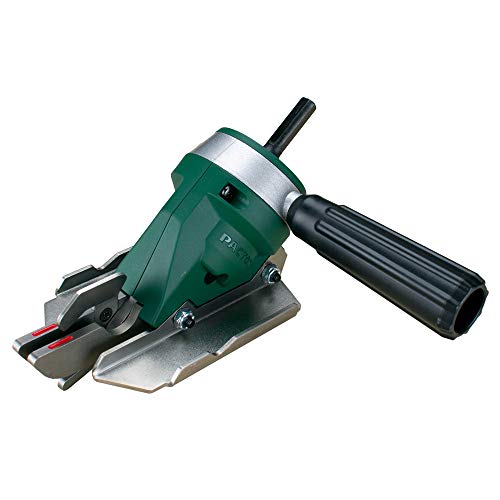
PacTool Snapper Shear Pro – Fiber Cement Cutting Tool for Siding Pros
- Drill Compatibility: Works with 18V or higher cordless drills
- Material Compatibility: Cuts 1/4 to 1/2-inch fiber cement board
- 360° Rotating Head: Allows versatile shape cuts including curves and circles
As an affiliate, we earn on qualifying purchases.
As an affiliate, we earn on qualifying purchases.
Frequently Asked Questions
What Tools Are Best for Cutting Cement Board?
You should use a utility knife for scoring and snapping cement board, which works well for straight cuts. For more precise or complex cuts, a circular saw with a carbide-tipped blade or a wet tile saw offers clean, water-resistant cuts essential for tile installation. These tools handle water-resistant materials effectively, ensuring your cement board is cut accurately and safely. Always wear safety goggles and a dust mask during cutting.
How Do I Prevent Chipping When Cutting?
To prevent chipping when cutting cement board, start with proper surface preparation by supporting the board on a stable, flat surface. Use a sharp blade, and apply gentle, steady pressure during cutting. Moisture control is vital—cut in a dry environment and keep the board dry beforehand. Additionally, scoring the surface with a utility knife before making the full cut minimizes chipping, resulting in cleaner edges.
Can I Use Power Tools for Fastening?
Yes, you can use power tools for fastening cement board. Studies show that proper fastening techniques greatly improve cement board durability, preventing issues like cracking or loosening over time. Using a cordless drill with a masonry bit and corrosion-resistant screws ensures secure attachment. Just remember, fasteners should be driven to the right depth without over-tightening, maintaining the board’s integrity and ensuring long-lasting, durable results.
What Safety Gear Is Recommended?
You should wear personal protective equipment like safety goggles, a dust mask, and gloves to protect your eyes, lungs, and skin from cement dust and debris. It’s also essential to implement dust control measures, such as using a vacuum or wet cutting methods, to minimize airborne particles. These safety precautions help prevent injuries and health issues while working with cement board, ensuring a safer and more efficient project.
How Do I Handle Cuts Around Fixtures?
When handling cuts around fixtures, start with precision marking to guarantee accurate cuts without damaging fixtures. Protect fixtures by covering them with painter’s tape or padding before cutting. Carefully score the cement board around the fixture, then use a saw or utility knife to make clean cuts. Always work slowly and steadily to avoid accidental damage, and double-check your measurements to ensure a precise fit around fixtures.

Hard-To-Find Fastener Phillips Self-Piercing Cement Board Screws, Durable Steel Hardware Fasteners for Home Improvement, DIY, Construction, 8 x 1-1/4, Pack of 157
- Material: Durable Steel Construction
- Design: Self-Piercing Sharp Tip
- Protection: Corrosion-Resistant Ceramic Coating
As an affiliate, we earn on qualifying purchases.
As an affiliate, we earn on qualifying purchases.
Conclusion
Now that you know the proper way to cut and fasten cement board, you’ll guarantee a durable and professional finish for your project. Remember, using the right tools and techniques reduces waste and prevents future issues. Did you know that improper installation can lead to moisture problems, costing homeowners thousands in repairs? By following these steps carefully, you’re not just building—you’re creating a long-lasting, high-quality surface that stands the test of time.

TWIN-TOWN 7-1/4 Inch 6 Tooth Polycrystalline Diamond Tipped (PCD) Hardie Fiber Cement Saw Blade with 5/8 Inch Arbor
- Kerf Thickness: 1.8mm thin kerf for fast cuts
- Designed For: Cuts fiber cement, MDF, Corian
- Coating: Anti-stick coating resists rust
As an affiliate, we earn on qualifying purchases.
As an affiliate, we earn on qualifying purchases.

Goldblatt Cement Board Tape with 150-Count #8 1-5/8'' Cement Board Screws
- Fiberglass Mesh Tape: Self-adhesive, alkali-resistant, durable
- Cement Board Screws: 150 pieces, T-25 bit, rust-resistant coating
- Easy Installation: Star drive for one-handed use, no pre-drilling needed
As an affiliate, we earn on qualifying purchases.
As an affiliate, we earn on qualifying purchases.

![[Mimi] Arts And Crafts. [222]](https://tooltrekpro.com/wp-content/uploads/2026/08/mimi-arts-and-crafts-222-featured-260x140.jpg)