
TL;DR

Get tools and workshop supplies delivered free — and shop member deals
- Fast, free delivery on millions of items
- Access to Prime Big Deal Days deals on October 6–7
- Prime Video, Amazon Music and more included
A Family Handyman report featuring a strength coach and a physical therapist says there is no single age when people should stop moving furniture. They advise judging the task by strength, balance and control, and getting help or hiring movers when a piece cannot be handled safely.
A Family Handyman report featuring strength coach Zac Armstrong and physical therapist Joshua Holskey says there is no fixed age at which people must stop moving furniture; the safer test is whether they can lift and carry a piece with control. The advice matters because heavy lifting can cause back, shoulder and other injuries, while falls and physical exertion may pose additional risks for some older adults.
Armstrong told the publication that furniture moving most commonly puts the lower back and shoulders at risk. He said injuries can occur during a carry, particularly when someone twists to keep hold of a load. Possible injuries include muscle strains, sprains, back problems and shoulder injuries. The report also notes that reduced bone density, muscle mass or balance can make a fall more consequential, including the risk of fractures.
The work can also be strenuous for the cardiovascular system. The article cautions that people with cardiovascular disease may face serious risks when exerting themselves, and advises working slowly and being alert to possible heart attack symptoms. It does not offer individualized medical guidance or assess any particular reader’s health.
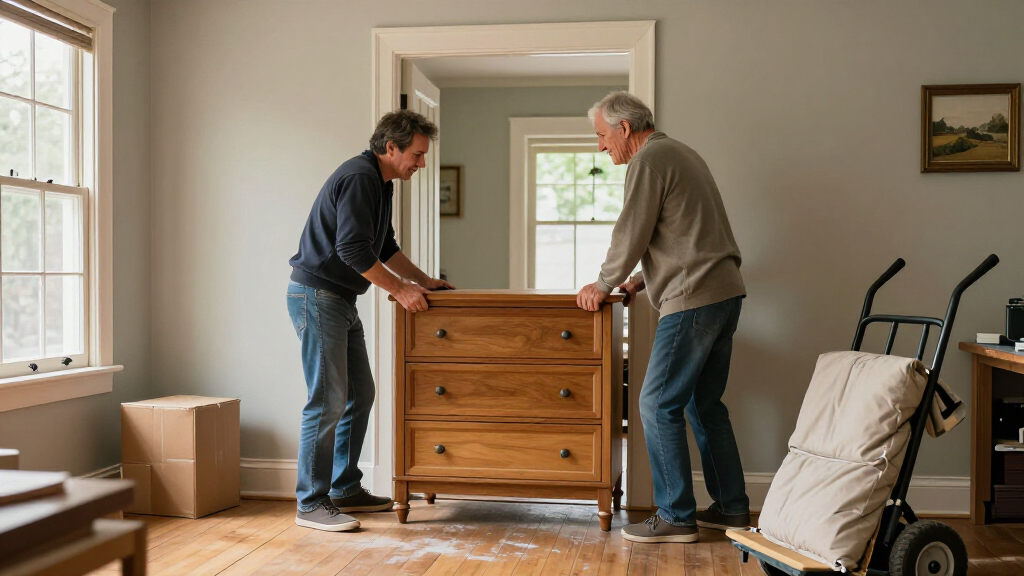
Holskey recommends getting another person to help rather than lifting more than one’s body is prepared to handle. The experts also suggest warming up, clearing obstacles, planning routes and turns, and using equipment such as furniture slides, straps or dollies. Armstrong advises lifting in stages where possible; both experts emphasize avoiding twisting and using controlled movement. The report recommends asking for help or hiring movers when a person is unsure they can manage a piece safely.
How Ability Shapes Moving Risk
The advice shifts the decision away from a birthday and toward the specific task and person. A small, manageable item in a clear space is different from a heavy piece that must be carried on stairs or around tight corners. Strength, balance, health and the ability to control the load all affect the risk, so a universal age rule would not capture individual differences.
That distinction can help readers avoid treating an injury as an inevitable part of aging or, conversely, assuming that past ability guarantees present safety. The report’s practical takeaway is to stop if the item cannot be moved smoothly and under control, and to use assistance rather than forcing the lift. For someone with relevant health concerns, a furniture-moving task may warrant professional or medical advice rather than a do-it-yourself attempt.
As an affiliate, we earn on qualifying purchases.
The Experts’ Practical Test
The report draws on advice from Zac Armstrong, a retired U.S. Marines naval commander and strength coach who founded Executive Health Edge in Coronado, California, and Joshua Holskey, a physical therapist and doctor of physical therapy at ATI Physical Therapy. Their comments address household furniture moving, not a formal clinical standard or age-based guideline.
Armstrong’s central test is whether a person can pick up an item smoothly and carry it with full control. He told Family Handyman there is no age at which everyone should stop: the same load might be unsuitable for one person but manageable for another. The report does not supply a weight threshold, a medical screening tool or a specific age range. Its guidance is to judge the particular lift and seek help when confidence or control is lacking.
““Is there an age to stop? No. But there is a strength-and-control test: If you cannot pick the item up smoothly and carry it under full control, it is too heavy for you today — at 45 or at 75.””
— Zac Armstrong, strength coach, as quoted by Family Handyman
As an affiliate, we earn on qualifying purchases.
No Universal Age or Weight Limit
The report does not define a specific age, lifting weight or health threshold for stopping. It also does not provide research data comparing injury rates by age or quantify how much any one safety measure reduces risk. The experts’ comments are practical guidance, not a personalized assessment of whether a particular person can safely move a particular item.
Individual circumstances remain important: the furniture’s weight and shape, the route, available help, balance and strength, and a person’s health can all affect the task. The article does not specify which symptoms should prompt emergency care; anyone who experiences possible heart attack symptoms should seek urgent medical attention rather than continue lifting.
furniture sliders for hardwood floors
As an affiliate, we earn on qualifying purchases.
As an affiliate, we earn on qualifying purchases.
Decide Before Attempting the Lift
Before moving furniture, assess the object and route, clear trip hazards, and arrange a helper and suitable equipment. If the item cannot be lifted and carried with steady control, or the move involves conditions that feel unsafe, the report advises asking for help or contacting a professional mover. Family Handyman says some moving companies provide in-home furniture-moving services.
The article gives no scheduled follow-up, new official guidance or further milestone. Its immediate recommendation is to make the decision case by case, rather than use age alone as the measure of whether a move is safe.
lifting straps for moving furniture
As an affiliate, we earn on qualifying purchases.
As an affiliate, we earn on qualifying purchases.
Key Questions
Is there an age when people should stop moving furniture?
The experts quoted by Family Handyman give no single age cutoff. They say the key question is whether a person can lift and carry the specific item smoothly and under control.
What are the main risks of moving heavy furniture?
The report identifies possible back and shoulder injuries, muscle strains, sprains, falls and fractures. It also warns that strenuous lifting can pose cardiovascular risks, particularly for people with cardiovascular disease.
What steps can make a furniture move safer?
The experts recommend getting help, warming up, clearing obstacles, planning the route and using equipment such as a dolly or furniture slides. They also advise avoiding twisting and moving the load in controlled stages where possible.
When should I hire professional movers?
Family Handyman recommends seeking help or calling movers if you are unsure you can move the item safely. Armstrong’s test is whether you can lift it smoothly and carry it with full control; if not, treat it as too heavy for you at that time.
Source: rss
Halloween Picks
halloween
As an affiliate, we earn on qualifying purchases.