If you’re starting your workshop, a circular saw is a smart first choice because it’s portable, easy to use, and handles quick, rough cuts well. However, if you plan to do more precise, repetitive work and have space, a table saw will give you better accuracy and control. Consider your projects and workspace — if you’re unsure which to prioritize, keep exploring to see which tool suits your needs best.
Key Takeaways
- Choose a table saw first for precise, straight cuts in a dedicated workshop environment.
- Opt for a circular saw initially if portability and on-site versatility are your priorities.
- A table saw is ideal for detailed, repetitive cuts; a circular saw suits quick, rough cuts.
- Consider your workspace: a fixed workshop favors a table saw, while a job site benefits from a circular saw.
- Your long-term needs determine the best first tool—stability and accuracy or mobility and convenience.
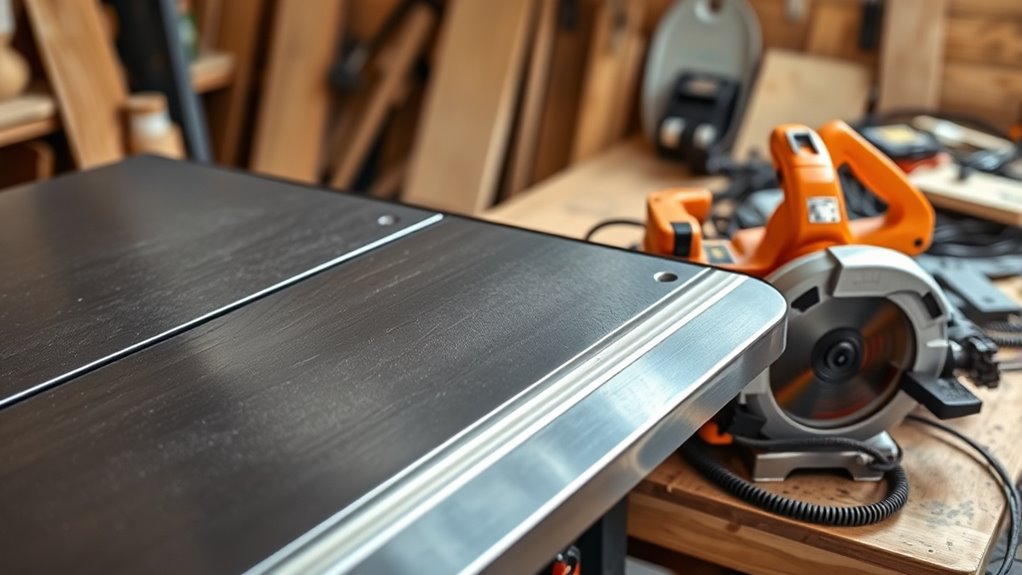
When choosing between a table saw and a circular saw, understanding their differences can help you make the right decision for your projects. One of the biggest factors to consider is blade accuracy. A table saw typically offers superior precision because the blade remains fixed in one position, allowing you to make consistent, straight cuts with minimal effort. Its stable surface and adjustable fence help you achieve clean, accurate cuts on large sheets of wood or panels. On the other hand, a circular saw requires more skill to maintain blade alignment, and the cut quality can vary depending on your steadiness and setup. While it’s possible to achieve good cuts, especially with guides, it generally doesn’t match the blade accuracy of a table saw. Additionally, the Free Floating feature of some saws can impact how easily you can control the cut and maintain accuracy, especially for complex cuts.
Portability benefits are another key difference. Circular saws are lightweight, compact, and easy to carry around, making them ideal for on-site work or projects where mobility is essential. You can quickly load one into your vehicle, carry it to a job site, and set it up almost anywhere. They don’t require a dedicated workbench or a large space, which is a significant advantage if your workshop is small or if you’re working outdoors. Conversely, a table saw is a larger, stationary tool that usually stays in your workshop. Moving it around can be cumbersome, and it demands a solid surface or stand for stability. If your projects involve frequent transportation or working in different locations, a circular saw’s portability benefits make it a more practical choice.
Additionally, the ease of use varies. Circular saws are generally straightforward to operate, especially for simple cuts. They’re perfect when you need to make quick, rough cuts or when working with irregularly shaped materials. Meanwhile, a table saw, although more complex to set up initially, provides greater control for detailed, precise work — especially when cutting multiple pieces to the same size. If your woodworking involves a lot of repetitive, accurate cuts, investing in a table saw will save you time and improve your results.
Ultimately, your choice depends on your specific needs. If precision and stability are your priorities, and you mainly work in a dedicated workshop, a table saw is likely the better investment. However, if you value portability and versatility for various job sites, a circular saw will serve you well. Both tools have their strengths, but understanding their differences in blade accuracy and portability benefits ensures you pick the right one to enhance your projects.
Frequently Asked Questions
Can a Circular Saw Do the Same Cuts as a Table Saw?
A circular saw can’t match a table saw’s blade precision for precise, straight cuts, but it offers greater cut versatility for various materials and angles. While a circular saw is portable and ideal for on-site work, it requires more skill to achieve perfect cuts. If you need accurate, repeatable cuts, a table saw is better, but for flexibility and portability, a circular saw is a great choice.
Which Saw Is Better for DIY Home Projects?
For DIY home projects, a circular saw is your best bet. Imagine wielding portable power that easily slices through plywood and framing lumber, offering blade versatility for various cuts. Its portability means you can work anywhere, from the driveway to the garage, without hassle. While a table saw provides precision, a circular saw’s flexibility and ease of use make it the smarter choice for tackling diverse home improvements efficiently.
Are There Safety Concerns Unique to Each Saw Type?
Yes, safety concerns differ between the saws. For table saws, you need operator training to prevent kickbacks and guarantee proper blade alignment, along with safety gear like push sticks and goggles. Circular saws require careful handling to avoid kickback and blade contact; always wear safety gear such as gloves and eye protection. Both saws demand proper safety gear and training to minimize risks and operate them safely.
How Much Space Does Each Saw Typically Require?
Think of a circular saw as a nimble dancer, needing just a small corner for its routine—usually around 12-18 inches wide. A table saw, on the other hand, is like a steady giant, demanding more space, often a 3-4 foot square, for stability and operation. When considering storage requirements and portability, the circular saw’s compact design makes it easy to tuck away, while the table saw’s larger footprint requires dedicated space and sturdy setup.
What Is the Average Cost Difference Between the Two?
The cost comparison shows that circular saws generally cost between $50 and $150, making them budget-friendly options for most DIYers. Table saws tend to be more expensive, ranging from $200 to over $600 depending on features and quality. When considering your budget, think about what you’ll use most often; a circular saw is more affordable upfront, but a table saw offers more precision for larger projects.
Conclusion
Think of choosing between a table saw and a circular saw like picking a sturdy canoe or a speedy kayak. The table saw is your reliable, all-around vessel for steady, precise work—perfect if you want control and power. The circular saw is your nimble kayak, ideal for quick, on-the-go cuts. Start with the one that best fits your current needs; soon, you’ll have the perfect fleet ready to navigate any woodworking adventure.